
Introduction: Everyone Is Actively Not Looking

On a crowded train, the passengers don’t look at each other. They look at phones, at windows, at nothing in particular. This is not rudeness. It is an adaptation — something urban life develops in people who need to share enclosed space with strangers at close range, every day.
There are reasons the heart closes in that space. And knowing the reasons makes a different practice possible in the same space.
No need to open up. No need to feel anything in particular. Just direct intention, quietly, toward one person.
Session 1: Why the Heart Closes — and Why Intention Is Enough

The closing of the heart in a crowded public space is not a failure of character. It is a load-management response — the nervous system applying a design that evolved for small-group environments to a situation that design never anticipated. The commute places hundreds of strangers in sustained physical proximity, daily. The cognitive cost of empathy toward each of them would be prohibitive. The closing is not coldness. It is the system doing what it was built to do.
This matters for practice because it removes one obstacle before the practice begins. The closed feeling is not something to overcome or feel guilty about. It is the accurate starting condition — the same condition that every person in the carriage is also in. The practice does not ask the heart to open. It asks for something more minimal than that.
What Mettā asks for, in this context, is intention without emotional momentum. The traditional structure of Mettā practice is a graduated expansion — self, loved one, neutral person, difficult person, all beings. Strangers are the neutral-person stage: the point at which existing feeling is absent and intention has to be generated on its own. This is not a harder version of the practice. It is the version the practice was designed for. You do not need to feel warmth toward the person gripping the overhead bar. You only need to direct something quietly in that direction. The intention itself is the practice.
Session 2: Closed, and Directing
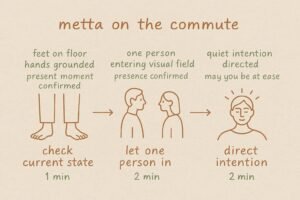
STEP 1: Check the current state (1 minute)
Standing or seated — confirm what is physically present right now.
The contact between feet and floor. Whatever the hands are touching. The movement of the train. Bring attention to these once, briefly.
STEP 2: Let one person enter the field of vision (2 minutes)
No need to close the eyes. No need to look directly.
Someone who has naturally entered the visual field — a tired face, a hand gripping the overhead bar, a shoulder turned inward. Confirm their presence.
This person has also been through a day. That is all that needs to be confirmed.
STEP 3: Direct intention (2 minutes)
Toward that person, quietly, in the mind:
May you be at ease.
It doesn’t need to be a phrase. If something warm moves in that direction, that is enough. If nothing moves yet, begin there anyway.
If extending to the whole carriage feels available, extend. If one person is what’s possible, one person is enough.
Session 3: Social Identity, Civil Inattention, and Why Intention Was Always the Right Design
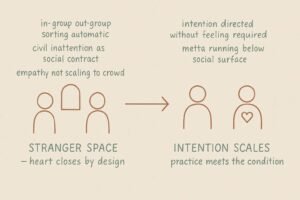
Why the heart closes around strangers — and why Mettā still functions there — is a question social psychology and sociology have each answered, arriving at the same practical implication from opposite directions.
Henri Tajfel’s Social Identity Theory identified a consistent pattern in how human beings process social information: the world is automatically sorted into in-group and out-group, with higher empathy and cooperation directed toward those classified as in-group. This sorting does not require deliberate judgment — it activates on minimal cues, including shared uniforms, shared language, or simply the fact of being in the same recurring context. The cognitive cost of empathy toward out-group members — strangers — is structurally higher than toward in-group members. This is not a character flaw. From an evolutionary perspective, the environment in which human beings developed was a small-group world of roughly a hundred people. The morning commute — hundreds of strangers in physical contact, daily — sits entirely outside what that design anticipated. The closing of the heart in that space is a load-management response, not a moral failure.
Sociologist Erving Goffman described what happens in urban public space as civil inattention: a specific interactional practice in which city dwellers briefly acknowledge a stranger’s presence — a momentary glance — and then deliberately withdraw attention. In Behavior in Public Places, Goffman observed that this is not indifference but a tacit social contract: I have registered that you exist; I will not monitor you. The crowded train carriage running on mutual non-acknowledgment is this contract operating at scale — a collective adaptation that makes dense anonymous space navigable. Mettā practice does not require breaking the contract. Directing something inward toward another person changes nothing visible — no eye contact, no expression, no gesture. The practice runs entirely below the surface of the social arrangement.
Philosopher Paul Bloom’s distinction in Against Empathy (2016) clarifies why intention is the right design for this context. Empathy — feeling what another feels — requires emotional identification with a specific person and does not scale. Directed compassion operates independently of emotional state. You cannot feel the suffering of everyone in the carriage. You can direct a quiet intention toward one person, or toward all of them, without requiring anything to be felt first. The neutral-person stage of Mettā practice was always built for exactly this condition — the absence of emotional momentum is not an obstacle to the practice. It is the condition the practice was designed to meet.
Conclusion: The Closed-Off Space Was the Condition

Strangers in close proximity, no one acknowledging anyone. That is the condition this practice was designed for.
No feeling required. No eye contact. No change to anything visible. One person, one quiet intention.
The carriage was full of people actively not looking at each other. That’s what made it the right place to practice.
KEY TERMS
Social Identity Theory
Henri Tajfel’s framework for how human beings automatically sort the social world into in-group and out-group, directing higher empathy and cooperation toward in-group members. Activates on minimal cues; does not require deliberate choice. The higher cognitive cost of empathy toward strangers is a structural feature of this design, not a disposition. Tajfel’s work is collected in Human Groups and Social Categories (1981).
Civil Inattention
Erving Goffman’s term, from Behavior in Public Places (1963), for the interactional practice of briefly acknowledging a stranger’s presence and then deliberately withdrawing attention — a tacit contract of recognition without surveillance. The mutual non-acknowledgment of a crowded train is this contract operating collectively. Mettā practice requires no modification to the external arrangement — intention directed inward leaves the social surface unchanged.
Graduated Mettā
The traditional practice structure of Mettā meditation: self, loved one, neutral person, difficult person, all beings. Strangers function as the neutral-person stage — the point at which emotional momentum is absent and intention must be generated on its own. The commute is structurally suited to this stage of the practice.
Rational Compassion
Paul Bloom’s distinction, developed in Against Empathy (2016), between empathy — emotional identification with a specific person, high in cognitive cost and resistant to scaling — and rational compassion, which operates independently of emotional state. The design of Mettā practice toward strangers does not ask for feeling. It asks for intention. This is why the practice remains available even when the heart is closed.