
Introduction: The Window Is Already There

Hours at a screen. The same visual distance, the same cognitive demands, the same narrowing field of attention — until the thinking starts to feel like moving through concrete.
You don’t need a park or a forest or a weekend away. You need a window and three minutes. Not because nature is magical, but because the visual system has been locked at the same distance for hours and the brain has been doing the same kind of work — and both of them are ready for something different.
Today’s practice requires no technique. Just the sky, whatever it looks like today, and the willingness to actually look at it.
Session 1: Why the Sky? Because the Brain Needs to Look Far Away

When we’re under sustained pressure, the visual and cognitive fields narrow together. The amygdala’s threat-detection mode pulls focus inward and close — which was adaptive when threats were physical and immediate. In a modern office, the result is a kind of progressive tunnel vision: the screen gets closer, the thinking gets more rigid, and the sense of possibility contracts.
Looking at the sky reverses this physically. The ciliary muscles — which control the eye’s focusing lens and are held in sustained tension during close-up work — release when the gaze shifts to a distant, open field. This muscular release is one of the earliest physiological signals to the nervous system that the immediate-threat mode can downgrade. The body relaxes because the eyes have stopped bracing.
Beyond the muscular mechanism, a changing sky offers the visual system something it hasn’t had access to for hours: a field that moves on its own, asks nothing back, and doesn’t require a response. That combination — motion without demand — is rarer in a working day than it sounds.
Session 2: Three Minutes with the Sky
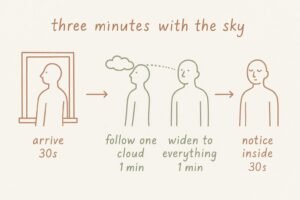
STEP 1: Arrive at the window (30 seconds)
Stand or sit facing the window. Let your posture open slightly — spine lengthened, shoulders back. Make a quiet internal declaration: the next few minutes belong to this. Set the phone face down. Let the screen go dark if it will.
It may feel strange to stop deliberately for something as simple as looking out a window. That strangeness is information — it’s a measure of how completely the pull toward productivity has colonized the available space. This step is the reclamation of three minutes.
STEP 2: Follow one cloud (1 minute)
Choose a single cloud and simply track it. Watch it move — slowly, or faster than you expected. Notice how its edges shift, how the light changes across its surface, how it interacts with what’s around it. No commentary needed. No judgment about whether it’s interesting. Just follow.
If there are no clouds, find something that’s moving — a branch, a bird, a change in light across a rooftop. The content matters less than the quality of attention: open, easy, non-demanding.
STEP 3: Widen to everything (1 minute)
Release the single point of focus and let the whole field of vision open. The full gradient of the sky. The shapes of buildings against it. The peripheral movement of leaves or traffic or light. Take it all in without fixing on any part of it. Let it be a field rather than a subject.
STEP 4: Notice what’s changed inside (30 seconds)
Close your eyes gently. Check in: how is the breath moving now? Is there anything different in the shoulders, the jaw, the quality of the thoughts? Nothing has to have changed. The noticing itself is the point.
Session 3: Why Looking at Nothing in Particular Is Doing Something Precise
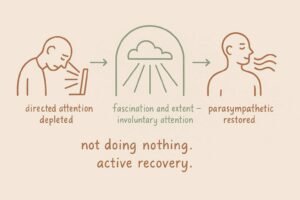
The restorative effect of looking at open natural environments isn’t anecdotal. It has a theoretical framework — and the framework explains exactly why a few minutes of sky gazing produces what it does.
Environmental psychologists Stephen and Rachel Kaplan developed Attention Restoration Theory to describe why natural settings recover mental fatigue in ways that urban or task-focused environments don’t. The theory distinguishes between two kinds of attention. Directed attention is the effortful, voluntary focus we use for work, screens, and complex tasks — it’s finite, it depletes with use, and sustained depletion produces the cognitive flatness, irritability, and reduced judgment quality we recognize as mental fatigue. Involuntary attention is drawn effortlessly by stimuli that are inherently interesting — it doesn’t deplete directed attention, and experiences that engage it allow directed attention to recover passively while the mind remains engaged.
The sky is a near-perfect vehicle for involuntary attention, because it possesses what Kaplan called fascination: the property of holding attention without effort. Clouds move unpredictably. Light shifts continuously. No moment repeats. The instruction to follow a single cloud engages this effortless tracking — the visual system stays active while the directed-attention circuits rest. This is why looking at the sky doesn’t feel like doing nothing. It isn’t. It’s active recovery.
The second condition Attention Restoration Theory identifies is extent — the experience must be large enough to occupy the mind, offering depth and breadth rather than a constrained field. A screen offers extent in informational terms but not spatial ones. The sky offers spatial extent that the visual system hasn’t had access to for hours. Widening to the whole field deliberately activates this: peripheral vision comes back online, spatial processing expands, and with it, something in the thinking loosens.
That last point deserves emphasis. Peripheral vision is largely suppressed during close-up screen work. Its reactivation during open-field viewing has been associated with a shift toward parasympathetic nervous system dominance — which is part of why the shoulders tend to drop after a few minutes of genuine sky gazing. The body isn’t responding to a mood. It’s responding to a change in visual input.
Conclusion: The Recovery Was Always One Window Away

This practice doesn’t ask for a changed schedule or a different kind of day. It asks for three minutes with something that requires nothing back — a field that moves on its own, holds attention without demanding it, and gives the directed-attention system the one thing it can’t give itself: a reason to stop. The sky doesn’t know it’s doing this. It’s doing it anyway.
The recovery was always one window away. The three minutes were the only thing that wasn’t automatic.
KEY TERMS
Attention Restoration Theory (ART)
Developed by environmental psychologists Stephen and Rachel Kaplan. Proposes that natural environments restore directed attention fatigue by engaging involuntary attention — the effortless, non-depleting kind. Four conditions are identified for restorative experience: fascination, extent, a sense of being away, and compatibility with the person’s intentions. Sky gazing engages at least three of these simultaneously.
Directed Attention Fatigue
The depletion of voluntary, effortful focus through sustained use. Manifests as difficulty concentrating, reduced decision quality, and increased irritability. Not recovered by rest alone — requires active engagement of involuntary attention, which allows the directed-attention system to restore passively while the mind remains gently occupied.
Fascination
One of Attention Restoration Theory’s core recovery conditions. The property of holding attention without effort — found in unpredictable, continuously changing stimuli like clouds, water, fire, and shifting light. Engages the visual system in effortless tracking while directed-attention circuits rest. Distinguished from interest, which may require effort to sustain.
Peripheral Vision
The visual field surrounding the point of direct focus. Largely suppressed during close-up screen work, which keeps the visual system in a narrow, high-effort mode. Reactivated during wide-field viewing — and associated with a shift toward parasympathetic nervous system dominance, contributing to the physical relaxation that accompanies genuine open-field gazing.
Ciliary Muscle
The smooth muscle controlling the eye’s focusing lens. Held in sustained contraction during close-up work; released when the gaze extends to a distant field. The release of ciliary tension is one of the earliest afferent signals indicating that the sustained-focus demand has ended — contributing to the broader physiological shift toward parasympathetic engagement.