
Introduction: The Last Thing You Look at Is Shaping How You Sleep

The day is done. You’re in bed, the lights are low — and almost automatically, the phone is in your hand. A few minutes of scrolling to wind down. Except it doesn’t wind down. It just extends the day into the space where sleep was supposed to begin.
The last input before sleep isn’t neutral. It sets the neurological conditions for what follows. Tonight’s practice is about choosing that input deliberately — and it takes five breaths.
Session 1: Why Gratitude Instead of the Phone?

The phone’s effect on sleep operates on two levels. The first is physical: the blue light emitted by screens suppresses melatonin secretion, delaying the onset of natural sleepiness. The second is cognitive: social feeds, news, and unread messages activate the brain’s alerting system — keeping the sympathetic nervous system engaged at precisely the moment it needs to begin releasing.
Gratitude works in the opposite direction. Feeling genuine appreciation — even mild, quiet appreciation — activates the brain’s reward circuitry in a way that’s calming rather than stimulating. It nudges the nervous system toward parasympathetic dominance. It doesn’t force sleep. It creates the conditions in which sleep becomes easier to enter.
The switch from screen to gratitude isn’t just a behavioral substitution. It’s a neurological one. And the gap between the two — between what the phone offers and what the nervous system actually needs — is exactly what this practice is designed to close.
Session 2: Five Breaths, Five Moments of Thanks
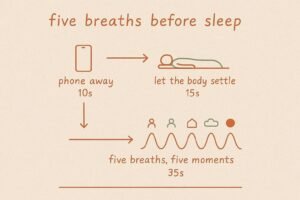
STEP 1: Put the phone somewhere out of reach (10 seconds)
Not face-down on the nightstand — somewhere that requires actual effort to retrieve. The physical distance is part of the practice. As you set it aside, make a quiet internal declaration: this time is mine.
STEP 2: Let the body settle into the bed (15 seconds)
Lie on your back and release. Feel the weight of your head in the pillow. The surface of the mattress receiving you. Let each part of the body register that it’s supported, that nothing is required of it right now.
STEP 3: Five breaths, five moments (35 seconds)
With each exhale, find one thing.
First breath: the clearest moment of gratitude from today — a person, a conversation, something that went well.
Second breath: something your body did today — a sense that worked, a discomfort that signaled care, the simple fact of being carried through the day.
Third breath: something in the immediate environment — the pillow, the quiet, the temperature of the room.
Fourth breath: something difficult from today — a frustration, a failure, something that taught you something even if it didn’t feel like it at the time. This one may take a moment longer to find. That’s expected. The instruction isn’t to feel grateful for difficulty — it’s to acknowledge that the day contained more than its worst parts.
Fifth breath: the simple fact of being here, now, in this moment.
Nothing needs to be profound. Small is fine. Even uncertain is fine.
Session 3: What the Brain Is Doing in the Dark Before Sleep Finds It
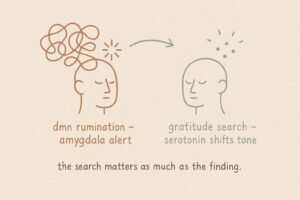
The reason gratitude practice improves sleep isn’t simply that it feels pleasant. It interrupts a specific neural pattern that keeps the sleeping brain awake.
When we lie down, the Default Mode Network doesn’t automatically stop. For many people, it shifts into rumination mode — cycling through unresolved concerns, replaying difficult moments, rehearsing tomorrow’s risks. This processing keeps the norepinephrine system active. Norepinephrine is the neurotransmitter most associated with alertness and threat-readiness; its sustained activity at bedtime is one of the primary neurochemical reasons people lie awake feeling tired but unable to sleep. The amygdala participates too, continuing to process unresolved emotional content and signaling the body that vigilance is still required.
Gratitude practice intervenes here in a specific way. Research into the neuroscience of positive emotion describes how the act of noticing and naming things we’re grateful for gently activates the brain’s reward circuitry — producing modest releases of serotonin and dopamine that shift the emotional tone of the DMN’s processing. Crucially, this activation works against the amygdala’s alerting function: the recognition that something good happened, that the day contained value, sends a signal that the threat-scanning mode can begin to release.
The searching aspect of the practice matters as much as the finding. The instruction to look for gratitude — to actively scan the day for moments worth acknowledging — engages a different neural pathway than rumination. Rumination moves between past regret and future worry in a loop. Searching for gratitude directs attention toward specific, concrete, past experiences with a mild positive valence. These two processes compete for the same neural resources. When the search is genuine, even effortful, it tends to win.
Sleep quality is determined not just by duration but by the neurological state at the moment of entry. A nervous system with quieted norepinephrine activity, a disengaged amygdala, and a DMN gently redirected toward positive memory retrieval is physiologically closer to the conditions required for deep, restorative sleep — and to the non-REM stages where the most significant cognitive and emotional recovery occurs.
Conclusion: The Door Was Always There

Some nights, the gratitude will come easily. Other nights, you’ll search and find almost nothing — and that’s fine too. The searching itself is the practice. Even I’m trying to find something to be grateful for is a form of attention that’s doing something useful, redirecting the DMN away from the loop it would otherwise run on its own.
Sleep always comes. What gratitude does is change what the brain is doing when it finally does.
KEY TERMS
Norepinephrine
The neurotransmitter most associated with alertness, vigilance, and stress readiness. Sustained by rumination and screen use at bedtime; quieted by parasympathetic activation and the gentle reward-circuit engagement of gratitude practice. Its activity level at the moment of sleep onset is one of the primary neurochemical determinants of how easily sleep arrives and how restorative it becomes.
Melatonin
The sleep-onset hormone secreted by the pineal gland in response to darkness. Suppressed by blue light and sustained sympathetic nervous system activity. Released more readily as parasympathetic dominance increases — which is why the body’s transition into sleep depends on more than just darkness, and why the neurological state at bedtime matters as much as the hour.
Rumination
The DMN’s default pattern at bedtime: cycling through unresolved concerns, replaying difficult moments, and rehearsing tomorrow’s uncertainties. Gratitude practice redirects this processing by engaging a competing neural pathway — specific, concrete, positively valenced memory retrieval — that draws on similar cognitive resources and tends to displace the rumination loop when the search is genuine.
Serotonin
A neurotransmitter associated with emotional stability and a sense of wellbeing. Gently activated by gratitude and positive memory retrieval. Also the biochemical precursor to melatonin — meaning that conditions which support serotonin release in the evening indirectly support the sleep-onset process as well. The relationship between gratitude practice and sleep quality runs partly through this biochemical pathway.
Defusion
A core skill in Acceptance and Commitment Therapy (ACT). The capacity to observe thoughts as passing mental events rather than facts requiring immediate response. When *I’m worried about tomorrow* arrives during the practice, noticing it — “there’s that thought” — without following it, and returning attention to the breath and the search for gratitude, is defusion applied to the specific vulnerability of the pre-sleep mind. The thought is present. It does not have to be the next thing the brain runs with.