
Introduction: Why Small Habits Hurt So Much When You Love Each Other

After dinner, you start washing the dishes immediately. Your partner leaves them in the sink — we can do them all at once later. You arrive ten minutes early as a matter of course. Your partner walks in exactly on time. No anger, no malice. And yet these small recurring misalignments accumulate into something heavier than they should — a deep fatigue, and sometimes the quiet fear that this will always be this hard.
This is not a personality mismatch. Each of us grows up absorbing a sense of what is normal and correct — not as explicit rules, but as something closer to instinct. When two of those absorbed systems meet, the love between the people doesn’t always reach the distance between the cultures.
Session 1: The Nature of the Collision — “Normal” as an Invisible Weapon

At the root of adjustment fatigue is the fusion of one’s own cultural habits with a sense of identity and rightness.
The foundation is the collision of self-evident worlds. Your own habits — punctuality, indirect expression, specific domestic roles — feel like simply how things are. They don’t feel cultural. They feel natural. Which means that when your partner does something differently, it doesn’t register as a difference. It registers as a deviation from how things should be. My normal and the normal have merged into the same thing, and the partner’s different normal looks, from inside that merger, like an error.
Onto this layers the misreading of love as compliance. The unspoken expectation: if you understand me, if you love me, you’ll accept how I do things. When a partner behaves according to their own cultural logic rather than yours, the action gets processed as emotional information — as evidence of insufficient understanding, insufficient care. The gap between cultural habits becomes a statement about the relationship itself.
Then there is the asymmetry of visible and invisible adjustment. The sense of I’m the one always adapting tends to count only the adjustments that can be seen — the behavioral compromises, the explicit concessions. What goes uncounted is the internal work: the restructuring of values, the renegotiation of what things mean, the effort of holding two frameworks at once. That labor is real, and it is almost never acknowledged, by either person, in either direction.
Session 2: Practice — Turning Collision into Curiosity
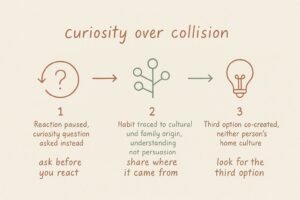
This practice redirects the conversation from defensiveness and reaction toward a shared exploration of where each person’s habits actually come from.
STEP 1: Ask before you react
When the familiar pattern appears and the familiar reaction rises — pause before expressing it. Step back from the internal story of right and wrong, and replace the reaction with a question that comes from genuine curiosity.
“Hey, I noticed something earlier — I’m curious what that’s like for you. From where I was standing, it looked like this, but I want to understand how you’re experiencing it.”
The phrase what’s that like for you is the hinge. It reframes the partner’s behavior from something to be judged to something to be understood — an invitation into their way of making sense of things rather than a verdict on it.
STEP 2: Share where the habit came from
Set aside time to talk about specific habits — time, money, family involvement — not to debate them, but to trace them back to their origins.
“Growing up, how did your family handle time? What happened if someone was late?”
“When you think of family, what’s the first image that comes to mind — what roles and expectations did you grow up with?”
The purpose is not persuasion. It is the understanding of the cultural and familial context in which the habit formed. Understanding doesn’t require agreement, but it consistently reduces the hostility that forms in its absence.
STEP 3: Look for the third option together
When a conflict reduces to a binary — your way or mine — stop pursuing a winner and start looking for a third possibility that neither of you brought from home.
“What if you take the lead on the kitchen, and I take the lead on the living room?”
“What’s the value we both actually care about here — efficiency, spaciousness, mutual respect? Is there a way to honor that value that neither of us has thought of yet?”
This is not compromise in the sense of both people getting less. It is the co-creation of a shared practice that belongs to the relationship itself — something that didn’t exist in either culture before the two of you met.
Session 3: The Culture That Made You
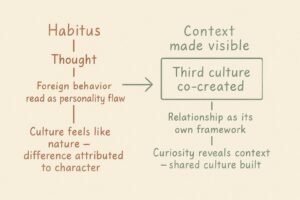
Why “normal” functions as a weapon
Sociologist Pierre Bourdieu’s concept of habitus describes the way culture installs itself not as explicit knowledge or rule, but as a system of dispositions — ways of moving, sensing time, holding a conversation, judging what is appropriate — that operate below the threshold of conscious thought. The person carrying a habitus experiences it not as culture, but as nature. As simply how things are. This is the structural source of cross-cultural friction: when your habitus and your partner’s habitus produce different behavior, your nervous system registers theirs not as a different logic but as a failure of logic.
The foreignness doesn’t feel relative. It feels wrong.
Why it feels like a personality flaw
Psychologists studying the fundamental attribution error have documented a consistent bias: when explaining the behavior of others, people tend to reach for personality and intention as the cause, rather than situation and context. Cross-cultural couples are particularly vulnerable to this error, because the cultural context producing the partner’s behavior is largely invisible. They’re late because they’re inconsiderate. They didn’t call because they’re emotionally unavailable. The cultural formation — the time norms, the communication styles, the family structures that shaped these behaviors over decades — doesn’t make it onto the list of possible explanations.
And once the behavior is attributed to character rather than context, the conclusion that follows is almost always the same: this person can’t change. That conclusion is where adjustment fatigue curdles into something closer to despair.
How deep the difference actually runs
Cultural psychologists Hazel Markus and Shinobu Kitayama’s research established that cultures differ not just in their practices but in their fundamental conception of what a self is. An interdependent self-construal — in which the self is understood as defined by and through relationships — and an independent self-construal — in which the self is understood as a bounded, autonomous individual — are not simply different preferences. They produce different intuitions about what counts as appropriate intimacy, what constitutes healthy attachment, what it means to prioritize family, how much emotional expression is honest versus excessive.
The surface habit — the dishes left in the sink, the call not made, the family visit that ran too long — is the visible fraction of a difference that runs to the foundations of how each person understands what a human self is and how relationships work. Adjusting the surface behavior without understanding what’s underneath it tends not to hold.
The third culture neither of you grew up in
The third culture concept in cultural psychology describes a phenomenon observed in people who grow up between two cultures: rather than belonging fully to either, they form a distinct cultural identity that draws on both but reduces to neither. Cross-cultural couples have the ability to do this intentionally. Not through one person yielding to the other, and not through the negotiation of a compromise in which both people get less than they wanted — but through the co-creation of a shared framework that belongs specifically to their relationship.
The answer to the dishes doesn’t live in your culture or your partner’s. It lives in the culture the two of you build together. That culture doesn’t exist yet. It has to be made.
Conclusion: The Conflict Isn’t Between You

Habitus is slow to shift. The fundamental attribution error operates automatically. Cultural self-construal runs deeper than any single habit. None of this resolves quickly, and pretending otherwise produces its own fatigue.
But the recognition — this is a cultural difference, not a character flaw — is available at any moment. That single shift in frame moves both people from opposite sides of a conflict to the same side of a shared question, which is where the work of building a third culture can actually begin.
The conflict isn’t between you. It’s between the cultures that made you.
KEY TERMS
Habitus
Pierre Bourdieu’s term for the way culture installs itself not as explicit knowledge but as a system of dispositions — ways of perceiving, judging, and acting that operate below conscious awareness. Experienced by the person who carries it as natural rather than cultural, which is why encountering a different habitus tends to register as wrongness rather than difference. The structural origin of cross-cultural adjustment fatigue.
Fundamental Attribution Error
The documented cognitive bias toward explaining others’ behavior through personality and intention rather than situation and context. In cross-cultural relationships, this error is particularly consequential: the cultural formation that produced a partner’s behavior is largely invisible, making character the default explanation. The error converts cultural difference into evidence of personal failing — and produces the conviction that the person cannot change.
Cultural Self-Construal
A concept from cultural psychologists Hazel Markus and Shinobu Kitayama describing fundamental cultural differences in how the self is understood. An interdependent self-construal defines the self through relationships; an independent self-construal defines the self as a bounded autonomous individual. These deep-level differences generate the surface habits that couples most frequently fight about — and adjusting the habits without understanding their foundation tends not to hold.
Third Culture
A concept from cultural psychology describing the distinct cultural identity formed by people who grow up between two cultures — belonging fully to neither, drawing on both. Cross-cultural couples can build this intentionally: not through compromise in which both get less, but through the co-creation of a shared framework that belongs specifically to their relationship. The practices of this third culture don’t exist in advance. They have to be made together.
Defusion
The capacity to notice the fusion between one’s own habitus and the sense that it represents the only correct way of doing things — and to place a moment of observational distance between the reaction and the response. The practice of asking what’s that like for you? before reacting is a form of defusion: it interrupts the automatic process by which cultural difference becomes personal judgment.