
Introduction: Why More Learning Can Make You Feel Shallower

The stack of reading notes. The cloud folder of saved articles. The number of books finished keeps growing, but the sense that any of it has been integrated into actual decisions and behavior remains thin. What grows instead is the anxiety about the book not yet read, the concept not yet fully understood, the nagging sense of only collecting rather than absorbing.
This is not a knowledge shortage. It is a problem with what is being done with the knowledge.
Session 1: The More Notes Accumulate, the Further Action Recedes

When the gap between learning and acting widens over time, what is operating is not laziness. It is a structural mechanism.
I’ll act once I understand this properly sounds responsible. Moving without adequate preparation risks failure. But the standard for adequate preparation rises with every new thing learned. New knowledge generates new questions, and new questions justify more reading. Inside this loop, learning stops functioning as preparation for action and starts functioning as a reason to delay it.
Taking notes adds a layer to this. Highlighting a passage, writing a careful summary, organizing a system — each of these produces the feeling of having learned something. That feeling is genuine, but it is also a stopping point. The satisfaction of having captured the knowledge can substitute for the forward motion of using it. The note becomes a destination rather than a departure.
The experience of feeling shallower the more one learns is not a sign of insufficient knowledge. It is a sign that the knowledge has been changing shape without changing anything else.
Session 2: Practice — Moving From Collecting to Using
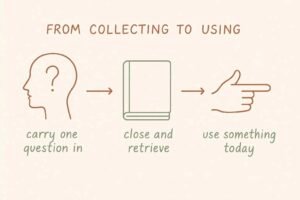
This practice is not about taking better notes. It is about shifting the endpoint of learning from the notebook to the action that follows it.
STEP 1: Carry One Question Into the Reading
Before opening a book, pause for thirty seconds.
What question in my actual life might this help with?
The shift from absorb everything to find the answer to this one thing changes what reading is for. When the session ends, ask once: what from this could I try tomorrow? Not what to write down — what to do. The question redirects the endpoint from the note to the next move.
STEP 2: Close the Book and Write What Remains
Instead of transcribing while reading, close the book after a section and write what can be recalled without looking.
What is still present from what I just read?
What can’t be recalled doesn’t need to be chased. The act of reaching for what remains — the effortful retrieval rather than the passive copying — is what presses the material into memory. An imperfect reconstruction in one’s own words will be more usable later than a perfect transcript of someone else’s.
STEP 3: Use Something Within Twenty-Four Hours
Take one thing from the reading and use it in some form within twenty-four hours. The application doesn’t need to be large.
Before responding in tomorrow’s meeting, take one breath first.
Tonight, actually check where the ingredients came from.
A single use transforms knowledge from something owned into something operative. Knowledge that stays in the notebook remains in the notebook. Knowledge used once becomes attached to an experience — and experience is where retention actually lives.
Session 3: The Preparation Was Keeping the Action Away
When Learning Becomes the Avoidance
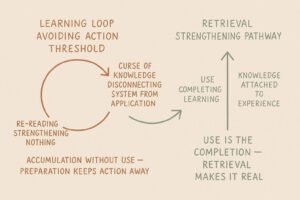
Research on procrastination consistently shows that delay arises less from laziness than from fear of failure or negative evaluation. The tendency to avoid uncomfortable internal experiences is well documented. What operates here is a more specific pattern: learning, which appears entirely legitimate, functioning as the vehicle for avoiding the moment of action. I’ll do it once I know enough is a coherent sentence that carries real anxiety management inside it. The threshold for knowing enough rises with each new thing learned, because learning sharpens the awareness of how much remains unknown. This pattern tends to be strongest in capable people — precisely because their sensitivity to the limits of their current understanding is most acute. The reading notes that keep accumulating are not only evidence of genuine curiosity. They may also be evidence of a learning loop that has found a way to stay in motion without ever arriving at the place where the learning would need to be tested.
The More That Accumulated, the Harder It Became to Use
Research on the curse of knowledge describes a specific asymmetry that expertise creates: the more deeply something is understood, the harder it becomes to remember what it was like not to understand it. This affects more than communication. As a body of knowledge becomes more internally organized and elaborate, the pathways connecting it to new contexts, unfamiliar problems, and practical application become less visible rather than more. The person who has read widely on a subject can find it harder, not easier, to reach for that knowledge when an ordinary situation calls for it — because the knowledge has become a system, and systems don’t translate automatically into responses. The experience of feeling shallower the more one learns may not be inaccurate. It may be the accurate perception of knowledge that has grown in complexity without growing in connection to the situations where it would actually be useful.
Retrieving Was More Powerful Than Re-reading
Cognitive psychologists Henry Roediger and Jeffrey Karpicke’s research on retrieval practice established one of the most replicable findings in learning science: attempting to recall information — the testing effect — produces substantially stronger long-term retention than re-reading the same material. The mechanism is not mysterious. When the brain reaches for something and finds it, the retrieval pathway is strengthened. When the brain passively receives something again, the pathway is less engaged. Copying notes is an input operation — information moves from the page to the notebook. Closing the book and writing what remains is a retrieval operation — information moves from memory into language, which strengthens the memory in the process. Using the knowledge in actual situations is retrieval in its most powerful form. The preparation loop that delays action and the curse of knowledge that makes accumulated learning hard to apply both yield to the same mechanism: the knowledge has to be used. Using it is not the application of learning. It is the completion of it.
Conclusion: The Note Was Always a Departure Point

The preparation loop will keep running tomorrow. The curse of knowledge will keep making accumulated material harder to connect outward. The notes will keep accumulating. The structure does not change. But the question where could I use something from this within the next twenty-four hours can be asked at the end of any reading session, before any new book is opened. That question is the shift from collecting to using — which is where the learning was always supposed to end up.
The knowledge wasn’t the destination. Using it was.
Key Terms
Preparation as Procrastination
The pattern in which learning — an apparently legitimate activity — functions as a vehicle for avoiding the moment when the learning would need to be tested. The tendency to avoid uncomfortable internal experiences takes a specific form here: more preparation as a way of keeping the action threshold perpetually out of reach. The threshold rises with each new thing learned, because learning sharpens awareness of how much remains unknown — making the pattern strongest in capable people with high sensitivity to their own limitations.
Curse of Knowledge
The cognitive finding that the more deeply something is understood, the harder it becomes to remember what it was like not to understand it — and, by extension, to connect the knowledge to new contexts and practical applications. As a knowledge system becomes more internally organized, the pathways to unfamiliar situations become less visible rather than more. The experience of feeling shallower the more one learns may be the accurate perception of knowledge that has grown in complexity without growing in connection to the situations where it would actually be used.
Testing Effect / Retrieval Practice
Henry Roediger and Jeffrey Karpicke’s finding that attempting to recall information produces substantially stronger long-term retention than re-reading the same material. The retrieval operation — reaching for what remains after the book is closed — strengthens the memory pathway in a way that passive re-reading does not. Using knowledge in actual situations is retrieval in its most powerful form: not the application of learning after the fact, but the completion of the learning process itself.
Knowledge Integration
The process through which learned material becomes usable knowledge by connecting to existing experience, live questions, and actual contexts. Information that remains in an isolated system — organized but unconnected — stays in the notebook. Information that gets used once becomes attached to an experience, and experience is where retention lives. The twenty-four-hour practice is the shortest available path from collected information to integrated knowledge.
Defusion
The capacity to notice that the thought — I need to understand this more fully before I can act on it — has fused with the experience of learning, and to observe it as a pattern rather than an accurate assessment of readiness. Recognizing that the preparation loop is running — that the learning has become the destination rather than the departure — is the first gap between the accumulation habit and the move toward use.