
Introduction: When Good Intentions Start Costing Too Much

The footage from a conflict zone. The climate numbers. The news of another injustice that shouldn’t have happened. You close the screen, but the weight stays. At first, the impulse to do something generates action. Then, at some point, opening the news becomes something to dread. The fatigue of engaging begins to look like an exit toward not feeling anything at all.
This is not what happens when someone cares too much. It is what happens when a heart that keeps receiving has no place to rest.
Session 1: Compassion Fatigue Is Not an Emotional Failure

When ethical fatigue arrives, what is operating is not weakness of will. It is a structural mismatch.
The capacity to feel another person’s suffering as if it were your own is a natural function of being a social animal. The problem lies in the gap between the scale this capacity was designed for and the scale that the contemporary information environment delivers. Empathy was built for neighbors with faces, for communities with edges. Now a screen delivers suffering from the other side of the world at the same emotional proximity as a conversation across the table.
The flow of that information is not neutral. Content that generates the strongest emotional response is prioritized by design. Fear, anger, grief — these hold attention and sustain engagement. The result is that good intentions encounter the emotionally heaviest material first, in the highest volume, most persistently.
The exhaustion is not evidence of caring too much. It is the predictable output of being placed, without preparation, inside an environment designed to produce it.
Session 2: Practice — Changing How Empathy Is Used
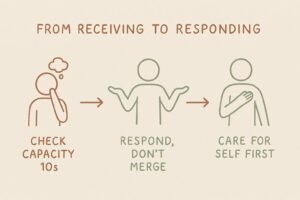
This practice supports the shift from empathy as emotional absorption to compassion as engagement that maintains a place to stand.
STEP 1: Check Your State Before Receiving
Before opening a news source, or after encountering something heavy, pause for ten seconds.
Am I in a state to actually receive this right now?
This is not a question about avoiding information. It is a question about current capacity. Continuing to receive while already depleted does not deepen empathy — it overloads the circuit. Recognizing that the capacity is not there is not a failure of sensitivity. It is an accurate reading of the present moment.
STEP 2: From “Suffering With” to “Responding To”
When encountering news of suffering, before being fully absorbed into the emotional weight, ask once:
What response to this suffering is actually available to me right now?
“Nothing right now” is a complete answer. What matters is the distinction between emotional absorption — taking the suffering on as one’s own — and response, which can be action, attention, or simply knowing. The second does not require the first.
STEP 3: Place Self-Compassion at the Starting Point
After encountering something heavy, turn toward yourself once:
My mind is tired right now. I’m going to receive that without adding criticism to it.
Sustained engagement with the world requires a vessel that is in reasonable condition. Self-compassion is not self-indulgence — it is the first operation in restarting a depleted circuit. Confirming that steadiness inside before extending outward is not a retreat. It is the sequence that makes continued engagement possible.
Session 3: Where Exhaustion Is Manufactured and Where the Exit Is
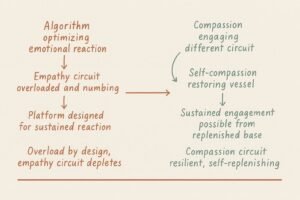
The Environment That Was Designed for Overload
Sociologist Shoshana Zuboff’s analysis of surveillance capitalism identified the structural logic by which platforms collect, predict, and modify human behavioral data to generate profit. Within this framework, maximizing emotional engagement becomes a design objective. Fear, anger, and grief are efficient — they hold attention longer and drive sharing behavior more reliably than quieter emotional states. The algorithm does not deliver the most important content. It delivers the content most likely to sustain a reaction. Ethical fatigue is not what happens when a well-intentioned person engages too deeply. It is the predictable result of being placed inside an environment optimized for emotional reaction. The experience of feeling drained every time the news is opened is not a sign of excessive sensitivity. It is the honest response of a person encountering a system that is functioning exactly as intended.
Empathy and Compassion Use Different Circuits
Neuroscientist Tania Singer and psychologist Olga Klimecki’s research demonstrated that empathy and compassion involve distinct neural processing pathways. Feeling another’s suffering as one’s own — empathy — activates the insula and anterior cingulate cortex, regions associated with the processing of emotional distress. Repeated activation of these areas produces fatigue, and sustained overload triggers avoidance and emotional numbing as protective responses. Compassion — the orientation of wanting to help relieve suffering while remaining aware of it — engages circuits associated with the medial prefrontal cortex. This pathway is linked not to depletion but to resilience, and strengthens rather than degrades with use. Ethical fatigue is not the erosion of moral sensitivity. It is the signal that the empathy circuit has been overloaded to the point where the nervous system has begun protecting itself. The care is still present. The route it is traveling has become unsustainable.
Self-Compassion as the Foundation for Sustained Engagement
Psychologist Kristin Neff’s research on self-compassion shows that the capacity to receive one’s own distress and limitation without self-criticism — treating difficulty as part of shared human experience rather than personal failure — functions as an emotional foundation for sustained engagement with others. People higher in self-compassion show greater affective stability in contexts requiring ongoing care, and recover more quickly from compassion fatigue. This runs against the instinct that says continued engagement requires directing more energy outward. But a depleted empathy circuit is not restored by increasing the load. It is restored by replenishing the vessel first. The capacity to respond to the world’s suffering is renewed by turning toward one’s own with the same quality of attention one wishes to extend outward.
Conclusion: The Exhaustion Was Never Proof of Too Much Care

The algorithm keeps optimizing for emotional reaction. The empathy circuit remains vulnerable to overload. The structure does not change. But the question am I in a state to receive this right now? can be brought to any piece of news, before any screen is opened. Engagement that begins there functions as compassion rather than absorption — it does not deplete, it sustains.
The world kept asking for everything. Knowing what you could actually give was never the smaller act.
Key Terms
Ethical Fatigue
The mental and emotional depletion produced by repeated engagement with social harm, injustice, and moral demand. Distinct from helplessness produced by invisible outcomes — which arises from the invisibility of change — ethical fatigue operates through the accumulation of emotional overload, specifically the repeated overtaxing of empathy circuits in an information environment designed to maximize emotional reaction.
Emotional Contagion
The mechanism by which another person’s emotional state is automatically transmitted and mirrored. Associated with mirror neuron systems, emotional contagion operates not only in direct physical encounters but through screen-mediated images and text. When combined with an information environment optimized for emotional intensity, it becomes a continuous source of unintentional affective loading.
Empathy Fatigue vs. Compassion
The distinction established by Singer and Klimecki’s neuroscience research. Empathy — feeling another’s suffering as one’s own — activates the insula and anterior cingulate cortex and produces depletion under sustained load. Compassion — the orientation toward relieving suffering while remaining present with it — engages medial prefrontal circuits associated with resilience. The same intention to care can travel two different neural routes with substantially different outcomes.
Self-Compassion
Kristin Neff’s research-based construct describing the capacity to receive one’s own distress and limitation without self-criticism, treating difficulty as part of shared human experience. Functions as an emotional foundation for sustained engagement with others — not as self-indulgence but as the mechanism through which a depleted empathy circuit is restored. The sequence of self-compassion before outward engagement is the structural basis of sustainable care.
Surveillance Capitalism
Shoshana Zuboff’s framework describing the economic logic by which platforms collect behavioral and emotional data to predict and modify human behavior for profit. The maximization of emotional engagement as a design objective produces an information environment in which fear, anger, and grief
are systematically amplified — manufacturing the conditions for ethical fatigue at scale.