
Introduction: Saying the Right Things and Watching Things Break

Climate change. Racial injustice. Gender equality. The posts come from a genuine place — a real desire to make things better. And then the comments fill with hostility, followers fracture along familiar lines, and relationships that mattered become casualties of a thread. The intention was to help. The result moved in the opposite direction.
This is not a problem with the content of what was said. It is a problem with what the saying had quietly become — who it was actually for, and what it was actually doing.
Session 1: Who Is the Post Actually Reaching?

When well-intentioned posts produce conflict rather than connection, what is operating is not a failure of values. It is a structural mechanism.
Social media platforms gather people with shared interests and perspectives. Surrounding oneself with others who care about the same things feels right — supportive, energizing, real. Inside this environment, posts are affirmed, shared, and built upon. The feedback is genuine. But inside this same comfort, the direction of the posts begins to shift without announcement.
When opinions are shared repeatedly within a homogeneous group, they do not settle toward the middle. They move toward the more extreme end of the range the group already occupies. The sense that this isn’t strong enough or that framing is too soft emerges organically from the group dynamic. Posts become sharper, more exclusive, more focused on internal differentiation than on reaching anyone outside. The function has changed from persuading the unconvinced to confirming standing within the group — and this change happens without any conscious decision to make it.
The structure moves the motivation. The intention stays the same while the purpose transforms around it.
Session 2: Practice — Check the Direction Before Sending
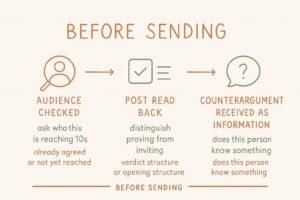
This practice is not about posting less or softening the message. It is about building the habit of checking what the post is actually for before it goes out.
STEP 1: Ask Once Who This Is Reaching
Before sending, pause for ten seconds.
Is this post directed at people who already agree — or is it trying to reach someone who hasn’t considered this yet?
Neither answer is wrong. The point is to notice which one is true. A post directed at those who already agree will reach those who already agree. That may sometimes be the right purpose — solidarity and shared language have their own value. But when the stated intention is to change minds or build understanding, and the actual audience is the already-converted, the gap between intention and function is worth seeing clearly.
STEP 2: Distinguish Between Proving Rightness and Inviting Understanding
Read the post back once before sending.
Does this frame the other side as wrong — or does it share how I arrived at thinking what I think?
A post structured around you are wrong activates the reader’s defenses before any content lands. A post structured around here is what I felt and how I came to think this leaves room for the reader to compare it with their own experience. The same position can be carried by either structure. The structure determines whether the reader encounters a verdict or an opening.
STEP 3: Receive the Counterargument as Information
When a reply arrives that pushes back, before responding in kind, ask once:
Does this person know something I don’t?
This is not agreement. It is not concession. It is the question that keeps the other person human rather than a category. Understanding the logic behind a position — the experience and context that makes it coherent to the person holding it — is possible without endorsing that position. That understanding is where contact begins.
Session 3: The Structure That Made Good Intentions Stop Reaching Anyone
How the Audience Became Only Those Who Already Agreed
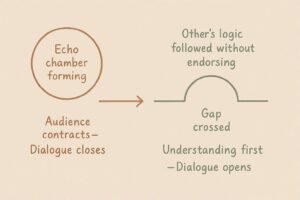
Legal scholar Cass Sunstein’s research on group polarization demonstrated that deliberation within homogeneous groups consistently moves opinion not toward the center but toward the more extreme end of the range the group already occupies. The mechanism is straightforward: within a like-minded group, arguments supporting the shared position are abundant and reinforced, while counterarguments are scarce or absent. Individual members leave group discussion holding more extreme positions than they entered with. Social media filter bubbles are a structural amplifier of this effect. In an environment populated almost entirely by those who share the same values and framings, posts about social justice gradually shift function — from reaching people who haven’t considered the issue toward proving purity of commitment within the group that already has. The language sharpens. The tolerance for nuance narrows. The audience contracts to those already inside. This is not a failure of commitment. It is what the structure of the environment produces when the feedback loop runs long enough.
Moral Certainty Made the Other Side Harder to See as Human
Research on moral outrage has demonstrated that as its intensity increases, the cognitive tendency to perceive those on the opposing side as representatives of a category of wrongness — rather than as individuals with particular experiences and circumstances — strengthens. Research on moral identity, developed most influentially by psychologist Karl Aquino and colleagues, showed a related dynamic: people who place moral values at the center of their self-concept develop a stronger motivation to publicly demonstrate and prove those values. When these two processes operate together, posting about social issues stops functioning as problem-solving and starts functioning as moral self-presentation — the demonstration of rightness, and the designation of the other side as its opposite. When the person on the other side is no longer visible as a person, dialogue becomes structurally impossible. The content may be entirely accurate. It will not land where it needs to.
Understanding the Logic Was Always the Starting Point
Research on bridging dialogue has identified a consistent finding: contact across genuine disagreement does not begin with finding common ground or locating a compromise. It begins with the willingness to understand why the other position is coherent to the person holding it — to follow the logic of a worldview without necessarily endorsing it. This is a specific and learnable orientation. It requires suspending the verdict long enough to ask what experience would make someone think this way. The person is not being agreed with. They are being seen as someone whose thinking has a structure that can be understood. When the purpose of a post shifts from proving rightness to looking for the entry point into another person’s worldview, the language changes — not softer, but differently oriented. It becomes possible for something to travel across the gap.
Conclusion: The Post Reached Everyone Who Already Agreed

Group polarization keeps pulling shared opinion toward the extreme within homogeneous spaces. Moral identity claiming keeps substituting self-presentation for outreach. Dehumanization keeps closing the possibility of contact each time the outrage rises. The structure does not change. But the question is this post directed at people who already agree, or at someone who hasn’t considered this yet? can be brought to any moment before a post goes out. That question is the first movement from internal confirmation toward external contact — which is where the intention was always trying to go.
The post reached everyone who already agreed. The question was always whether that was the point.
Key Terms
Group Polarization
Cass Sunstein’s finding that deliberation within homogeneous groups moves opinion not toward the center but toward the more extreme end of the range the group already occupies. Combined with social media filter bubbles, this causes social justice posts to shift function from reaching the unconvinced to proving purity of commitment within the already-convinced. The structural origin of why well-intentioned posts stop reaching anyone new.
Moral Identity Claiming
Based on Karl Aquino and colleagues’ research on moral identity. People who place moral values at the center of their self-concept develop a stronger motivation to publicly demonstrate and prove those values. The mechanism through which social media posting shifts from problem-solving to moral self-presentation — demonstrating rightness rather than building understanding.
Moral Dehumanization
As moral outrage intensifies, the tendency to perceive those on the opposing side as representatives of wrongness rather than as individuals with particular experiences and circumstances strengthens. The cognitive mechanism through which conflict escalates and dialogue becomes structurally impossible — regardless of the accuracy of the content being posted.
Bridging Dialogue
Research on bridging dialogue identifies contact across genuine disagreement as beginning not with finding common ground but with the willingness to understand why the opposing position is coherent to the person holding it — to follow the logic of a worldview without endorsing it. The reorientation from proving rightness to understanding the other’s framework is where contact becomes possible.
Purity Competition
The dynamic within homogeneous communities in which members compete over the correctness and consistency of their positions, producing a drift toward more extreme and exclusive expression. A specific mechanism of group polarization in social justice contexts — where nuance is read as insufficient commitment, and internal differentiation takes precedence over external engagement.