
Introduction: What Helplessness Actually Is
Watching the news about a problem too large to solve, and feeling that nothing you do matters. Saying what’s the point at work or at home. Standing before a current that feels bigger than you, and shrinking.
This feeling is not an accurate reading of reality. And it is not produced by weakness of character or negative thinking. The sense of being small and separate has origins in culture and in neuroscience — and understanding those origins is the beginning of being able to work with it differently. The smallness was built. Which means it can, slowly, be unbuilt.
Session 1: Why the Feeling of Separation Keeps Arriving
When helplessness becomes chronic, what is operating is not a personality trait. It is a structure.
I am an independent individual, and my success or failure originates within me — this story has seeped into the texture of modern life in individualist cultural environments so thoroughly that it no longer announces itself as a story. It presents itself as reality. The story carries genuine value: it supports autonomy and a sense of personal responsibility. But the cost it extracts is significant. The obligation to control everything alone produces a weight that cannot be sustained, and when the impossibility of that control becomes clear, what arrives is not just disappointment but a specifically isolated form of helplessness — the feeling of a solitary self failing against a vast world.
This story was not discovered. It was made — historically, culturally, over time. And the longer it is lived inside, the more the actual experience of being held within a network of connections fades, leaving what feels like a small, isolated point facing everything alone.
The problem is not inside the person. It is inside the story.
Session 2: Practice — Letting the Body Register “Supported”
This practice is not about understanding connection intellectually. It is about registering it as experience — through breath and body — so that the nervous system encounters it rather than just the mind. Five minutes is enough to begin.
Sit in a comfortable position and close the eyes gently.
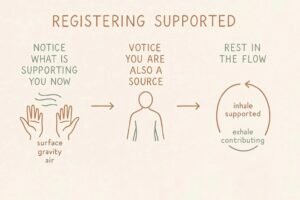
STEP 1: Notice What Is Supporting You Right Now
Turn attention toward what is holding you in this moment.
The surface beneath you receiving the weight of the body. The sensation of gravity keeping you in contact with the ground. The air being drawn in right now — sustained by plants, oceans, and atmospheric circulation that have nothing to do with individual effort.
Right now, something is holding me here.
Receive this without analyzing it. The clothes being worn, the light in the room, the food eaten today — each of these arrived through farmers, transport workers, and countless hands before reaching you. Being supported is not special or occasional. It is the condition of this moment, and every moment.
STEP 2: Notice That You Are Also a Source
Now turn attention toward the other direction — the ways you are also a point of influence in the same network.
Was there a moment today when I was present for someone — or something?
It doesn’t need to have been a word. An expression, a choice, a quality of attention. If nothing comes immediately, that’s fine — the question itself is the practice, not the answer. These contributions cannot always be proven. But they cannot be ruled out either.
Receiving and giving are two faces of one circulation. Breathe in with the sense of being supported. Breathe out with the sense of contributing. Stay with that for a few breaths.
STEP 3: Rest in the Flow
Finally, hold this sense of circulation and simply remain with it.
There is nothing to change or become. The feeling of being a small, isolated point may still be present — notice it without requiring it to disappear. Allow the sense of being within something rather than against everything to land in the body, not just the mind. Stay with it for a few breaths before returning.
Session 3: Where the Separation Was Made — and Where It Can Be Unmade
The Norm of the Separate Self Had a History
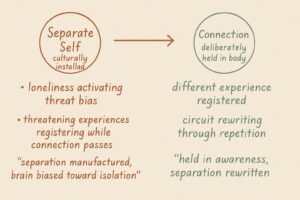
Sociologist Robert Bellah and colleagues’ research documented the deep roots of American individualism as a historically and culturally formed set of habits rather than a natural condition. The story of the autonomous, self-sufficient individual who achieves or fails entirely through personal effort was constructed through specific social, economic, and religious currents and reinforced across generations. When this cultural norm becomes pervasive, people attribute both success and failure to what is inside themselves, and evaluate themselves in isolation from the networks of relationship and structural condition in which their lives are actually embedded. The feeling of being small and powerless is not a sign of weakness. It is the emotional consequence of a story — the story of the separate self — that the culture has spent centuries installing. Because the story feels like reality, questioning it requires noticing it as a story first.
Loneliness Was a Neurological State, Not Only a Feeling
Neuroscientist John Cacioppo’s research demonstrated that loneliness operates not only as an emotional experience but as a neurological state with wide-ranging effects on brain and body. Chronic loneliness activates the threat-detection system persistently, producing a perceptual bias toward reading the world as dangerous and other people’s actions as hostile or indifferent. This is the neurological loop through which the sense of separation deepens the experience of helplessness — a brain in a state of chronic threat alert reads every signal through that filter. Social neuroscientist Matthew Lieberman’s work on the social brain offers a complementary perspective: the brain’s default state — what it does when not otherwise occupied — is organized around processing social connection. The capacity for connection is not an add-on to human cognition. It is the baseline operating mode. The sense of being a separate, isolated self is in this light not the natural state but the aberrant one — culturally manufactured and neurologically reinforced, but running against the grain of what the brain is built to do.
The Brain Could Be Retrained Through What It Was Given to Register
Research on experience-dependent neuroplasticity offers a practical framework for understanding how a brain shaped by chronic loneliness and threat — biased toward reading separation as reality — can be retrained through the deliberate registration of different experiences. The central finding is a distinction between an experience passing through awareness and an experience being consciously held in awareness long enough to produce structural change. Positive experiences — of being supported, of being connected, of mattering within a network — tend to pass quickly without registering, while threatening experiences register readily. This asymmetry is not fixed. The practice of deliberately staying with the experience of connection for even a few seconds, allowing it to land in the body rather than immediately moving on, provides the nervous system with the material it needs to build different circuits. The meditation practice in this guide is the repetition of that registration — returning, breath by breath, to the experience of being held within something rather than isolated against everything. Each return is a small contribution to the rewriting of the circuit that culture and nervous system had been maintaining together.
Conclusion: The Separateness Was a Habit
Cultural individualism keeps producing the story of the separate self. Chronic loneliness keeps activating the threat system and confirming the separation. The structure does not change on its own.
But the question what is supporting me right now, in this breath? can be brought into any moment when the familiar smallness arrives. The experience of finding an answer — and holding it for a few seconds — is the neurological path through which the habit begins, very slowly, to be rewritten.
The culture built the story. The nervous system learned to confirm it. The practice was always the one thing neither of them had scripted.
KEY TERMS
Cultural Individualism
Based on Robert Bellah and colleagues’ research on the historically constructed habits of American individualism. The story of the autonomous, self-sufficient individual who succeeds or fails through personal effort alone — constructed through specific social and economic currents rather than discovered as natural. When pervasive, it produces the habit of evaluating the self in isolation from the relational and structural context in which life is actually embedded. The cultural origin of the feeling of smallness and separation.
Neuroscience of Loneliness
John Cacioppo’s finding that loneliness functions not only as an emotional experience but as a neurological state — one that activates the threat-detection system persistently, producing a perceptual bias toward reading the world as dangerous and others as hostile or indifferent. The mechanism through which the cultural sense of separation is neurologically reinforced into a chronic experience of helplessness.
Social Brain Hypothesis
Matthew Lieberman’s finding that the brain’s default state is organized around processing social connection — that connection is the baseline operating mode of human cognition rather than an add-on. The neurological basis for understanding the sense of being a separate, isolated self as an aberrant state rather than a natural one: the brain is built for connection, and the cultural installation of separateness runs against that design.
Experience-Dependent Neuroplasticity
The brain’s capacity to change in response to what it is given to register — specifically, the finding that deliberately holding a positive experience in conscious awareness for several seconds provides the nervous system with material to build different circuits. Positive experiences of connection tend to pass without registering, while threatening experiences register readily. Deliberately staying with the experience of being supported counteracts this asymmetry, gradually rewriting the circuits that confirm separation.
Chronic Threat Bias
The neurological tendency — formed through cultural isolation and chronic loneliness — to read the world as dangerous and neutral situations as threatening. Links Cacioppo’s loneliness research and the neuroplasticity framework. In this state, the experience of connection is difficult to register even when present. Retrainable through deliberate and repeated registration of supported experience — which is what the practice in this guide is designed to provide.