
Introduction: What Is Actually Shaking When Certainty Shakes

Posting with passion about a social issue, receiving the agreement of people who share your values. Making what feels like the ethical call at work, and feeling grounded in it. Then a single opposing view arrives, and what follows is an unsettling depth of anxiety — what if I’m wrong about this? Is this belief actually mine?
This is not a sign of weak conviction or shallow thinking. It may be an honest signal pointing toward something worth examining about the nature of certainty itself.
Session 1: What Does “Being Certain” Actually Mean?

When certainty shakes, what is operating is not personal weakness. It is the structure of how beliefs are formed.
Most beliefs — ethical ones especially — are not constructed in isolation through independent reflection. They take shape through the groups one belongs to, the media encountered regularly, and the people whose judgment is trusted. The feeling of this is right is often the internalized form of in my group, this is what is considered right. The conviction feels entirely personal. Its origins are more collective than they appear.
This is not an accusation that beliefs are false. It is a description of how human cognition is designed. Using the group’s understanding as a reference point under uncertainty is an efficient cognitive strategy. But without knowing this about how the belief was formed, a view that arrives from outside the group registers as a threat rather than as information. The experience of a challenge to my conviction feeling like a challenge to me as a person is the structure at work.
The shaking may not mean the belief is failing. It may mean that the capacity to ask where the belief came from has briefly surfaced.
Session 2: Practice — From Defense to Inquiry
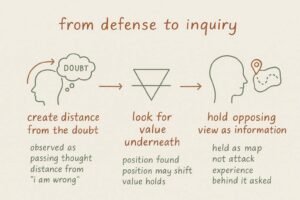
This practice uses the moment of shaking not as a threat to manage but as an opportunity to check what is actually underneath the belief.
STEP 1: Create Distance Between the Doubt and Yourself
When the anxiety or unsettling arrives, step back from it rather than inside it.
Right now, the thought “I might be wrong about this” is passing through.
The shift is from I am wrong to there is a thought that I might be wrong, and I can observe it. This small distance transforms the shaking from an emergency into something observable. When the feeling is strong, that distance may not come easily — the thought and the self can feel like the same thing. If that happens, bring attention to the body once: a physical tightening in the chest or stomach is a more stable anchor to the present than the thought spiral it is attached to.
STEP 2: Look for the Value Underneath the Position
Take one layer deeper into the belief that is shaking.
What value is underneath this position? Is that value still present in me right now?
A position and the value it is trying to protect are not the same thing. The position may be shifting, while the value holds. Or the shaking may be making the value clearer than it was before. Doubt about a position is not the same as the erasure of what mattered underneath it.
STEP 3: Hold the Opposing View as Information Rather Than Threat
Take the view that triggered the shaking and hold it temporarily as material rather than as something to defeat.
What experience might have led this person to think this way?
Agreement is not the goal — and reaching for it prematurely can be its own form of avoidance. The aim is to read the opposing view as a different map rather than as an attack on yours. That reorientation is what converts the shaking from a defensive emergency into something that can be learned from.
Session 3: Where Certainty Comes From — and Where Doubt Can Go
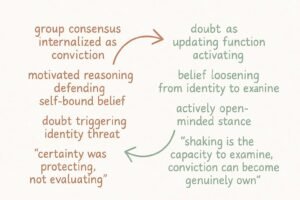
Much of the Conviction Was the Group Speaking
Psychologist Arie Kruglanski’s research on the need for cognitive closure identified the tendency, under conditions of high uncertainty or discomfort with ambiguity, to seek definitive answers and to close off further inquiry — often by adopting the positions of trusted authorities or in-group consensus. Social psychologist John Turner’s self-categorization theory demonstrated that when a person identifies with a particular group, that group’s norms and values are automatically adopted as one’s own. When these two processes converge, the formation of ethical conviction becomes visible in a specific way: facing uncertain social and moral questions, people are particularly likely to internalize the group’s authoritative position as personal certainty. Much of what is experienced as my ethical belief has been shaped through this process. This is not evidence that the belief is false. It is a description of how human cognition operates under conditions that make uncertainty uncomfortable. The first honest answer to is this conviction actually mine? may be: not entirely — and that is worth knowing.
When Certainty Was Present, the Brain Was Protecting, Not Evaluating
Psychologist Ziva Kunda’s research on motivated reasoning showed that when people encounter evidence that contradicts a belief they hold, the reasoning process is not neutral. Before any objective evaluation takes place, the motivation to reach a particular conclusion — this counter-evidence must be wrong — directs how the evidence is processed and interpreted. The stronger the connection between the belief and the person’s sense of self, the more pronounced this effect. When a belief is bound up with identity — I am someone who stands for this — a challenge to the belief is processed not only as information but as a threat to the self as a whole. This is why the shaking of a deeply held ethical conviction can produce a response that feels disproportionate to what the disagreement actually involves. When the shaking arrives, it is the moment that motivated reasoning’s defense has been temporarily breached — and what that means is that the capacity to actually evaluate the belief has briefly become available.
The Doubt Was the Updating Function Working
Cognitive scientist Keith Stanovich’s concept of actively open-minded thinking describes the cognitive stance of treating one’s own beliefs as revisable — as hypotheses that can in principle be disconfirmed by evidence and updated accordingly. Stanovich’s key finding is that this is not a sign of intellectual weakness or indecisiveness. It is a marker of a sophisticated cognitive capacity: the ability to step outside one’s own reasoning process and observe it, rather than simply executing it. Certainty that is maintained through motivated reasoning is closed; it can only confirm what it already holds. Certainty that is held with active open-mindedness remains in genuine contact with evidence and can change. The shaking of a conviction can be read as this capacity briefly activating — the moment when the belief loosens its grip on the identity enough to be examined. When the question does this belief actually come from what I value? becomes possible to ask, the answer — whether it confirms or revises the belief — moves the person a step closer to a conviction that is genuinely their own.
Conclusion: What Shook Was the Defense, Not the Belief

The group’s norms continue to shape belief formation. Motivated reasoning continues to activate whenever conviction is challenged. The pull toward cognitive closure operates reliably under uncertainty. The structure does not change.
But the question what value is underneath this position? can be brought into any moment when certainty is shaking. That question is the movement from the group’s voice toward one’s own — and toward a conviction that has actually been examined rather than only held.
The doubt was never the problem. It was the first honest assessment the certainty had allowed.
KEY TERMS
Need for Cognitive Closure
Arie Kruglanski’s concept describing the tendency, under conditions of high uncertainty or discomfort with ambiguity, to seek definitive answers and close off further inquiry — often by adopting the positions of trusted authorities or in-group consensus. In the formation of ethical conviction, the mechanism through which group norms are internalized as personal certainty. Applied here specifically to the context of ethical belief formation, where moral uncertainty and social belonging converge to accelerate the closure process.
Self-Categorization Theory
John Turner’s finding that when a person identifies with a particular group, that group’s norms and values are automatically adopted as one’s own. In conjunction with the need for cognitive closure, explains how much of what is experienced as personal ethical conviction has been shaped through group membership and identification. Focused here on the automatic adoption of group norms as belief content — the mechanism by which the group’s voice becomes indistinguishable from one’s own.
Motivated Reasoning
Ziva Kunda’s research demonstrating that when a belief is challenged, the reasoning process is directed by the motivation to reach a particular conclusion before any neutral evidence evaluation occurs. The stronger the connection between the belief and identity, the more pronounced the effect. The cognitive explanation for why challenges to ethical conviction produce responses that feel disproportionate — and why the shaking of conviction represents the moment this defense has been briefly breached.
Actively Open-Minded Thinking
Keith Stanovich’s concept describing the cognitive stance of treating one’s own beliefs as revisable — as hypotheses that can in principle be updated by evidence. Not intellectual weakness or indecisiveness, but a sophisticated capacity to observe one’s own reasoning process from the outside rather than simply executing it. The basis for reading the shaking of certainty as the updating function working, rather than the belief failing.
Belief Updating
In this context, the state in which motivated reasoning’s defense has been temporarily breached and the capacity to genuinely evaluate a belief has become available — distinct from the technical Bayesian sense of probability revision. Understood here as the moment when a conviction loosens its grip on identity enough to be examined. The movement from a belief shaped by group membership and cognitive closure toward one that has been interrogated against personal values — and in that sense, is more genuinely one’s own.