
Introduction: Why the Free Hour Produces Anxiety

Friday evening, nothing scheduled. Finally, time with no demands on it — and yet something unsettled arrives alongside it. The phone gets opened and closed and opened again. A low-level pressure to be doing something moves through the hour. By the time it ends, the tiredness that remains has nothing to show for itself.
This anxiety is not a sign of insufficient sociability or a character that needs fixing. It is the result of living inside a structure that requires every hour to be organized toward some outcome — and that has quietly redefined purposeless time as failure.
Session 1: What Makes Alone Time Feel Like a Problem

When time alone consistently arrives alongside guilt or restlessness, what is operating is not a personal disposition. It is a structure.
Contemporary urban life organizes time as a resource — continuously directed toward output, whether professional, social, or self-improving. This organizing pressure does not only arrive from outside. It becomes internalized: what can I do with this time, what should I be producing, what does it mean that I’m doing nothing. These are not private thoughts. They are a cultural evaluation standard that has moved inside.
The problem is that this organizing requirement treats purposeless time as evidence of failure rather than as a condition for recovery. When alone and temporarily free from external demands, what becomes possible — in principle — is access to one’s own thoughts, feelings, and internal sense of what matters. But the anxiety about not doing anything arrives first and occupies the space before that access can open.
The difficulty of time alone is not intrinsic to aloneness. It is the result of being inside a framework that defines the absence of organized purpose as loss.
Session 2: Practice — Entering Purposeless Time With Intention
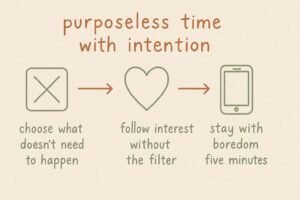
This practice is not about spending alone time meaningfully. It is about arriving in alone time before the cultural anxiety does — and creating the conditions for purposeless time to do what it is actually for.
STEP 1: Choose one thing that doesn’t need to happen today
When alone time arrives, before asking what to do with it, identify one thing that is not required today.
No replies needed today. Nothing needs to be completed. Being productive is not required right now.
Giving explicit permission for purposelessness is the first entry point. Without it, the anxiety moves in and organizes the time before anything else can.
STEP 2: Follow wherever interest moves, without asking if it’s useful
When something in the time draws attention — a direction, an impulse, a mild curiosity — follow it without first asking whether it serves any purpose.
The window. A piece of music. Something to write. The impulse to walk.
The question is this useful is the voice of the cultural evaluation standard. Following interest without that filter is the act of beginning to restore access to what is internally generated rather than externally required.
STEP 3: When boredom arrives, stay with it for five minutes before reaching for the phone
When boredom appears, before opening anything, wait five minutes.
Boredom is here. Something wants to happen but hasn’t formed yet. Five minutes, just staying.
Boredom is not failure. It is the experience of being between external demand and internal motivation — a transition, not an endpoint. Five minutes is the minimum for that transition to have somewhere to go.
Session 3: The Empty Hour Was Never Failure. Acceleration Removed It — and Intrinsic Motivation Was Waiting Inside It
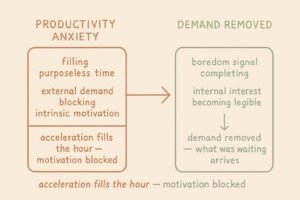
Acceleration had organized purposeless time out of existence
Sociologist Hartmut Rosa’s concept of social acceleration describes a three-layered transformation of contemporary time experience: the acceleration of technology, of social change, and of the pace of life itself. Under these combined pressures, time functions as a resource that must continuously be directed toward output. The language of contemporary productivity culture makes this visible: use your downtime strategically, rest efficiently, maintain your connections. Each of these formulations brings purposeless time inside the productivity framework — converting what was once simply leisure into a task with measurable outcomes. The time that once existed as wandering, sitting without agenda, doing something because it was interesting rather than because it would lead somewhere — this time has been progressively redefined as waste. The anxiety that arrives in an empty hour is not a psychological problem. It is the internalized version of a cultural evaluation that has been applied to time for long enough to feel like a personal verdict.
Removing external demand was the condition for accessing what was already there
Psychologists Edward Deci and Richard Ryan’s self-determination theory established a distinction between intrinsic motivation — interest in an activity for its own sake, independent of external reward or evaluation — and extrinsic motivation, which depends on outcomes, approval, and performance. Intrinsic motivation is the basis of sustained engagement, creativity, and psychological well-being. It is also the form of motivation that requires a specific condition to become accessible: a temporary reduction in external demand. When time is continuously organized toward outcomes, this condition is never met. The person who is always working toward something has no way of discovering what they would reach toward if nothing were required. Alone time, in principle, provides this condition — but only when the anxiety about purposelessness doesn’t arrive first and fill the space with the same organizing pressure the rest of the day already contained. The access that alone time makes possible is blocked not by aloneness but by the cultural framework that follows into the hour.
Boredom was the signal that the transition was already happening
Philosopher and psychologist Andreas Elpidorou’s research on the motivational function of boredom reframes the experience as a signal rather than a state to be escaped. When boredom arrives, the brain is registering that the current situation is not satisfying internal motivation — and generating pressure toward something that would. This is information. Immediately filling the boredom with external stimulation — a feed, a task, content of any kind — intercepts the signal before it can complete its function. The restlessness of boredom is the pre-condition of intrinsic motivation becoming legible: I am not satisfied by this, and something else is trying to form. The five-minute pause before reaching for the phone is not a discipline exercise. It is the minimum time for the signal to do what it is designed to do — orient attention toward what is internally generated rather than externally supplied.
Conclusion: The Framework Made It Feel Like Failure. The Hour Itself Was Always Waiting

The social acceleration that organizes time toward continuous output continues. The productivity framework that defines purposeless hours as loss remains in place. The anxiety will keep arriving alongside the empty hour.
But the choice to let one thing be unnecessary today — and to follow wherever interest moves without asking if it’s useful — is available in any hour that opens up. That choice is the entry point. And what the hour was always waiting to do begins from there.
The hour was never empty. It had just stopped being organized for someone else.
KEY TERMS
Social Acceleration and the Organization of Time
Hartmut Rosa’s concept describing how the three-layered acceleration of contemporary life — technology, social change, and life pace — transforms time into a resource that must continuously be directed toward output. Purposeless time is progressively redefined as waste within this framework, and the anxiety that arrives in an empty hour is its internalized form. The sociological basis for understanding the discomfort of alone time as a structural condition rather than a personal disposition.
Self-Determination Theory and Intrinsic Motivation
Edward Deci and Richard Ryan’s framework distinguishing intrinsic motivation — interest in activity for its own sake — from extrinsic motivation dependent on outcomes and evaluation. Intrinsic motivation requires a temporary reduction in external demand to become accessible. When time is continuously organized toward outcomes, this condition is never met, and alone time’s capacity to restore access to internal motivation is blocked before it can begin.
Motivational Function of Boredom
Andreas Elpidorou’s research reframing boredom as a signal that the current situation is not satisfying internal motivation — and that something is trying to form in its place. Immediately filling boredom with external stimulation intercepts this signal before it completes its function. The five-minute pause before reaching for the phone is the minimum time for the signal to orient attention toward what is internally generated. Boredom is not failure; it is the pre-condition of intrinsic motivation becoming legible.
Cultural Elimination of Purposeless Time
The compound effect of Rosa’s social acceleration and productivity culture’s redefinition of leisure as optimizable resource. What once existed as purposeless wandering, unagenda’d sitting, and interest-following without outcome has been progressively converted into tasks with measurable results. The guilt and anxiety of doing nothing is the internalized form of this cultural redefinition — not a personal verdict but a structural one.
Access Conditions for Intrinsic Motivation
The minimum conditions — purposeless time, permission to follow interest without utility-checking, willingness to remain in boredom for five minutes — under which intrinsic motivation becomes accessible and the transition from external demand to internal generation can complete. Social acceleration and productivity culture structurally remove these conditions. Designing alone time means restoring them — not as a self-improvement project but as the recovery of a condition that was always already there.