
Introduction: Seeing the Same Faces Every Day and Still Feeling Far

Months on the same project. Several lunches together. And still, in a quiet moment, the thought arrives: I don’t really know anything about this person. Showing up as the role even when the body is flagging. A real thought reaching the throat and being swallowed. Laughter in the meeting room, and then something slightly hollow after the door closes.
This is not a sign of insufficient sociability. It is what happens inside a structure that makes deep connection rationally difficult.
Session 1: What Workplace Loneliness Actually Is

When deeper connection consistently fails to develop in a workplace, what is operating is not a communication deficit. It is a structure.
Connection deepens through accumulated investment — self-disclosure that goes both ways, trust built across small moments, the experience of showing a weakness and finding the relationship still intact. But the entire process depends on a background assumption: that the relationship will continue long enough for the investment to be worth making.
Contemporary workplaces have made this assumption structurally unreliable. Project-based staffing, short-cycle performance evaluation, and normalized mobility have made the duration of any given working relationship genuinely uncertain. Within that uncertainty, the emotional cost of deep self-disclosure becomes harder to justify. The resistance to investing is not a character trait. It is a rational response to conditions in which the return on that investment cannot be assumed.
The additional layer is that workplaces organize sustained evaluation, competition, and visibility into the daily environment. This keeps the brain’s threat detection system running at a low chronic level. Under chronic threat, the behaviors that require vulnerability — self-disclosure, genuine questions, admitting confusion — become neurologically harder to initiate. The sense of a wall between role and person at work is not being built by the people in the room. It is a structural feature of the room.
Session 2: Practice — Generating Local Safety
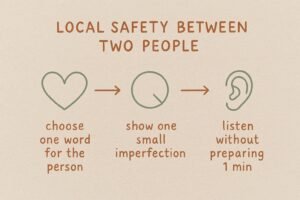
This practice is not about transforming the workplace. It is about creating a small amount of room — in the immediate space between two people — where something outside the role can occasionally be visible.
STEP 1: Choose one word that reaches the person rather than the function
When interacting with a colleague, select one thing to say that touches their presence rather than their performance.
The tone of that explanation was easy to follow. You look like today has been heavy — are you doing okay? That was a careful piece of work and I noticed.
This single observation will not change the relationship. But it functions as a small signal: something outside the role is visible here.
STEP 2: Show one small imperfection
When something is unclear, when a mistake has been made, when pressure is being felt — instead of concealing it entirely, name it briefly.
I’m not familiar with this tool yet — if you have a shortcut, I’d appreciate it. I need a few minutes to check this properly. Let me get back to you.
Not an appeal for sympathy. Not an abdication of responsibility. A small honest statement that creates implicit permission for others to be similarly imperfect in this space.
STEP 3: For one minute, listen without preparing a response
When a colleague begins speaking — about anything — stop constructing the reply and spend one minute with the single purpose of understanding what they are actually saying.
Reflect back what was heard: So the issue is that the timeline shifted and that changed the whole plan? Stay with that rather than moving immediately to a solution.
Being fully heard — even briefly — produces the experience of being treated as a person rather than a role-holder. That experience is what the practice is generating.
Session 3: The Wall Was Never Built by the People in the Room
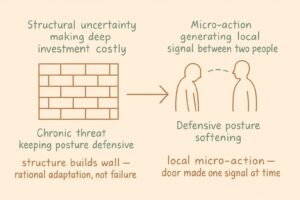
Employment fluidity had made long-term relational investment rationally difficult
Sociologist Richard Sennett’s concept of the corrosion of character describes how short-cycle performance evaluation, project-based organization, and the normalization of employment mobility structurally erode the conditions under which long-term commitment and mutual investment between people can form. Deep connection is a product of accumulated reciprocal investment — self-disclosure that travels in both directions, trust built through repeated small tests, the discovery that vulnerability doesn’t end the relationship. All of this requires time and, crucially, the reasonable expectation that the relationship will continue. When the duration of any working relationship is structurally uncertain — when the project may end, the team may be reorganized, the colleague may leave or be moved — the rational calculus shifts. The emotional cost of deep self-disclosure becomes difficult to justify against an uncertain return. The surface-level quality of most workplace relationships is not evidence of a failure to connect. It is evidence of a rational adaptation to conditions in which deep connection carries risk that the structure cannot underwrite.
Chronic threat conditions had made the default posture defensive
Neuroleadership researcher David Rock’s SCARF model identified five domains of social threat that are particularly active in workplace environments: status, certainty, autonomy, relatedness, and fairness. Performance evaluation threatens status. Organizational change threatens certainty. Micromanagement threatens autonomy. Exclusion from information or decisions threatens relatedness. Unequal recognition threatens fairness. When these threat domains are chronically activated at low levels — which the structure of most workplaces ensures — the brain maintains a baseline defensive posture. Organizational psychologist Amy Edmondson’s research on psychological safety described what this chronic defensive posture produces at the level of team behavior: when people believe that showing failure, admitting confusion, or disagreeing carries interpersonal risk, they suppress exactly the behaviors that make genuine collaboration and connection possible. The reluctance to self-disclose, to ask genuine questions, or to show imperfection at work is not a personality configuration. It is the neurologically predictable output of an environment in which the conditions for psychological safety have been structurally compromised.
Micro-actions had been generating local safety in the space between two people
One of the most practically significant findings in Edmondson’s research is that psychological safety is not a property that an organization either has or lacks in a binary sense. It is generated and maintained locally — in the specific interactions between specific people. The wall that employment fluidity and chronic threat conditions build at the structural level is real and does not dissolve through individual effort. What individual effort can do is create a locally different condition in the immediate space between two people. None of these actions changes the structure. But each one generates a local signal — something different is possible here — and that signal is the condition under which the chronic defensive posture can begin, locally, to soften. The wall was a design feature of the room. The door in the wall is something that can be made, one micro-action at a time, by the people inside it.
Conclusion: The Structure Built the Wall. The Micro-Action Opens a Door in It

The employment fluidity that makes long-term relational investment rationally difficult continues. The SCARF threat conditions that keep the defensive posture as the workplace default remain active. Psychological safety at the organizational level does not change quickly.
But the one word that reaches the person rather than the function — the small named imperfection, the minute of genuine listening — is available in the next conversation. That is where the local signal begins. And the local signal is where something different becomes possible.
The wall between role and person was never built by the people inside the room. It was a design feature of the room itself.
KEY TERMS
Employment Fluidity and Temporalization of Relationships
Richard Sennett’s concept from the corrosion of character framework: short-cycle performance evaluation, project-based organization, and normalized mobility structurally erode the conditions under which long-term relational investment can form. When relationship duration is uncertain, deep self-disclosure carries risk that the structure cannot underwrite — making surface-level connection a rational adaptation rather than a social failing.
SCARF Threat State
David Rock’s neuroleadership model identifying five workplace domains of social threat — status, certainty, autonomy, relatedness, and fairness — whose chronic low-level activation maintains a baseline defensive posture. The neurological basis for understanding why the behaviors required for genuine connection — self-disclosure, vulnerability, genuine questions — are systematically harder to initiate in most workplace environments.
Psychological Safety
Amy Edmondson’s organizational psychology concept: the shared belief that showing failure, admitting uncertainty, or disagreeing will not carry interpersonal cost. Its absence — produced by chronic threat conditions — suppresses exactly the behaviors that make collaboration and genuine connection possible. Understood here as the structural outcome of employment fluidity and chronic SCARF activation rather than as a leadership style choice.
Local Generation of Psychological Safety
Edmondson’s finding that psychological safety is not binary at the organizational level but is generated and maintained locally in specific interactions between specific people. The practical basis for understanding micro-actions — a word that reaches the person, a named imperfection, a minute of undivided attention — as capable of creating a locally different condition even within a structurally unsafe environment.
Person-Level Recognition Beyond Role
The act of directing language toward someone’s presence, state, or effort rather than their performance or function. Operates as a local signal that the role is not the only thing visible — creating the minimum condition for the chronic defensive posture to soften in the immediate space between two people. The mechanism through which the first micro-action generates the first change in local safety.