
Introduction: What the Phrase “Just Put Yourself Out There” Leaves Out

I’m not good at building connections. I should have made more effort. When loneliness arrives, the interpretation that reaches first is usually personal — a failure of initiative, a deficit of social skill, a character that doesn’t quite measure up. This interpretation conceals something important. Access to connection in cities was never equally distributed to begin with.
How deep the loneliness runs is structured, in significant part, by which neighborhood is home, what kind of employment is the current reality, and how much time is actually free. The claim that anyone who tries hard enough can find connection rests on a premise that the conditions for connection are roughly equivalent across urban life. They are not.
Session 1: What the Inequality in Connection Actually Is

When loneliness varies dramatically between people in the same city, what accounts for the difference is not primarily variation in social skill or personality. It is structural variation in access to the conditions that make connection possible.
Cities concentrate wealth and opportunity — but they do not distribute them evenly. Neighborhoods where higher-income residents cluster tend to accumulate social infrastructure: libraries, parks, community spaces, cultural institutions, the kinds of places where people can be present without transactional purpose and where incidental contact becomes possible. Neighborhoods where lower-income residents cluster tend to have less of this infrastructure, and fewer safe, non-commercial spaces for lingering. The same city offers structurally different access to the conditions for connection depending on where within it a person lives.
The employment dimension compounds this further. Deep connection requires time — specifically, time that is unhurried, predictable, and available for mutual presence. Precarious employment arrangements remove this time from certain people’s lives systematically: irregular hours that cannot be planned around, multiple jobs that leave no margin, schedules that shift too unpredictably to maintain social commitments. Connection is not equally within reach for people whose working lives leave them without the time it requires.
The framework of personal responsibility for loneliness — the assumption that connection is available to anyone who makes sufficient effort — is worth examining in light of these structural conditions. The conditions are not equivalent. The effort required to overcome unequal conditions is not equivalent either.
Session 2: Practice — Building the Observational Frame
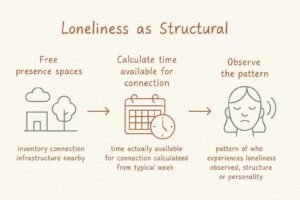
This practice is not about solving the structural problem. It is about developing the capacity to see loneliness as something that has a structure — one that can be observed, named, and understood as something other than personal failure.
STEP 1: Inventory the connection infrastructure in your immediate area
Look at the neighborhood where you currently live and count how many places exist where you can simply be present — at low or no cost, without an obligation to consume.
Libraries, parks, public squares, community centers — places where nothing is required of you except presence.
Compare this count and quality to a place you lived previously, or a neighborhood you know well. This is a first observation about how much your current loneliness is correlated with geographic conditions rather than personal ones.
STEP 2: Calculate the time actually available for connection in a typical week
Take a typical week and subtract the hours consumed by paid work, commuting, domestic labor, and sleep. From what remains, estimate how much is genuinely available for the kind of unhurried mutual presence that builds or maintains deep connection.
Has this time increased or decreased as employment conditions changed? Did the quality of connection change when the working arrangement changed?
This calculation is not self-criticism. It is a structural observation about whether the basic resource that connection requires — time — is actually available, and whether its availability has been determined more by employment conditions than by personal disposition.
STEP 3: Observe the pattern of who experiences loneliness
Think of the people you know who experience loneliness most acutely, and those who seem to have easiest access to connection. Without reducing individuals to categories, notice whether the difference correlates more closely with personality or with conditions — employment stability, neighborhood, available time, predictability of schedule.
People working precarious hours. People who have moved repeatedly. People whose neighborhoods lack non-commercial gathering spaces.
The purpose is not judgment but pattern recognition: noticing what structural conditions tend to appear alongside deep loneliness, and what conditions tend to appear alongside accessible connection.
Session 3: The Loneliness Was Never Equally Distributed
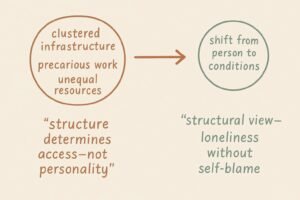
Access to connection was geographically and economically segregated from the start
Urban economist Richard Florida’s research on the spatial concentration of the creative class documented how higher-income, higher-education workers cluster in specific urban neighborhoods — and how social infrastructure, cultural capital, and the conditions for informal social life cluster with them. Urban sociologist Loïc Wacquant’s analysis of urban outcasts describes the other side of this geography: in neighborhoods shaped by concentrated poverty, safe public spaces for lingering are scarce, the social infrastructure that generates incidental connection is thin, and the structural conditions for building community are systematically compromised. The assumption underlying the personal responsibility narrative — that connection is available to anyone willing to pursue it — requires that the opportunity to pursue it be roughly equally distributed. Florida’s and Wacquant’s work together demonstrate that it is not. Where a person lives within a city shapes, at a structural level, what connection infrastructure surrounds them. This is a geographic condition, not a social skill.
Precarious employment had been removing the time that connection requires
Research on time poverty establishes that the time required to build and sustain deep connection — unhurried, predictable, mutually available time — is not equally distributed across contemporary working life. Sociologist Guy Standing’s concept of the precariat extends this into the employment dimension: people working under zero-hours contracts, holding multiple part-time positions, or navigating irregular schedules face not only time scarcity but the specific form of time that precarious employment produces — unpredictable, unchosen, impossible to plan social commitments around. Deep friendship requires the repeated, reliable co-presence that allows trust to accumulate. Precarious employment structurally prevents this accumulation for the people it affects. When connection is described as something available to anyone with sufficient social initiative, the analysis stops before reaching the question of whether the time that initiative requires is equally available. It is not. For a significant portion of urban workers, connection has become not merely difficult but structurally undersupplied — a resource whose conditions of access are determined by employment arrangements rather than by any quality of the person.
Fundamental cause theory had relocated the problem from the person to the distribution of resources
Public health sociologists Bruce Link and Jo Phelan’s fundamental cause theory proposed that health and social disparities persist across time not because their surface-level causes are unchangeable but because their root causes — unequal access to resources — remain unaddressed. The resources that determine who is able to maintain social connection are identifiable: money, time, social networks, knowledge, and the power to shape one’s own circumstances. These resources are unequally distributed. Their unequal distribution predicts, at a population level, who will experience chronic loneliness — not because of personality differences but because of differential access to what connection materially requires. When the social narrative attributes loneliness to personal failure, it operates as a mechanism that redirects attention from the unequal distribution of these resources toward the individual who lacks them. The person who internalizes this narrative bears not only the loneliness but the additional weight of believing the loneliness reflects something deficient about them.
Conclusion: The Distribution Was Always Unequal. The Self-Criticism Was Misdirected

The geographic and economic segregation of access to connection infrastructure continues. The precarious employment arrangements that make time a scarce resource for specific populations remain in place. The narrative that loneliness reflects personal effort levels keeps circulating.
But the recognition that this is a problem of resource distribution rather than personal inadequacy is available in any moment the self-critical interpretation arrives. That recognition is the redirection — from the self toward the structure — and from that position, a more accurate account of the loneliness becomes possible.
The loneliness was not equally distributed. The resources that make connection possible never were either.
KEY TERMS
Geographic and Economic Structure of Connection Inequality
Richard Florida’s documentation of how social infrastructure concentrates in high-income urban neighborhoods, and Loïc Wacquant’s analysis of how low-income neighborhoods are structurally deprived of the conditions for incidental connection. Together they establish that access to the circumstances under which connection becomes possible varies systematically by geography and income — not by social skill or personal effort. The basis for understanding urban loneliness as a distributional problem.
Precariat and Temporal Deprivation of Connection
Guy Standing’s concept of the precariat — people working under zero-hours contracts, multiple part-time positions, or unpredictably shifting schedules — applied to the specific way precarious employment removes the predictable, available time that building deep connection requires. Not only time scarcity but the structural unpredictability that makes social commitments impossible to maintain. The basis for understanding the connection deficit of precarious workers as a condition of their employment rather than a social failing.
Time Poverty and Opportunity Cost of Connection
Research on how the distribution of discretionary time is unequal across contemporary working life, with the time required for deep connection — unhurried, mutually available, recurring — systematically extracted from the lives of lower-wage and precarious workers. Connection becomes a resource whose conditions of access are determined by employment arrangements. Describing its absence as personal effort failure misidentifies the cause.
Fundamental Cause Theory
Bruce Link and Jo Phelan’s public health sociology framework proposing that health and social disparities persist because their root causes — unequal access to resources including money, time, social networks, and power — remain unaddressed even when surface-level causes are targeted. Applied here to loneliness: the distribution of resources that make connection possible predicts who will experience chronic social isolation more accurately than any account based on personality or effort. The theoretical basis for redirecting the self-assessment of loneliness from the person to the distribution.
Dismantling the Individual Responsibility Narrative
The critical position that the cultural narrative attributing loneliness to personal effort and social skill functions to conceal the unequal distribution of the resources that make connection possible — redirecting attention from structural conditions to individual characteristics and converting a distributional problem into a moral assessment of the people most affected by it. Understanding this function is the first step toward an accurate account of what the loneliness is about and where the appropriate response is directed.