
Introduction: In the Forest, the Mind Kept Moving

The effort was made to come. The green was there. The phone was put away. And still the mind replayed yesterday’s conversation, surfaced tomorrow’s schedule, wondered whether a better spot was somewhere further along the path.
The feeling that arises — something must be wrong with me if I can’t relax in a forest — is more common than it appears. But the inability to switch off in nature is not evidence of a poor relationship with the outdoors or a failure to know how to rest. It is the predictable result of specific historical and structural conditions that don’t pause at the treeline.
Session 1: Why Doing Nothing Feels So Difficult

Sitting down in the forest, the impulse to do something arrives almost immediately.
This impulse has a history. Sociologist Max Weber’s analysis of the Protestant work ethic documented the process by which industriousness became a moral value — a sign of character, a measure of worth. The religious framework that produced this equation has largely dissolved, but the structure it left behind has not. Time that produces nothing is wasted time. Activity without a productive outcome requires justification. This logic has been absorbed into the body, not just the mind, and it does not suspend itself because the surroundings have changed.
What complicates this further is the arrival of a newer demand: doing rest correctly. Forest bathing protocols, mindfulness techniques, optimized recovery strategies — when rest itself becomes a performance category, simply sitting under a tree generates a different kind of anxiety. Not just I should be doing something but I’m not doing this right. The permission to do nothing has been structurally withdrawn on two fronts simultaneously.
Session 2: Practice — Being Inside the Extent
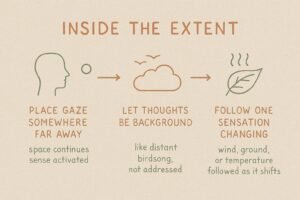
This practice is not an attempt to relax. It is a way of creating the conditions under which a shift toward sensory mode can happen without being intended.
STEP 1: Place the gaze somewhere far away
From wherever you are sitting, find the furthest point the eyes can reach — a gap between trees where sky is visible, the line where a slope disappears, the edge where mist begins. No need to focus. Just rest the gaze there.
There is more beyond this. The space continues.
Focusing on a nearby object activates directed attention. Resting the gaze at a distance releases it. The sense that the space continues — that there is extent here — begins to shift what the attention is doing, without requiring it to do anything differently.
STEP 2: Let the thoughts be part of the background
When thinking surfaces in the forest, resist addressing it. Instead, treat it the way the sound of distant birds is treated — as something present in the background that doesn’t require a response.
Thinking again. That’s also just something that’s here right now.
Trying to stop thinking directs attention toward thought. Treating thought as background lowers its priority in the attention hierarchy. As thought recedes, sensory information tends to move forward on its own.
STEP 3: Follow one sensation as it changes
Wind moving across the face. The pressure of ground through the soles of the feet. The temperature of the air on an inhale. Choose one and follow how it changes — not interpreting what the changes mean, just tracking them as they happen.
This is what is actually here right now.
Tracking sensory change competes with ruminative thought for the same processing resources. As sensation occupies more of the foreground, the internal monologue becomes relatively quieter.
Session 3: Why the Forest Couldn’t Deliver What It Seemed to Promise
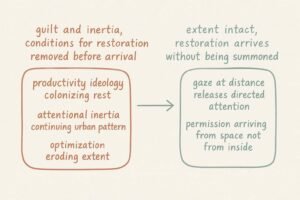
The guilt about doing nothing has a structural origin, not a personal one
Weber’s analysis located the source of the modern compulsion toward productivity in a specific historical moment — the transformation of industriousness from practical necessity into moral virtue. The theological scaffolding has been removed, but the interior logic persists in the body as a felt sense that unproductive time must be justified. Barbara Ehrenreich’s work on compulsory optimism extends this further: the demand to feel good correctly, to use leisure productively, to extract value from every experience has colonized the domain of rest. In the forest, these two pressures converge. Not only is simply sitting potentially wasteful — it may also be the wrong kind of rest, inadequately mindful, insufficiently restorative. The guilt about doing nothing is not a personal character trait. It is what the internalization of productivity ideology looks like when it reaches the treeline.
Mind-wandering is automatic — and the environment trained it to be
Psychologists Matthew Killingsworth and Daniel Gilbert documented that people spend approximately 47% of waking hours thinking about something other than what they are currently doing. This mind-wandering consistently predicted lower reported wellbeing — but what matters here is its character as an automatic process rather than a chosen one. Urban and digital life intensify this tendency. Frequent notification cycles, rapid task-switching, fragmented information flows — these create habitual patterns of attention that continue operating when the environment changes. The attention doesn’t know it has entered a forest. It runs the pattern it was trained to run everywhere else. The inability to be present in nature is not a problem of concentration. It is a problem of attentional inertia — the continuation of a pattern the environment no longer requires but hasn’t yet been given a reason to stop.
Extent creates the conditions for sensory mode to arrive without being summoned
The most consistently overlooked element in Kaplan’s attention restoration theory is the concept of extent — the quality of a restorative environment that allows a sense of being in a whole other world, a place rich enough to occupy the mind without demanding it perform. Recovery in natural settings is not produced by the presence of trees or birdsong alone. It requires a spatial and temporal sense that there is more here than can be immediately taken in — that the space continues, that the time is not allocated, that nothing is waiting at the end of the path. Optimized walking routes, nearby focal points, periodic time checks — these erode extent before restoration can begin. Resting the gaze at a distance, choosing no destination, leaving the watch behind — none of this constitutes a technique for achieving relaxation. It is simply the removal of what was preventing extent from doing what it does when left intact. The permission to do nothing doesn’t have to come from inside. When the conditions are right, it arrives from the space itself.
Conclusion: It Wasn’t Failure to Switch Off. The Conditions for Switching Off Were Absent

The pressure of productivity ideology continues past the treeline. Mind-wandering doesn’t stop at the forest entrance. The internal voice will keep running for a while after arrival regardless.
But the choice to rest the gaze somewhere far away — in this forest, today — is always available. That single act begins to create the conditions. The space does the rest.
The forest was always ready. The permission to do nothing in it was the part that had been systematically revoked.
KEY TERMS
Internalized Productivity Ideology
The embodied logic, traced by Weber to the Protestant work ethic, that time without productive output requires justification. The theological origin has dissolved but the structure persists — felt in the body as an impulse to do something, even in settings designed for rest. Extended in contemporary life by the demand to rest correctly, introduced by wellness culture: not just unproductive time is suspect, but rest that doesn’t optimize recovery.
Mind-Wandering
Killingsworth and Gilbert’s term for the automatic process by which attention moves to something other than the current activity — documented as occurring in approximately 47% of waking hours. Not a voluntary choice but a trained default. Digital and urban environments intensify the tendency through notification cycles and task-switching demands. The pattern continues operating in natural settings because it is environmental in origin: it was built by the previous environment, not the current one.
Attentional Inertia
The continuation of habitual attention patterns — rapid switching, fragmented processing, anticipatory scanning — in environments that no longer require them. The forest doesn’t ask for these patterns, but the attention system doesn’t register the change immediately. The experience of being mentally elsewhere in a natural setting is attentional inertia, not personal failure.
Extent
The element of Kaplan’s attention restoration theory describing the quality of environmental richness that allows the mind to be occupied without being directed — the sense that the space continues, that there is more here than can be immediately processed. Distinguished from other restorative qualities by its dependence on spatial and temporal openness. Eroded by focal points, time pressure, and optimized routes. When intact, it creates the conditions for sensory mode to arrive without being consciously sought.
Compulsory Optimism Extended to Leisure
Ehrenreich’s concept of compulsory optimism — the cultural demand to maintain positive affect and productive orientation — applied to the domain of rest. The requirement to use leisure well, to achieve the correct quality of recovery, to extract value from natural experience. Produces a second layer of anxiety in the forest: not only is doing nothing potentially wasteful, it may also be the wrong kind of rest. The internalization of this demand is structural, not personal.