
Introduction: A Quiet Place Was Found. Quiet Didn’t Come

The noisy office was left behind. A forest was sought, or a spot near water, or somewhere with fewer people. And still the mind didn’t quiet. If anything, the harder the effort to be quiet, the louder something inside became.
Maybe the place wasn’t quiet enough. Maybe a quieter destination is needed.
If that thought has arisen, the question may have been framed the wrong way around. Quiet is not a property of locations. It is a state that appears on the inside when the relationship with sound changes. And that relationship can change anywhere — including places that are not silent at all.
Session 1: Why Complete Silence Is Unsettling

People who enter an anechoic chamber — a room engineered to eliminate virtually all external sound — typically report discomfort within minutes. The sound of their own heartbeat, the movement of blood, the subtle noise of joints shifting become audible in ways they ordinarily aren’t. The quietest possible environment produces not relaxation but a particular kind of unease.
What this reveals is that the felt sense of quiet has nothing to do with sound pressure levels. When quiet is actually experienced, what is happening is not the elimination of sound but a change in the relationship with it — a shift from sound as something to be processed, resisted, or escaped, to sound as something that is simply present. That shift is what this guide is about.
Session 2: Practice — Changing the Relationship with Sound
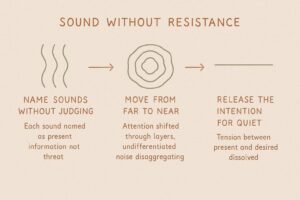
This practice is not about finding a quieter place. It is about changing what happens between you and sound in the place you are already in.
STEP 1: Name the sounds, without judging them
Whatever is audible right now — give each sound a name. Air conditioning. Traffic. A voice somewhere. Wind. Nothing more than the name. No assessment of whether it is welcome or unwelcome.
This sound is here. That one is also here.
The moment a sound is labeled as too loud or intrusive, the brain enters an alert state oriented toward that sound as a problem. Naming without judgment keeps the sound in the category of present information rather than active threat. The processing changes without the sound changing at all.
STEP 2: Move from the far sound to the near sound
With eyes closed, find the furthest audible sound. Hold it for a moment. Then move to something closer. Then closer still — eventually to the sound of breathing itself. Far to near, in sequence.
Sound has layers. The space is larger than one sound.
This movement draws attention to the spatial dimension of the sound environment. Once the layering becomes apparent, the single undifferentiated experience of it’s noisy begins to disaggregate into something more specific — and something more specific is easier to be present with.
STEP 3: Release the intention to be quiet
When the impulse to make the environment quieter, or to make the mind quieter, is noticed — release it. Not as a suppression of the impulse, but as a simple setting down.
Quiet doesn’t come when called.
The intention to become quiet signals to the brain that the current state is unacceptable. That signal maintains the alert orientation. When the intention is released, the tension between the present sound environment and the desired sound environment dissolves, and something else becomes possible.
Session 3: Why Quiet Places Don’t Always Produce Quiet
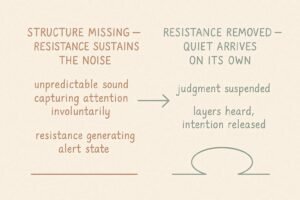
The most fatiguing sounds are not the loudest ones
Sound researcher Staffan Hygge and colleagues have documented that the stress effects of sound depend far more on informational content and unpredictability than on volume. When other people’s speech is audible, the brain automatically processes it for meaning — regardless of whether the listener wants it to. Notification sounds generate predictions about what might be arriving. These sounds fatigue not because they are loud but because they capture attention involuntarily and generate continuous prediction tasks. The experience of being more drained in a quiet office than in a noisy café, when it occurs, reflects this mechanism: the café noise is relatively undifferentiated, while the office noise — individual voices, notification tones, the specific sounds of colleagues — carries high informational content that the brain cannot stop processing. Urban environments produce chronic fatigue not primarily through volume but through the structural persistence of informationally rich, unpredictable sound.
The auditory system was shaped by a different sound environment
Soundscape ecologist Bernie Krause developed a framework classifying natural sound into three layers: geophony — sound produced by non-biological physical processes, wind, water, geological activity; biophony — sound produced by non-human living organisms; and anthrophony — sound produced by human activity. In intact natural environments, these layers occupy distinct frequency bands, producing a structured acoustic environment in which different sounds are spatially and spectrally differentiated. Human hearing evolved across deep time within this differentiated structure. The fatigue produced by urban sound environments has a dimension that neither volume nor unpredictability fully accounts for: the ecological differentiation the auditory system expects is absent. What arrives is instead an acoustically undifferentiated field in which the expected structure cannot be found. Friston’s predictive processing framework adds a further layer: the attempt to impose quiet — to resist the sound environment — generates its own prediction errors. The intention to make things quieter signals to the brain that the current environment is not acceptable, sustaining the very alert orientation that prevents quiet from arriving.
Quiet appears when resistance to sound stops
The Pali term passaddhi, translated in early Buddhist meditation literature as tranquility or lightness, describes not the absence of external sound but the internal state that arises when resistance to sensory experience ceases. The standard description is of a quality that cannot be produced by effort — that appears, rather, when the effortful relationship with experience is released. This framing inverts the ordinary approach to quiet entirely. The search for a quieter location is a search for the right external conditions. What passaddhi points toward is the recognition that the external conditions were never the determining factor. None of these practices create quiet directly. They remove the resistance that was preventing quiet from appearing on its own.
Conclusion: The Place Was Quiet Enough. The Resistance to Sound Was What Kept Quiet Away

The informationally dense sound of urban environments continues. Access to genuinely quiet natural spaces is not equally distributed. The auditory system will keep processing speech and notification tones whether or not it is asked to.
But the choice to name what is audible right now — without judgment, just as a name — is available in any environment. That choice is the minimum shift in the relationship with sound. And the relationship is where quiet actually lives.
Silence was never the absence of sound. It was what happened when the resistance to sound finally stopped.
KEY TERMS
Informational Content and Unpredictability of Sound
The finding from Hygge and colleagues’ acoustic research that the stress effects of sound depend primarily on informational content and unpredictability rather than volume. Speech and notification tones fatigue because they capture attention involuntarily and generate continuous prediction tasks, not because they are loud. The basis for understanding why urban environments produce chronic auditory fatigue and why the quietest physical spaces are not always the most restoring.
Soundscape Ecology
The field developed by Bernie Krause that analyzes sound environments as ecological structures. Classifies natural sound into geophony, biophony, and anthrophony — layers that occupy distinct frequency ranges in intact natural environments. Human hearing evolved within this differentiated structure; its absence in urban environments contributes to auditory fatigue at a level that volume and unpredictability alone do not explain.
Predictive Processing and Sound Resistance
An application of Friston’s predictive processing framework to the experience of trying to find quiet. The intention to make the environment quieter signals to the brain that the current state is unacceptable, generating prediction errors and maintaining the alert orientation that prevents quiet from arriving. The attempt to produce quiet is, in this account, one of the mechanisms by which quiet is prevented.
passaddhi
A Pali term from early Buddhist meditation literature, typically translated as tranquility or lightness. Describes not the absence of external stimulation but the internal state that arises when resistance to sensory experience is released. Reframes the search for quiet as a search for an internal relational shift rather than an external acoustic condition — and identifies release of resistance, rather than reduction of sound, as the operative mechanism.
Involuntary Attentional Capture
The automatic orientation of attention toward informationally rich stimuli — other people’s speech, notification tones, unpredictable sounds — regardless of the listener’s intentions. A core mechanism in the fatigue produced by urban sound environments. Distinguished from voluntary attention by its resistance to suppression: the brain processes these sounds whether or not the person wants it to, making the standard response of trying to ignore them largely ineffective.