
Introduction: The Body Has Already Been Recording
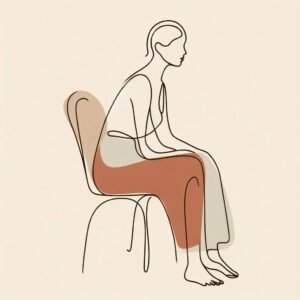
The shoulders are tight. There’s a heaviness somewhere in the chest. The abdomen feels compressed in a way that has no clear name.
These are not metaphors. Stress, fatigue, and emotional tension accumulate as actual physical changes in the body’s tissues. But most of the time, these signals are bypassed before they’re processed — attention returns to thinking, and the body’s record goes unread.
The body scan is a practice for reading that record systematically. Relaxation is not the goal — knowing what is there is the goal. And in most cases, knowing is where change begins.
Session 1: The Body Stores Emotion
It feels as though thinking and feeling happen in the brain alone. They don’t.
Emotions are encoded as bodily states — this is not a metaphor but a finding. Damasio’s research has shown that changes in heart rate, patterns of muscular tension, visceral sensations are not byproducts of emotion. They are components of it. The expressions gut feeling, heavy-hearted, carrying a burden use physical language not by accident. Emotion is literally inscribed in the body.
This reframes what the body scan is doing. Moving attention systematically through each region of the body is a process of surfacing information that has been encoded there. Noticing that the shoulders are held rigid is not only an observation about muscle tone. It is a reading of something that has been stored.
Areas where nothing is felt are also informative. Nothing felt here is data too.
Session 2: The Practice
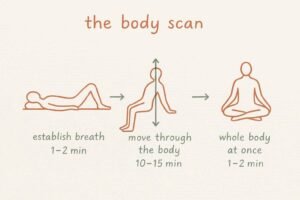
Find a quiet space. Lie on your back, or sit deeply reclined in a chair. Close the eyes gently.
STEP 1: Establish the breath (1–2 minutes)
Begin with the breath as a whole — the sense of the body as a single container that is breathing. Stay here until the mind has settled slightly and the body feels ready to be surveyed.
STEP 2: Move attention through the body (10–15 minutes)
Work from the feet toward the head, or in reverse — either direction is fine. At each region, place attention there and simply register what is present. Don’t try to change anything. Just read.
Feet and legs: Begin with the left big toe. Warmth, coolness, pulse, pressure, or simply the absence of sensation — receive whatever is there without evaluation. Move through the remaining toes, the sole, the heel, the ankle, the calf, the knee, the thigh. Then the right leg, in the same sequence.
Torso: The pelvis, lower back, abdomen — notice the movement of breathing here, the weight of the internal organs. The upper back, the chest — the expansion and release of the ribcage with each breath.
Arms and hands: From the fingertips through the palm, wrist, forearm, elbow, upper arm, and shoulder. Both sides.
Neck, face, head: The back of the neck, the throat, the jaw, the lips, the nose, the cheeks, the eyes, the space between the brows, the forehead, the crown.
What is here, right now? No adjustment needed. Just the reading.
STEP 3: The whole body at once (1–2 minutes)
Finally, release the focus on individual regions and receive the body as a single field of sensation. Not parts — the whole. Stay with this for a moment before returning.
Session 3: Why the Body Stores What the Mind Has Been Too Busy to Process
Understanding what the body scan is actually doing — from neuroscience and philosophy simultaneously — changes how the practice feels.
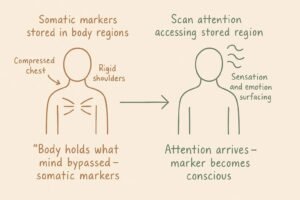
Damasio’s somatic marker hypothesis describes the role the body plays in emotion and decision-making. The brain stores past experiences not only as abstract information but paired with bodily states — heart rate patterns, muscular tension, visceral sensations. These bodily states function as markers that influence judgment and emotional response. The sense of something feels wrong about this or I can’t put my finger on it, but no is the marker system operating. When a body scan surfaces the awareness that the shoulders have been held rigid, or that something in the chest has been compressed — this is the process of bringing those markers into conscious awareness.
Lang’s bioinformational theory extends this picture: emotion is not a brain event with bodily side effects, but an information network distributed across the entire organism. Emotional memories are encoded with their somatic context — the breathing pattern, the muscular state, the visceral quality of the original experience. This is why attention directed to a specific body region during a scan can sometimes produce an unexpected emotional response. The information stored there is being accessed.
Kabat-Zinn introduced the body scan as a central practice in MBSR in the late 1970s, working initially with chronic pain patients. The clinical observation behind this was precise: treating pain as an enemy to be fought tends to amplify suffering; treating it as sensory data to be observed tends to change the relationship to it. The distinction between the sensation of pain and the resistance to pain — these two layers, when separated through sustained attention — can alter the experienced intensity of suffering.
Merleau-Ponty argued in 1945 that the body is not an object we possess but the medium through which we inhabit the world — what he called the lived body. We do not have a body. We are one. This is not a semantic distinction. It describes a fundamentally different relationship to physical experience: not observation from the outside but participation from within. As a challenge to the Cartesian framework — in which mind governs body as a separate system — this account resonates directly with what contemporary neuroscience and cognitive science have since confirmed. The body scan, practiced from the inside rather than administered from above, is an enactment of exactly this relationship.
Conclusion: Once You Can Read It, You Can Respond to It
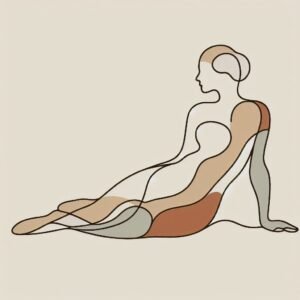
The body has been registering everything — tension accumulated across the day, emotional states that never completed their arc, signals that attention passed over without pausing. The record is accurate. It was never the body’s failing that it went unread. It was attention’s absence.
The record was always there. The scan is how you learn to read it.
KEY TERMS
Somatic Marker Hypothesis
Somatic Marker Hypothesis
Damasio’s theory of how the body participates in emotion and decision-making. Past experiences are stored paired with bodily states — heart rate, muscular tension, visceral sensation — which function as markers influencing judgment and emotional response. The body scan surfaces these markers by directing sustained attention to the regions where they are held.
Bioinformational Theory
Lang’s framework describing emotion as an information network distributed across the whole organism rather than a brain-localized event. Emotional memories encode their somatic context alongside cognitive content. Directed attention during a body scan can access this somatic encoding directly — which accounts for the emotional responses that sometimes arise when attention reaches a particular body region.
Lived Body
Merleau-Ponty’s concept, developed in 1945: the body is not an object possessed by a mind but the medium through which a person inhabits and engages the world. We do not have a body — we are one. As a challenge to Cartesian mind-body separation, this account resonates with what neuroscience and cognitive science have since confirmed about the distributed nature of emotion, cognition, and self-awareness.
MBSR (Mindfulness-Based Stress Reduction)
The program developed by Kabat-Zinn at the University of Massachusetts Medical School in the late 1970s, in which the body scan is a central practice. Originally developed with chronic pain patients around the clinical observation that observing pain as sensory data changes the relationship to it more effectively than resistance does. Since replicated across stress, anxiety, and emotional regulation contexts.
Defusion
A core skill in Acceptance and Commitment Therapy (ACT): the capacity to observe thoughts as passing mental events rather than facts requiring immediate response. When I can’t feel anything or I’m not doing this correctly arrives as a verdict during the scan, recognizing it as a thought rather than an accurate assessment — and returning attention to the next body region — is defusion applied to the self-evaluative response that somatic practice tends to generate. An area where nothing is felt is not a failed observation. It is an accurate one.