
Introduction: You Were Clapping Before You Decided To
A talk ends. A performance finishes. Someone is being celebrated.
And the hands are already moving.
There’s no moment of decision — the applause simply starts, carried by the room, by habit, by something older than conscious choice. Which is fine. The automaticity isn’t the problem.
But what if you were actually there for it — the pressure of the palms meeting, the sound appearing from nothing, the pull of the room’s rhythm on your own — what would that be like?
Today’s practice is about finding out.
Session 1: Why Applause

Clapping has a sensory structure that most everyday actions don’t.
You are the source of the sound.
When listening to music, watching rain, moving through a noisy street — sound arrives from outside. But in the moment of applause, the hands meet and a sound is born, and that sound reaches the ears within fractions of a millisecond. Tactile input and auditory input originate from the same action, simultaneously. The cause and the consequence are both immediately available to the senses.
This is rarer than it sounds. Most of the time, the body acts and the sensory results are delayed, distributed, or ambiguous. Applause collapses that gap entirely.
There’s a second layer in group applause. Anyone who has been in a concert hall or a lecture theater has felt it: the rhythms that start scattered gradually converge, and at some point — without deciding to — the hands are moving in time with everyone else’s. The entrainment happens on its own. This practice is about being conscious while it does.
Session 2: Three Steps
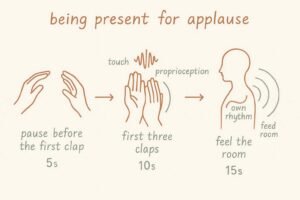
STEP 1: Pause before the first clap (5 seconds)
As the applause is about to begin, catch the moment just before the hands meet. One brief internal shift: I’m going to feel this. Nothing more.
STEP 2: Be fully present for the first three claps (10 seconds)
Open the sensory channels and receive what’s already there.
Touch — the pressure of the palms meeting, the temperature, the exact surface area of contact, the quality of the impact
Sound — the moment the sound appears, its volume and decay, the particular quality of this clap in this space
Proprioception — the arc of the arms, the flex of the wrists, the chain of muscles that produces the rhythm
Not analyzed. Just received.
STEP 3: Feel the relationship between your rhythm and the room’s (15 seconds)
Widen the awareness slightly. Hold both at once — your clapping and the clapping around you. Notice whether your rhythm is pulling toward the room’s rhythm. Feel the moment when they converge, if they do. Stay with the applause as it diminishes, all the way to the last sound and the silence that follows.
Session 3: Why You Find Yourself in Sync Without Deciding To
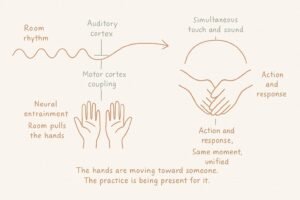
The convergence of individual rhythms during group applause isn’t coordination. Nobody decides to synchronize. It happens through a process called neural entrainment — the tendency of auditory cortex neurons to align their firing patterns with the rhythm of incoming sound.
When the acoustic environment carries a consistent rhythmic pulse, the auditory cortex begins oscillating at that frequency. Through its coupling with the motor cortex, this auditory synchronization progressively influences the timing of motor output — the hands begin tracking the external rhythm without instruction. The entrainment is passive and largely involuntary. The feeling of being pulled into the room’s rhythm, of finding your hands moving in time with everyone else’s without choosing to, is this mechanism operating exactly as it does in every person in the room simultaneously.
The instruction to observe the relationship between your rhythm and the room’s is an invitation to watch this process rather than simply undergo it. The entrainment still happens — it can’t be stopped by observing it — but the quality of the experience changes when it’s being witnessed.
The structure of applause also offers something that most sensory practices don’t. When the hands meet and a sound is produced, that sound arrives at the auditory cortex within a fraction of a millisecond. Tactile and auditory stimulation share the same origin point and the same moment of occurrence. This is what sensory agency refers to in its most direct form: the body acts, the world responds, and the response is received immediately and unambiguously. The medial prefrontal cortex and parietal regions integrate the action, the consequence, and the self-as-cause into a unified experience. Most daily actions distribute these elements across time and space. Applause delivers them simultaneously.
The hands are moving toward someone — toward a performance, a speech, a life event being marked. The sensory practice and the outward gesture are the same action. What is being fully felt is also being given. That coincidence doesn’t need to be named to be noticed.
Conclusion: The Sound Was Always Yours
Once today. Any room where applause happens. First three claps with full attention — then widen to the room, stay until the silence, and let the ending register before moving on.
The applause was always this immediate. Most of the time, the hands were there. The rest of you wasn’t.
The sound was always yours. The hearing of it was the only part that was ever optional.
KEY TERMS
Neural Entrainment
The alignment of auditory cortex firing patterns with an external rhythmic stimulus, and the subsequent influence of that alignment on motor timing. The convergence of individual clapping rhythms in a group setting is a direct expression of this mechanism — passive, involuntary, and operating identically in every person in the room. The neurological explanation for why you find yourself in sync without deciding to be.
Sensory Agency
The experience of the body’s action producing an immediate, unambiguous sensory consequence. In applause, the action and its result — tactile impact and sound — are separated by fractions of a millisecond, making the causal loop between movement and sensation unusually direct. Processed through integration in the medial prefrontal cortex and parietal regions. Rare in daily life in this form.
Multisensory Integration
The brain’s construction of unified experience from simultaneous inputs across multiple sensory modalities — tactile, auditory, and proprioceptive. In applause, these inputs share a single point of origin and a single moment of occurrence, making it an unusually direct instance of co-originating multisensory experience rather than the convergence of separate environmental streams.
Mettā
A Pali term for loving-kindness or goodwill — the orientation of care directed outward toward others. The hands moving toward someone in applause — toward a performance, a moment being honored — carry this gesture in one of its most open and unconstructed forms: a room of people, hands moving outward, together, without needing to name what they’re expressing.
Defusion
A core skill in Acceptance and Commitment Therapy (ACT): the capacity to observe thoughts and impulses as passing mental events rather than facts. When am I clapping right or this feels awkward arrives mid-applause, recognizing it as a thought rather than a verdict — and returning to the sound the hands are making — is defusion in one of its more socially specific forms.