
Introduction: Why Is Doing Nothing So Hard?

Sit down. Don’t check the phone. Don’t organize your thoughts. Don’t try to relax. Don’t try to do this practice correctly.
Just sit.
This turns out to be surprisingly difficult. Within seconds, something arrives — a sense that this is wasteful, or that something should be happening, or a vague unease about simply being here without a purpose. The restlessness isn’t a sign that something is wrong. It’s just what the mind does when the usual demands are briefly removed.
Today’s practice is about sitting with that — knowing what it is — for one minute.
Session 1: Why Non-Doing

Doing nothing is not rest for the brain.
When the focus on external tasks is released, a specific network activates — the default mode network (DMN), comprising the medial prefrontal cortex, posterior cingulate cortex, and precuneus. Once labeled the “mind-wandering circuit,” the DMN is now understood more precisely: it handles self-referential processing, future simulation, social cognition, and the integration of memory and concept — the foundational work underlying creative thought.
The DMN requires time free from task-directed processing to do this work. It exists in an anticorrelation with the task-positive network (TPN), the set of regions that activates during focused external attention. When one is up, the other is suppressed. The persistent feeling that something should be happening — the discomfort of not doing — is the habitual dominance of the TPN resisting the shift.
Sitting for one minute without agenda is practice in noticing that resistance as it happens.
Session 2: Three Permissions
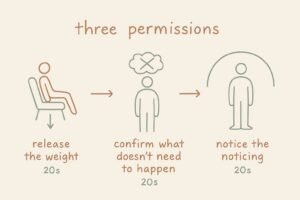
STEP 1: Release the body’s weight (20 seconds)
Sit in a comfortable position and let the body’s full weight settle into the chair and the floor. Not arranging, not adjusting for effect — just confirming the physical fact of being supported. Gravity is doing the work. The body doesn’t need to assist.
STEP 2: Confirm what doesn’t need to happen (20 seconds)
Give explicit permission for the following to not occur:
Thoughts don’t need to be organized
Relaxation doesn’t need to be achieved
Anything in particular doesn’t need to be felt
This practice doesn’t need to be done well
When the impulse to do something arrives — and it will — observe it as an impulse. Not a directive. Just something that arose.
STEP 3: Notice the noticing (20 seconds)
Not the breath, not the body sensations, not the thoughts passing through — but the fact that something is aware of all of these. The knowing that is already present before any particular object of attention is chosen.
Whatever arises, something is already aware that it arose. Rest in that awareness itself, briefly, without making it into a task.
Session 3: Why the Restless Mind Is Not the Problem
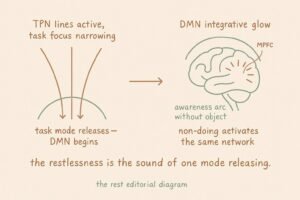
When task-directed attention is released, the DMN activates and begins processing work that was suspended during focused activity: consolidating self-relevant memories, running simulations of future scenarios, processing social information, integrating concepts across domains. This processing is automatic and continuous. The mind that won’t quiet down isn’t failing to rest. It has simply shifted to work that was waiting.
What’s worth noting is that the explicit confirmation that nothing needs to be achieved is not a passive state. When the mind acknowledges relaxation doesn’t need to happen or this doesn’t need to be done correctly, the medial prefrontal cortex is actively engaged in regulatory processing. This is also one of the DMN’s core structures. The intention to not-do and the activation of the DMN’s integrative function share the same neural substrate. The paradox resolves: deliberately creating space for non-doing engages precisely the network that non-doing is meant to activate.
Sati as practiced in breath and body awareness directs attention toward specific objects — a sensation, a movement, a breath. This practice moves to a different layer: awareness without a specific object. Not awareness of the breath, or of a thought, or of a sensation — but the prior fact that awareness is already present, already receiving, before any particular thing is selected for attention. Neuroscientifically, this self-referential metacognitive processing is supported by the interaction between the medial prefrontal cortex and the posterior cingulate cortex — the same structures at the center of the DMN. The network that naturally activates during non-doing is the same network that makes this particular quality of awareness possible. This overlap is not incidental.
The resistance to non-doing — restlessness, guilt, boredom — can be understood as the friction of a transition: the TPN’s habitual dominance encountering the conditions for DMN activation. The instruction to observe the urge to do something as an urge is an invitation to watch this transition in real time. The discomfort isn’t evidence that non-doing is failing. It’s the sound of one mode releasing and another beginning to run.
Conclusion: The Mind Was Already Working

Once today. One minute. Nothing to accomplish. Sit, notice the impulse to do something, and return to the sitting — not because the impulse is wrong, but because the sitting is the practice.
The mind was never not working. The practice is just learning to stop calling that a problem.
The restlessness was never the obstacle. It was the material.
KEY TERMS
Default Mode Network (DMN)
The brain network that activates when focus on external tasks is released, comprising the medial prefrontal cortex, posterior cingulate cortex, and precuneus. Handles self-referential processing, future simulation, social cognition, and cross-domain integration. Not a “mind-wandering circuit” but the brain’s primary integrative system — one that requires time free from task-directed processing to do its work properly.
TPN-DMN Anticorrelation
The inverse relationship between the task-positive network, active during externally focused attention, and the default mode network. When one is up, the other is suppressed. The habitual discomfort of non-doing — the sense that something should be happening — is the TPN’s dominance resisting the shift. Watching the urge to act as an urge, rather than a directive, is observing this anticorrelation in real time.
Metacognitive Awareness
Awareness of the fact that experience is occurring — the knowing that precedes the selection of any particular object of attention. Supported by the interaction between the medial prefrontal cortex and posterior cingulate cortex, which are also the DMN’s central structures. The instruction to notice the noticing is designed to make contact with this layer directly.
Sati — The Objectless Layer
Sati as practiced in breath and body awareness directs attention toward specific objects — a sensation, a movement, a breath. This practice approaches the layer beneath: awareness prior to any object being chosen. Rather than attending to something in particular, the attention rests in the prior fact that awareness is already present. The distinction between object-directed and objectless awareness is foundational to Theravada contemplative practice.
Defusion
A core skill in Acceptance and Commitment Therapy (ACT): the capacity to observe thoughts and impulses as passing mental events rather than facts requiring response. When I should be doing something arrives with the force of obligation, recognizing it as a thought rather than a directive — and returning to the simple physical reality of sitting — is defusion in its most fundamental application.