
Introduction: Why Does the Body Feel Different After a Stretch?
After hours at a desk, or in the first moments of waking — the body asks for a stretch. And after the stretch, something has changed. The shoulders have dropped slightly. The breath has deepened. The body feels, in some way that’s hard to articulate, less like itself from thirty seconds ago.
This isn’t a placebo effect or a change in mood. The nervous system has done something specific.
Today’s practice is about being conscious while it happens.
Session 1: Why Stretching
A stretch is not primarily about elongating muscle tissue. More precisely, it’s an instance of pandiculation — a three-phase sequence of contraction, maximum extension, and release through which the neuromuscular system resets its baseline tension level.
During prolonged static posture, the postural muscles — back, shoulders, neck — maintain a continuous low-level contraction. The muscle spindles embedded in these muscles, which normally report changes in muscle length to the spinal cord for ongoing postural adjustment, begin to register this contracted state as normal. Their sensitivity to further change decreases. The chronic tension becomes, neurologically, the new baseline.
The contraction-extension-release sequence of pandiculation corrects this drift. The prior contraction brings the muscle spindles to peak sensitivity; the subsequent extension generates a stronger neuromuscular feedback signal than passive stretching alone would produce; the release carries a recalibration instruction to the spinal cord. The lightness after a stretch is the body registering a downward revision of its tension baseline — not relaxation, but reset.
Session 2: Three Steps
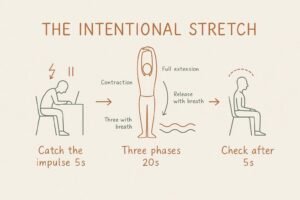
STEP 1: Catch the impulse before acting on it (5 seconds)
When the urge to stretch arrives, pause before moving. The body is signaling that a reset is needed. Acknowledge that before beginning — then start the stretch intentionally rather than automatically.
STEP 2: Follow the three phases (20 seconds)
Move through the stretch slowly enough to track each stage.
Contraction — the gathering of force just before the movement begins, the muscles preparing to extend
Extension — at maximum reach, where is the sensation? The back, the shoulders, the arms — follow it to its edges
Release — the moment the effort lets go, and the breath that follows it, arriving without being invited
Stay with the sequence rather than rushing toward the release.
STEP 3: Check the body after (5 seconds)
Once the stretch is complete, take a moment to compare. Where are the shoulders now relative to where they were? How deep is the breath? The difference between before and after is the record of what the nervous system just did.
Session 3: Why Every Mammal Stretches — and What Actually Happens When You Do
Every mammal stretches. Dogs, cats, primates — the full-body extension that follows rest or prolonged stillness appears across species without being taught. The behavior has been conserved through evolution because it serves a specific neuromuscular function that can’t be replicated by passive rest alone.
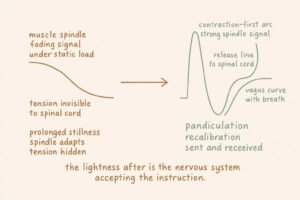
The mechanism centers on the muscle spindle — a mechanoreceptor embedded within muscle fibers that continuously monitors changes in muscle length and reports them to the spinal cord. Under normal conditions, this reporting drives the ongoing postural adjustments that keep the body upright and responsive. Under prolonged static load, however, the spindles adapt: the chronic contraction state is registered as baseline, their sensitivity to further change decreases, and the spinal cord receives progressively less signal from muscles that are in fact chronically tense. The tension becomes invisible to the system that should be regulating it.
Pandiculation addresses this through sequencing. The initial contraction — before extension begins — brings the muscle spindles to maximum sensitivity by actively loading the system before stretching it. This is the critical difference from passive stretching: when a muscle is stretched without prior contraction, the spindle response is comparatively muted. The contraction-first sequence produces a stronger afferent signal during the subsequent extension, and the release phase delivers what amounts to a recalibration instruction to the spinal cord: the tension level that was being maintained is higher than necessary. The lightness and mobility that follow are the felt experience of the nervous system accepting that instruction.
The deep breath that accompanies a full stretch is not incidental. When the thorax reaches maximum extension, pulmonary stretch receptors in the lung tissue activate and send signals via the vagus nerve to the brainstem, promoting parasympathetic engagement. This causal chain runs in the opposite direction from breath-first practices: where deliberate breathing shifts neural state directly, here body movement induces a breathing pattern, and that breathing pattern shifts neural state. The pathway is the same — the direction reverses. Following the release and the breath that follows it is the invitation to be present for this chain as it unfolds.
The body check after the stretch is the interoceptive registration of the new baseline. The difference between the pre-stretch and post-stretch body state — shoulders lower, breath deeper, the specific quality of reduced muscular holding — is not an impression. It is the felt record of a spinal recalibration. The body did the work, and awareness arrives to confirm it.
Conclusion: The Body Already Knew

Once today. One stretch, from the impulse through to the check afterward. Catch it, follow the three phases, and stay long enough to register what changed — because that difference is the point, not the stretch itself.
The tension was invisible because the system had accepted it as normal. The stretch was the one thing that could tell it otherwise.
KEY TERMS
Pandiculation
The three-phase neuromuscular sequence — contraction, maximum extension, release — through which the body resets its resting tension baseline. Distinguished from passive stretching by the prior contraction, which brings muscle spindles to peak sensitivity and generates a stronger recalibration signal during extension. The mechanism behind the lightness that follows a full stretch, and the reason the behavior has been conserved across mammalian species.
Muscle Spindle Recalibration
Muscle spindles are mechanoreceptors embedded in muscle fibers that monitor and report length changes to the spinal cord. Prolonged static posture reduces their sensitivity as chronic tension is registered as normal baseline. The contraction-extension-release sequence of pandiculation resets this registration, instructing the spinal cord to revise the maintained tension level downward.
Vagal Pathway
The parasympathetic signaling route running from the brainstem through the heart, lungs, and abdomen via the vagus nerve. During a full stretch, pulmonary stretch receptors activated by thoracic expansion send vagal signals promoting parasympathetic engagement. The causal chain here runs opposite to breath-first practices: body movement induces thoracic expansion, thoracic expansion activates pulmonary stretch receptors, and those receptors send vagal signals that shift neural state toward parasympathetic dominance.
Interoception
The perception of the body’s internal state — muscle tension, breath depth, temperature, the quality of physical holding or release. The body check after the stretch is an interoceptive act: consciously registering the post-pandiculation baseline as distinct from the pre-stretch state, making the nervous system’s recalibration available to awareness.
Defusion
A core skill in Acceptance and Commitment Therapy (ACT): the capacity to observe thoughts and impulses as passing mental events rather than facts. When I should get back to work arrives mid-stretch, recognizing it as a thought rather than an obligation — and staying with the extension for its full duration — is defusion applied to the specific impatience of productivity culture.