
Introduction: Have You Ever Glanced at a Clock and Watched the Second Hand Freeze?
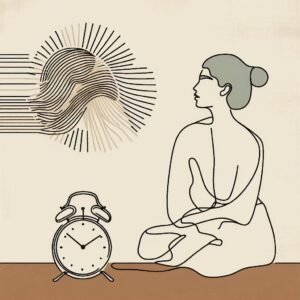
You look at an analog clock, and for a moment — just a moment — the second hand appears to stop. Then it moves again, normally, as if nothing happened.
This isn’t a trick of tired eyes. It’s the brain adjusting its experience of time at the moment attention shifts. And it happens to almost everyone, almost every time they look at a clock for the first time in a while.
The ticking has been there all along. Today’s practice is about actually arriving where it is.
Session 1: Why the Clock

Clock ticks are among the most completely predictable sounds in a human environment. One per second, without exception, without variation. No surprise, no irregularity, nothing to monitor for.
This complete predictability has a specific effect on the attentional system. Unpredictable stimuli pull attention outward — the system needs to stay alert because something unexpected might arrive. Fully predictable stimuli release that monitoring function. When the attentional system no longer needs to watch for what’s coming next, attention becomes available to move inward rather than outward. The clock doesn’t demand anything. That’s precisely what makes it useful.
At the same time, research on time perception shows that a second isn’t always experienced as the same length. The more attentional resources directed toward a given interval, the longer that interval is perceived to last. A second you’re fully present for is a different experience from a second you passed through on the way to something else. Following a single tick from onset through silence is designed to make that difference apparent.
Session 2: Three Steps
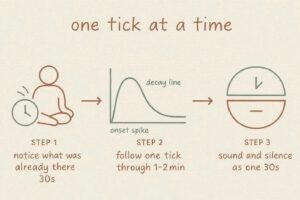
STEP 1: Find the sound that was already there (30 seconds)
Settle into a comfortable position near the clock. Close the eyes lightly. Rather than beginning to listen, simply notice that the sound is already present — it has been the whole time. The shift is not from silence to sound. It’s from not-noticing to noticing.
STEP 2: Follow one tick all the way through (1–2 minutes)
Take a single tick and stay with its complete arc.
The onset — the sharpness of the initial sound, the exact moment it appears
The decay — the way it spreads and thins in the air, becoming less until it’s gone
The silence — the space between this tick and the next, which has its own quality
Don’t move to the next tick until this one has fully resolved. One at a time.
STEP 3: Hold both the sound and the silence (30 seconds)
Widen the awareness slightly. Receive the tick and the silence as a single continuous experience rather than two alternating events. The sound defines the silence. The silence defines the sound. Neither exists independently of the other.
Stay with this for the remaining time without trying to analyze it.
Session 3: Why the Second Hand Froze — and What That Reveals About Time
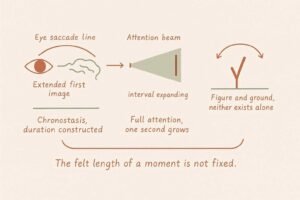
The frozen second hand has a name: chronostasis — from the Greek for time and standing still.
When the eyes move to a new target, there is a brief period during which visual processing is suppressed — the brain discards the blurred input generated by the eye movement itself. To paper over this gap in perception, the brain extends the duration of the first clear image it receives after the movement completes, effectively backdating it to fill the missing time. The result is that the first thing seen after a saccade appears to last slightly longer than it actually does. A stationary second hand, encountered at the moment of a gaze shift, is held in perception for longer than one second — which is experienced as the hand pausing before continuing.
This is worth knowing not just as a curiosity. Chronostasis is evidence that the duration of experience is not fixed. The brain constructs the felt length of a moment based on available processing resources, attentional state, and the need to maintain perceptual continuity. The same objective interval can be experienced as longer or shorter depending on how attention is engaged with it.
The attentional theory of timing formalizes this. According to this framework, the subjective duration of a time interval increases with the proportion of attentional resources devoted to it. When attention is divided — when part of the mind is somewhere else — less processing capacity is available for temporal tracking, and the interval is experienced as shorter. When attention is fully directed at a single stimulus across a brief interval, that interval expands. Following a single tick from onset through decay and into silence is the deliberate application of this principle: full attentional presence, one second at a time.
The complete predictability of clock ticks enables this in a way that less regular sounds cannot. Irregular or unpredictable sounds keep a portion of the attentional system in surveillance mode — something might need to be responded to, so monitoring must continue. A sound that arrives with perfect regularity releases this surveillance function. The attentional resources that would otherwise be spent watching for the unexpected become available for depth of engagement with what is already known to be coming. This is a different mechanism from habituation-based sensory gating, where repeated stimuli are suppressed through reduced transmission. Here, predictability doesn’t suppress the signal — it frees the attention to receive it more fully.
The observation that sound and silence define each other has a formal basis in perceptual psychology. Gestalt psychology’s figure-ground principle holds that perception is relational — a figure is only perceived as such against a ground, and the ground is only constituted as such by the presence of a figure. In auditory experience, each tick is figure; the silence surrounding it is ground. But the relationship is bidirectional: the silence is only perceptible as silence because the tick has established what sound is in this environment. Remove either element and the other loses its definition. They are not two things alternating. They are one thing with two aspects.
Conclusion: The Second Was Always This Long

Once today. Two minutes, a clock, and nothing else required. Find the sound, follow one tick from onset through silence, and stay with the stillness after — long enough to notice that the next tick, when it arrives, lands differently than the first one did.
The tick was always one second. What changes is how long one second can last.
KEY TERMS
Chronostasis
The perceptual phenomenon in which the first stimulus encountered after a shift in attention appears to last longer than it objectively does. Most commonly experienced when glancing at an analog clock and seeing the second hand appear to pause. The brain extends the duration of the first clear post-saccade image to fill the gap created by suppressed processing during the eye movement. Evidence that the felt duration of experience is constructed, not simply recorded.
Attentional Theory of Timing
The psychological framework holding that the subjective duration of a time interval increases with the attentional resources devoted to it. Divided attention compresses experienced time; full attentional presence expands it. The theoretical basis for following a single tick with complete attention — and the explanation for why one consciously attended second feels longer than one passed through automatically.
Predictability and Attentional Release
Fully predictable stimuli release the attentional system’s external surveillance function — no monitoring is required when what’s coming is already known. This frees attentional resources for depth of engagement rather than breadth of scanning. Distinct from habituation-based sensory suppression, where repeated stimuli are dampened at the transmission level: here the signal is not reduced, the attention is freed to receive it more fully.
Figure and Ground (Gestalt Perception)
The perceptual principle that a stimulus is only perceived in relation to its background — figure requires ground, ground requires figure. In auditory experience, each tick and the silence surrounding it are mutually constituting: neither has its perceptual character independently of the other. The instruction to hold sound and silence as a single experience rather than two alternating ones is the application of this principle in practice.
Defusion
A core skill in Acceptance and Commitment Therapy (ACT): the capacity to observe thoughts and impulses as passing mental events rather than verdicts. When this is boring or I don’t have a clock like this arrives as a thought, recognizing it as a thought rather than a verdict — and returning to the next tick — is defusion applied to the specific restlessness of directed, unhurried attention.