
Introduction: Why Managing Time Makes It Feel Scarcer

The calendar fills in fifteen-minute increments. The to-do app sends the next reminder. The timer marks the end of another focus block. The effort to use time fully produces, somehow, a sharper sense of never having enough.
The tools were supposed to create more time. In many cases, they create a different kind of pressure. That pressure has a structural origin that exists independently of how the tools are used.
Session 1: The Management That Produces the Need for More Management

The compulsion to manage time more effectively does not come from weak willpower or poor self-discipline. The tools themselves, and the cultural context they arrive in, structurally produce the feeling of scarcity they promise to address.
Time management tools carry a premise: time is a resource to be managed. Once that premise is accepted, time that isn’t allocated to a task — the unfocused afternoon, the purposeless walk, the hour with no agenda — registers as underutilized. Rest is no longer recovery. It becomes a reduction in output, accompanied by the low-grade guilt of resource waste.
The tools also install a habit of self-surveillance. How many minutes did each task take? What percentage of the goal was reached? This continuous stream of measurement creates the habit of observing one’s own time use from the outside — and once that habit is in place, the experience of time begins to change. The question what am I doing right now gets replaced by what should I be doing right now, and the present moment is processed as a means to a future metric rather than something being lived.
The cycle is self-reinforcing: the more time is managed, the more management seems necessary. The origin of that cycle is not personal.
Session 2: Practice — Moving from Managed to Present
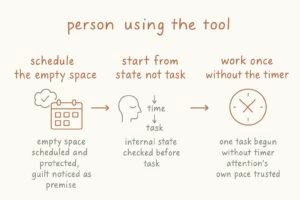
This practice is not about abandoning time management tools. It is about recovering the position of the person who uses them — rather than the person who is used by them.
STEP 1: Schedule the Empty Space
Once a day, or once a week, block fifteen to thirty minutes in the calendar with nothing assigned to them — treated with the same commitment as any other appointment.
The single rule for this time: nothing productive. Looking out the window. Sitting without direction. Walking without a destination. When guilt arrives during this time, that is the premise — time must be used — announcing itself. Noticing the guilt is enough to create a small distance from the premise that generated it.
STEP 2: Start from State, Not Task
Before opening the to-do list, pause to check the current internal state.
What do I actually need right now — focused work, recovery, something creative, or connection with someone?
Identify the state first, then allocate the time around it, then find the task that fits. When the sequence moves from state to time to task — rather than task to time — the tool stops functioning as a surveillance list and starts functioning as something that supports the person using it.
STEP 3: Work Once Without the Timer
This one will feel uncomfortable at first — the absence of a timer can register as the absence of structure. Choose one task today and begin it without setting a timer. Before starting, ask the body once: am I in a state to enter this naturally? When focus breaks, take a rest without waiting for a signal — and during that rest, measure nothing.
This practice reduces dependence on external rhythm and begins, incrementally, to restore trust in the attention’s own pace.
Session 3: The Tools Were Selling the Shortage
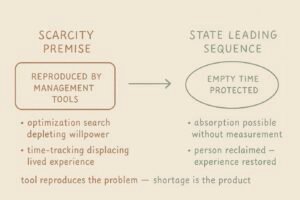
The Manufacture of Not Enough
Sociologist Juliet Schor’s analysis of time poverty — the chronic sense of insufficient time that persists regardless of how much time is actually available — traces its origins to two simultaneous developments: the extension of working hours and the commodification of leisure. As leisure was absorbed into consumer markets — entertainment, self-improvement, wellness — rest was redefined from the absence of work into time that should be correctly spent. The time management industry emerged within this context. Its tools present themselves as solutions to the problem of time scarcity. But by reinforcing the premise that time is a resource requiring active management, they reproduce the condition they claim to address. Each new system confirms that time, left unmanaged, will be wasted. The feeling of scarcity that drives people toward management tools is not incidental to the tools’ design. It is the precondition for their continued use.
The Search for Optimization That Exhausted the Optimizer
Psychologist Barry Schwartz’s paradox of choice describes the phenomenon in which an increase in available options produces not greater satisfaction but decision fatigue and reduced confidence in whatever choice is made. In the domain of time management, this paradox takes a specific form. GTD, time blocking, the Pomodoro technique, energy management frameworks — the search for the optimal approach consumes the willpower that the approach was intended to preserve. Adopting a system doesn’t resolve the search; the sense that a better method might exist persists alongside the commitment to the current one. And when the chosen system is not followed consistently, the gap becomes evidence of self-management failure rather than a neutral observation. The willpower required for effective time management is depleted by the process of selecting and evaluating time management systems. The problem is not which tool to choose. It is the pursuit of optimization as a goal.
When Measuring Replaced the Experience
There is a cost to self-monitoring that doesn’t appear in productivity metrics. Cognitive science research on metacognitive load shows that observing and evaluating one’s own behavior is itself a resource-consuming process. When time is tracked and recorded during a task, a portion of attentional capacity is continuously directed toward the act of recording rather than the task itself. The resulting split is structural: full absorption in the work becomes difficult to sustain when part of attention is occupied by its own measurement. The parallel to chronic health monitoring is direct: just as tracking biometric data displaced interoceptive experience with quantified proxies, chronic time-tracking displaces the lived texture of time — its flow, density, and quality — with numerical representations of it. The more rigorously time is measured, the harder it becomes to be inside the time being measured. The tools make time visible. When that visibility replaces the experience of time, management produces poverty rather than abundance.
Conclusion: The Experience Was Never in the Metric

Schor’s time poverty structure will keep operating tomorrow. The paradox of choice will keep depleting willpower with each new system considered. Self-monitoring costs will keep redirecting attention away from experience and toward its measurement. The structure does not change.
But the question am I inside this time or managing it from outside can be asked before any calendar is opened, before any timer is set. The unscheduled fifteen minutes — time that belongs to no metric — is where management’s logic doesn’t reach. Standing in that space, even briefly, is the nearest available entrance back into time as something lived rather than administered.
The tools were never managing your time. They were managing your sense of your own worth.
KEY TERMS
Time Poverty
Juliet Schor’s term for the chronic sense of insufficient time that persists independently of actual time available — produced by the simultaneous extension of working hours and the commodification of leisure. As rest was absorbed into consumer markets and redefined as time requiring correct use, time management tools emerged as solutions that reinforce the scarcity premise they claim to address. Time management compulsion reframed as a structural output of an industry that requires the feeling of shortage to sustain itself.
Paradox of Choice
Barry Schwartz’s finding that increasing the number of available options produces decision fatigue and reduces post-choice satisfaction. In time management, the search for the optimal system consumes the willpower the system was meant to preserve — while the persistent sense that a better method exists undermines confidence in whatever approach has been adopted. The willpower required for effective management is depleted by the process of selecting between management approaches.
Self-Monitoring Cost
The cognitive science finding that observing and evaluating one’s own behavior is itself a resource-consuming metacognitive process. When time is tracked during a task, attention is structurally divided between the work and the act of recording it, making full absorption difficult to sustain. Paralleling the displacement produced by chronic health monitoring, time-tracking replaces the lived texture of time — its flow, density, and quality — with numerical proxies. Managing time more rigorously makes it harder to be present within the time being managed.
Commodification of Leisure
The historical process through which leisure was absorbed into consumer markets — entertainment, self-improvement, wellness — and redefined from the absence of work into time requiring correct expenditure. Distinct from the moral pressure to be productive or the clock-time discipline that industrialization installed in the body: what operates here is the reframing of rest as a consumption category, providing the cultural foundation on which time poverty and the time management industry both depend.
Defusion
The capacity to notice that the premise — time must be used productively — has fused with one’s experience of unscheduled time, generating guilt as its automatic signal. Recognizing the guilt as the premise announcing itself, rather than as an accurate assessment of the time being wasted, creates the observational distance in which a different relationship to the empty hour becomes available.