
Introduction: Stopping at the Search for a Right Answer
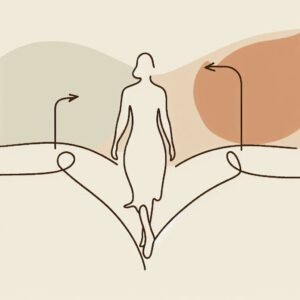
A factory that keeps local jobs is also polluting the water. A convenient, affordable service runs on precarious labor behind the scenes. A conversation with family turns political, and there is no way to say what you actually think without something breaking.
We encounter situations with no fully good option repeatedly. Whatever is chosen damages something, and the guilt stays. In the face of this, thinking stops.
The stopping is not a failure of will. It is not a failure of moral seriousness.
Session 1: The Paralysis Was Not a Sign of Failure

When an ethical dilemma produces the inability to move, a specific cognitive structure is operating.
Faced with a difficult choice, the search begins for an answer that is fully right, harmful to no one, and consistent with every value that matters. This search is a form of honesty. But in most real dilemmas, no such answer exists. Environmental protection and employment, individual freedom and community stability, honesty and the preservation of a relationship — these have a structure in which choosing one means partially sacrificing another.
The experience of there being no right answer is not a failure of sufficient thought. It is accurate recognition that genuinely legitimate values are in collision.
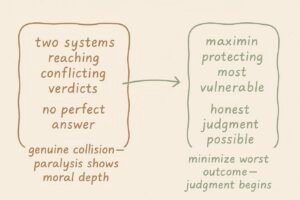
And this collision is happening literally inside the brain. When the system that responds with immediate moral feeling — this is wrong, this cannot be right — and the system that calculates consequences analytically reach different conclusions about the same situation, thinking enters a state of deadlock. Paralysis is not a character problem. It is what happens when two judgment systems are operating simultaneously and arriving at incompatible verdicts.
Session 2: Practice — Designing a Process for Choosing the Lesser Harm

This practice is not about finding the perfect answer. It is about building a process that moves judgment forward when paralysis has set in.
STEP 1: Replace “Find the Right Answer” With “Map the Impacts”
Begin by putting what is in the head onto paper. Write out every available option — not just Option A and Option B, but decide nothing for now and look for an entirely different route as well. For each, consider the impacts across four rings: yourself, the people directly involved, the wider community, and longer-term effects.
Every option causes some harm. The question shifts from “which option harms no one” to “where does the harm land, and how much.”
This shift alone moves thinking from the paralysis of there is no perfect answer toward the traction of there are options that can be compared.
STEP 2: Make “Who Bears the Most” the Central Question
When comparing options, place one question at the center:
Who is most affected by this choice — and which option minimizes the harm to that person or group?
Maximizing all values simultaneously is not possible. But minimize the impact on those least able to bear it is a criterion that functions even when values are in direct conflict. When the option this criterion points toward and the option most convenient for you are different, recognizing that gap honestly is where genuine judgment begins.
STEP 3: Add Reversibility as the Final Check
When a judgment is beginning to form, confirm one last thing:
If I later discover I was wrong — can this be corrected?
No choice is perfect. But a choice that allows for correction and a choice that forecloses it are different. Adding reversibility as a criterion reframes the choice from an absolute endpoint to one step in a continuing process. The fear of regret diminishes not because mistakes become impossible, but because the possibility of returning and adjusting is already built into the decision.
Session 3: Why There Is No Clean Answer — and What to Do With That
The Conflict Was a Feature of the Society, Not a Failure of Thinking
Political philosopher Isaiah Berlin’s value pluralism argued that liberty, equality, community, and individual rights are genuinely incommensurable — they cannot be reduced to each other or traded off on a single scale. Each is legitimate. None can be converted into another. When they collide in specific situations, a solution that fully satisfies all of them is not merely difficult to find — it does not exist in principle. What Berlin identified is that ethical dilemmas do not arise from insufficient thinking. They are a structural feature of any society in which multiple legitimate values coexist. The experience of there being no right answer is not a signal of failed reasoning. It is accurate perception of a genuine collision between values that each have real claims. This recognition is not a justification for paralysis. It is the release from the impossible demand of finding a perfect answer — which is the first thing required before judgment can actually begin.
Two Systems Were Reaching Different Verdicts Simultaneously
Neuroscientist Joshua Greene’s moral dual-process theory demonstrated that ethical judgment involves genuine neural competition between two distinct systems. The emotional and intuitive system, centered in the limbic regions, generates immediate moral responses — this is wrong, this cannot be permitted. The analytical and utilitarian system, centered in the prefrontal cortex, calculates the scale of consequences, probabilities, and longer-term effects. Greene’s research showed that when these systems reach different conclusions about the same situation, thinking enters a state of active competition rather than convergence. Paralysis in the face of an ethical dilemma is not weakness of will. It is what occurs when two judgment systems — both operating for legitimate reasons — are simultaneously producing incompatible verdicts. The paralysis is, in a specific sense, evidence of moral seriousness: both the immediate feeling that something matters and the analytical awareness of complexity are being registered at the same time.
A Different Question Unlocked the Judgment
Philosopher John Rawls’s maximin principle proposed that under conditions of uncertainty and competing values, the appropriate decision criterion is to minimize the worst outcome for the most disadvantaged position — to ask not which option produces the best overall result, but which option best protects those who can least afford to bear the cost. This is structurally different from the perfectionist demand that all values be satisfied simultaneously. When every available option causes some harm, the question changes from which option harms no one to which option minimizes harm to those who are most vulnerable to it. This criterion provides a shared reference point for both the emotional and analytical systems — it engages the moral feeling that the vulnerable deserve protection and the analytical concern with the actual distribution of consequences. Choosing the lesser harm under these conditions is not a compromise or a moral failure. It is the most honest form of judgment available when values that are each legitimate cannot all be honored at once.
Conclusion: The Paralysis Was Evidence of Honesty

Values will keep colliding. The brain’s two systems will keep reaching different verdicts on the same situation. Perfect answers will remain unavailable. The structure does not change.
But the question which option minimizes harm to those least able to bear it? can be brought into any dilemma, before the search for a perfect answer begins. When that question is in the room, the paralysis shifts into a process.
There was never a clean answer. There was only the most honest reading of what mattered most — and the question of who could least afford to bear the cost.
KEY TERMS
Value Pluralism
Isaiah Berlin’s argument that liberty, equality, community, and individual rights are genuinely incommensurable — none can be reduced to or traded for another on a single scale. Ethical dilemmas are not the product of insufficient thinking; they are a structural feature of any society where multiple legitimate values coexist. The experience of no right answer is accurate perception, not failed reasoning.
Moral Dual-Process Theory
Joshua Greene’s neuroscience research demonstrating that ethical judgment involves genuine competition between an emotional-intuitive system and an analytical-utilitarian system in the brain. When these systems reach different verdicts on the same situation, the result is paralysis — not weakness of will, but two legitimate systems operating simultaneously and arriving at incompatible conclusions.
Maximin Principle
John Rawls’s decision criterion for conditions of uncertainty and competing values: minimize the worst outcome for the most disadvantaged position. Shifts the question from which option satisfies all values to which option best protects those least able to bear the cost. The philosophical basis for choosing the lesser harm without treating that choice as moral failure.
Ethical Paralysis
The state in which judgment stops in the face of competing legitimate values, produced by the compound effect of perfectionist demands and the neural competition between dual processing systems. Not a failure of moral seriousness — in fact, evidence of it. The condition that the maximin principle and reversibility criterion are designed to move through.
Reversibility
The criterion of whether a choice, if later found to be mistaken, can be corrected and adjusted. Reframes decisions from absolute endpoints to steps in a continuing process. Does not eliminate the possibility of error — rather, it builds the capacity for correction into the decision itself, reducing the paralysis that comes from treating each choice as final and irrevocable.