
Introduction: The Intensity of the Reaction Is Not About Them

Just thinking about that person tightens something in the chest. Being in the same room is draining. Every time they speak in a meeting, something catches.
Explaining this as they’re just that kind of person is natural. Psychology questions that explanation.
The same individual produces a strong reaction in one person and almost none in another. Where does that difference come from? The intensity of a reaction reflects not the objective size of the other person’s behavior problem, but what is being activated internally. The feeling a difficult person triggers is information about you before it is information about them.
Session 1: Emotions Carry Information

Emotion psychologist Norbert Schwarz proposed what he called the affect-as-information framework: emotions are not simply reactions but a form of internal signal processing. They indicate that something matters, that something is threatened, that something has been violated.
A strong reaction to a difficult person, seen through this lens, contains information. Intense anger at unfairness reflects how deeply fairness is valued. Strong pain at being ignored reflects that recognition is a genuine need. Sharp resistance to controlling behavior reflects that autonomy matters. The intensity of the reaction points to what you care about — not to how bad the other person is.
This reframe is what makes it possible to treat the reaction as an object of observation rather than a verdict to act on.
Session 2: Three Steps
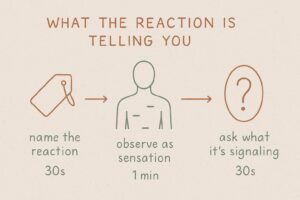
Begin when a difficult person comes to mind, or after an interaction that left something unresolved.
STEP 1: Notice the reaction and name it (30 seconds)
Register what emotion is present, without entering its content.
Anger is here.
Anxiety is here.
A sense of being dismissed is here.
Identify what kind of feeling it is. That’s the whole of this step.
STEP 2: Observe the reaction as body sensation (1 minute)
Locate where the emotion is in the body and what it actually feels like.
Heat or constriction in the chest.
Tension in the abdomen.
Tightness in the shoulders or jaw.
Sensation in the hands or feet.
Don’t try to change the sensation. Confirm what is actually there, as specifically as possible.
STEP 3: Ask what the reaction is pointing to (30 seconds)
With curiosity rather than judgment, hold the question:
What feels threatened here?
What matters enough that this is catching?
An answer isn’t required. Holding the question changes the relationship to the reaction — from something happening to you to something telling you something.
Session 3: The Fundamental Attribution Error, Affect as Information, and Why Sequence Matters for Mettā Practice
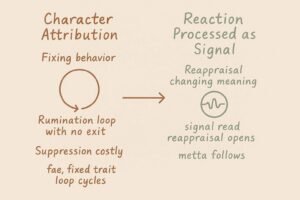
The reason reactions to difficult people are draining, and the reason that can change, has a cognitive psychology explanation.
Social psychologist Lee Ross named the fundamental attribution error in 1977: the universal tendency to explain other people’s behavior by attributing it to their character or personality while underweighting situational factors. That person is selfish. That person is aggressive. These explanations extract behavior from its context and fix it as a stable personality trait. The mechanism by which this produces sustained drain is specific: once behavior is attributed to fixed character, the situation is framed as unchangeable, and available responses narrow to endure or avoid. More significantly, character attribution fuels rumination. *Why is that person like that* is a question structured to have no answer — which is why it keeps cycling. The thought loop isn’t irrational. It is the predictable consequence of a framing that forecloses resolution. Ross’s work has been extended and replicated extensively; Daniel Kahneman’s treatment of it in Thinking, Fast and Slow remains one of the most accessible accounts of how this bias operates in everyday judgment.
Norbert Schwarz’s affect-as-information framework offers a different entry point into the same situation. Rather than asking what is wrong with that person, the question becomes what is this reaction signaling about my own internal state. This reframing is not merely a cognitive reframe — it changes what the emotion is used for. James Gross’s research on emotion regulation distinguishes between reappraisal and suppression as two fundamentally different strategies. Suppression holds the emotion down while internal processing continues — costly in cognitive resources, and associated with worse long-term outcomes. Reappraisal changes the meaning assigned to the emotional situation, altering the processing itself at an earlier stage — less costly, more durable, and associated with better emotional outcomes across a range of contexts. The question in STEP 3 — what is being activated here — is a reappraisal entry point. It shifts the meaning of the reaction from evidence of their fault to signal about my values and needs, which changes what the emotion is doing rather than simply suppressing what it is expressing.
Mettā — directing friendly intention toward another person — encounters its strongest resistance when directed at someone toward whom strong negative emotion is present. That resistance is understandable and is not a failure of practice. But research on compassion and loving-kindness practice consistently suggests that attempting to direct Mettā toward someone while the negative emotion remains unprocessed tends to produce either suppression or performance rather than genuine orientation. The sequence that works is: observe the emotion as an object, process what it is signaling, and then — from that slightly different position — direct Mettā. Not Mettā imposed over an unprocessed reaction, but Mettā offered after the reaction has been received and read. This guide is the preparation for that next step. The observation is not a detour. It is the precondition.
Conclusion: The Reaction Is Data. Read It Before Spending It

Next time a difficult person produces a strong reaction — before analyzing them, observe yourself.
What emotion is here. Where it is in the body. What it might be pointing to.
That reading changes what the reaction costs.
The reaction was always about something in you. The difficult person just happened to find it.
KEY TERMS
Fundamental Attribution Error
Lee Ross’s term for the universal tendency to explain others’ behavior through character or personality while underweighting situational factors. They’re just that kind of person closes the possibility of change, narrows available responses to endurance or avoidance, and sustains rumination by framing questions that have no available answers. One of the primary mechanisms by which difficult relationships produce sustained cognitive drain. Daniel Kahneman’s Thinking, Fast and Slow offers an accessible account of how this bias operates.
Affect as Information
Norbert Schwarz’s framework treating emotions as internal signals rather than reactions — indicators that something matters, is threatened, or has been violated. A strong reaction to a difficult person reflects what you value and what you need, not only what they did. Reframing the emotion as information about the self rather than evidence about the other person changes what the emotion is used for — from fuel for attribution to data for self-understanding.
Reappraisal vs. Suppression
James Gross’s distinction between two emotion regulation strategies. Suppression holds the emotion down while internal processing continues — cognitively costly and associated with worse long-term outcomes. Reappraisal changes the meaning assigned to the emotional situation at an earlier processing stage — less costly, more durable, and associated with better emotional outcomes. The question what is this reaction pointing to is a reappraisal entry point: it changes what the emotion means rather than suppressing what it expresses.
The Sequence That Enables Mettā
Research on loving-kindness and compassion practice indicates that directing Mettā toward someone while strong negative emotion remains unprocessed tends to produce suppression or performance rather than genuine orientation. The effective sequence is: observe the emotion as an object, process what it signals, then direct Mettā from that slightly different position. Observation is not a detour around the practice. It is the precondition for it.
Defusion
See Guide 5. When that person is genuinely the problem or my reaction is completely justified so there’s nothing to observe arrives as a conclusion, recognizing it as a thought rather than a closed case — and returning attention to the body sensation in STEP 2 — is defusion applied to the attribution thinking that difficult relationships consistently generate.