
Introduction: There Are Two Reasons It Lands This Way

“When are you getting married?” “Is that job really going to work out?” “You need to get it together.”
A friend could say the same words and it wouldn’t stay with you. From a parent, it sits in the chest for days.
This is not because you are unusually sensitive, or because the relationship is uniquely broken. There are neurological reasons why a parent’s words arrive through a different circuit than anyone else’s. And the place where those words land contains information — about what you value, and what you already know about yourself.
The goal is not to stop the reaction. It is to understand its structure well enough that the words lose their grip — long after the conversation has ended.
Session 1: Why This Voice Carries More Weight
When a parent’s words land hard, two things are usually happening at once — and they are easy to confuse for one.
The first is the circuit through which the words travel. The bond between a child and its primary caregiver is not simply emotional — it is survival architecture. A caregiver’s approval registered as safety; their disappointment registered as threat. That circuit was built first, and built deeper than any that came after. In adulthood, it remains structurally intact. A colleague’s skepticism about your choices reaches you through a different pathway than a parent’s — not because the colleague matters less, but because the parent’s voice was the first voice the nervous system learned to read for signs of danger.
The second is where the words land. When a parent’s question stings — is that job really going to work out — part of what is being touched is something you already know matters to you. The reaction is not only old circuitry firing. It is also a value being named, and resisting the naming. The place where the words sting is often the place where you already know what you stand for.
Both layers arrive simultaneously. The practice here is learning to tell them apart.
Session 2: Observing the Reaction
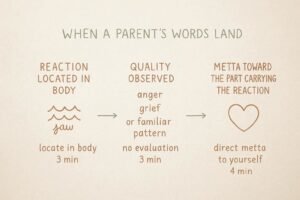
In the moments after a parent’s words have landed — or when they keep returning hours later — the first move is to stop treating the reaction as a problem to be solved.
STEP 1: Locate the reaction in the body (3 minutes)
When the words arrived, something happened somewhere in the body.
A tightening in the chest.
A cold drop in the stomach.
Something closing in the throat.
Tension moving into the jaw or shoulders.
No need to name it precisely. Just confirm: there is a reaction, and it is here.
STEP 2: Observe the quality of the reaction (3 minutes)
Notice whether the quality is closer to anger, or to something more like grief, or to the specific exhaustion of a pattern that has repeated many times.
There is no correct answer. The task is simply to observe what is actually present — without evaluating it, without explaining it, without trying to move it anywhere.
STEP 3: Direct Mettā toward yourself (4 minutes)
From that position of observation, direct quiet intention toward the part of you that is carrying the reaction.
This reaction is happening naturally.
There is someone here who is hurt.
May this pain settle, in its own time.
The intention is the practice. Nothing more is being asked.
Session 3: Attachment Theory, Intergenerational Transmission, and What the Sting Is Protecting
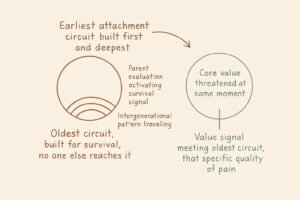
The question is not why you reacted — it is why this person’s words produced a reaction that no one else’s quite reaches. Developmental psychology, family therapy, and moral psychology each have an answer. Together, they explain not just the intensity but the specific quality of what lands.
The central observation of attachment theory, developed by John Bowlby and extended empirically by Mary Ainsworth, is that the bond between an infant and its primary caregiver is not merely emotional — it is survival architecture. A caregiver’s approval signals safety; a caregiver’s disappointment signals threat. What Ainsworth’s research demonstrated is that these early attachment experiences become encoded as an internal working model — a template for what to expect from oneself and from others — that persists in the nervous system long after childhood has ended. In adulthood, evaluations from the original attachment figure continue to be processed with a weight that no one else’s evaluation can fully replicate. This is not a failure of maturation. It is the structure of the earliest neural circuitry. When a parent asks “Is that job really going to work out?” and the question lands harder than the same words from a colleague, it is not because you are more fragile in that relationship. It is because the circuit that receives that signal was built first, and built deeper.
Family therapy has documented a parallel phenomenon under the name intergenerational transmission — the observation that emotional communication patterns move across generations. The words a parent directs toward a child, particularly those that take the form of criticism or expectation, are frequently repetitions of patterns the parent themselves received. Murray Bowen’s family systems theory showed that emotional reactivity transmits across family lines in ways that neither generation fully chooses. The parent who says “you need to get it together” may be passing on, with little awareness, the exact pressure that was once applied to them. This does not neutralize the words. But it does open a view: what arrived at you may have been traveling for longer than one lifetime. The pain at the end of the chain is real. So is the length of the chain.
There is a third layer. Social psychologist Jonathan Haidt’s work in moral psychology showed that emotions like anger and hurt function as a detection system for violations of what we value. We are designed to produce strong emotional responses when something we care about is threatened — and the intensity of the response is proportional to how much the value matters. If “is that job really going to work out?” lands with particular force, it is partly because you have already committed to something that matters to you, and that commitment is real. The place where the words sting is the place where you already know what you stand for. When both circuits fire at once — the oldest signal in the nervous system meeting a core value — the result is the particular quality of pain that a parent’s words can produce, and that almost no one else’s can.
Conclusion: What the Reaction Carries

The reaction to a parent’s words is not weakness to be managed. It is two pieces of information arriving at once: the history of the circuit through which those words travel, and the value they happened to touch on the way through.
When the words come again — locate the reaction in the body, and direct Mettā toward it. Not to dissolve it. To acknowledge what it is carrying.
From there, when it becomes possible, Mettā can extend toward the person who sent the words — someone who was also, once, on the receiving end of words like these.
The words came from someone who was also once a child, learning what love was supposed to sound like.
KEY TERMS
Attachment Theory
Developed by John Bowlby and extended empirically by Mary Ainsworth. The bond between infant and primary caregiver is encoded as survival architecture — the caregiver’s approval signals safety, their disappointment signals threat. These early experiences form an internal working model that persists into adulthood. Evaluations from the original attachment figure continue to carry a weight that no one else’s can fully replicate. The depth at which a parent’s words land is a function of this structure, not of fragility.
Internal Working Model
Bowlby’s term for the template — formed through early attachment experience — that organizes expectations of self and others. Operating largely outside awareness, it continues to shape emotional responses in adult relationships, particularly with parents. The question *am I acceptable?* was first answered in this relationship — and the nervous system has not forgotten who answered it.
Intergenerational Transmission
The observation, central to Murray Bowen’s family systems theory, that emotional communication patterns move across generations. Critical or expectation-laden words directed at a child frequently repeat patterns the parent received from their own parents. Neither generation fully chooses the transmission. The pain at the receiving end is real; so is its history.
Moral Emotions
Jonathan Haidt’s moral psychology identifies emotions like anger and hurt as a detection system for violations of what we value. The intensity of the reaction is proportional to the importance of the value being threatened. The place where a parent’s words sting is the place where something already matters. The reaction is not disproportionate — it is accurate.