
Introduction: When the Seasons Became Background
Walking past flowers on the commute without noticing them. Eyes on the phone on the park bench, bird sounds dissolving into traffic. Nature is there — in the gaps between buildings, in the strip of sky above the street — but the senses have stopped going toward it. The distance isn’t physical. Something in the way the day is structured keeps the senses pointed elsewhere.
This is not inattentiveness or diminished sensitivity. It is what happens to the senses when a particular kind of contact is removed from the environment for long enough.
Session 1: How the Senses Learned to Miss What Was There

The disconnection from nature in urban life is not a personal failure of attention. It is the result of the senses adapting to the stimuli that are actually available — and the stimuli that urban environments predominantly supply are not the kind that open the senses. They are the kind that consume them.
Urban environments offer visual information overload and sustained low-frequency noise. These stimulate without enriching. The varied, fine-grained stimulation that natural environments provide — the movement of light through leaves, the complex texture of bark, the unpredictable acoustic landscape of wind and water and living things — develops a different kind of sensory capacity. When contact with that kind of stimulation diminishes, sensitivity to it diminishes with it. The senses attune to stronger, simpler signals and lose their range at the quieter end.
Urban daily life also places continuous demands on cognitive processing — reading signs, navigating crowds, responding to notifications. This occupies attention in ways that leave little room for sensation itself. The senses have not gone numb. The attention that would direct them toward what is worth noticing has been continuously occupied elsewhere.
Session 2: Practice — Returning to What Was Always There
This practice requires no special location or time. The aim is to bring deliberate sensory attention to the natural fragments that already exist in an ordinary day — the commute, the window, the street.
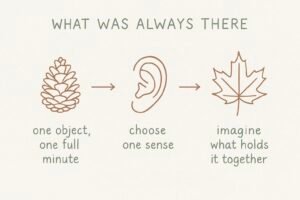
STEP 1: Give One Natural Object One Full Minute
A weed at the edge of the pavement. A single leaf. Moss in a crack in the concrete. A piece of sky. Choose one and give it a full minute of undivided attention.
Color, shape, the way the light falls on it, any slight movement. Don’t try to put it into words. Don’t evaluate it. When a judgment surfaces — beautiful, insignificant, strange — note it quietly as a label and return to the observation. This single minute is the transition from information-processing mode to sensory-experience mode. The two feel different. The difference is worth noticing.
STEP 2: Choose One Non-Visual Sense for the Day
On some days, deliberately switch away from the dominant visual channel. Listen for sounds that aren’t human-made — wind in something, a bird somewhere in the distance, rain on a surface. Use the palm or the cheek to register the texture of bark, the coldness of stone, the warmth of direct sun. Look for the smell of soil after rain, the green sharpness of a crushed leaf, the faint scent of street trees in flower.
Concentrating on one sense at a time gradually reopens it. Circuits that have been receiving little signal start receiving more. The sensitivity that had retreated begins to return.
STEP 3: Imagine, Briefly, What Is Holding the Thing Together
A dandelion at the roadside. A tree visible from the window. Take a moment to consider what it took for this to be here: soil providing minerals, rain arriving and draining, sunlight hitting at the right angle, something carrying the seed to this exact location.
This exists because of a particular convergence of conditions. So do I.
That brief consideration shifts the relationship with the natural object from passive scenery to active participation — something that is here, contingently, alongside you, for reasons that extend well beyond either of you.
Session 3: Nature Became a Managed Product
What the City Did to Nature
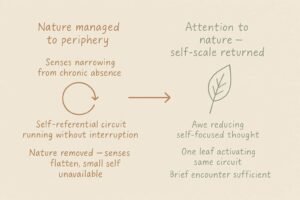
Modern urban planning reorganized nature as an object of efficiency and sanitation management. Through the nineteenth and twentieth centuries, as cities expanded, the natural environment was progressively separated from daily life and repositioned as a managed amenity — the park, the planted median, the maintained garden. Consumer culture completed the process by transforming nature into a lifestyle product: the resort coastline, the photogenic mountain view, the curated outdoor experience sold as a break from the ordinary. These two movements — urban management and consumer commodification — together displaced nature from the center of daily life to its managed periphery. The result is an environment in which contact with natural processes that are genuinely uncontrolled — weather arriving, things growing and dying on their own schedule, the unmanaged edges of the city — is structurally rare. Disconnection from nature is not what happens when people stop caring about it. It is what happens when the environment stops making contact with it available.
The Absence Had Reached the Senses
Writer and journalist Richard Louv developed the concept of nature deficit disorder to describe the range of effects — sensory, attentional, emotional — that follow from chronic reduction in contact with natural environments. The term is not a clinical diagnosis. It is a framework for taking seriously something that clinical language had not yet named: that the diminishment of nature contact produces measurable changes in how people sense, attend, and regulate their emotional states. Louv’s initial focus was on children, but the principle extends. In adults living in urban environments, chronic nature deficit correlates with sensory narrowing, sustained attentional difficulty, and emotional volatility. The feeling of vague depletion, the sense that the senses have gone flat, the difficulty finding genuine rest — these are not symptoms of a personal constitution. They are the downstream effects of an environmental absence reaching the nervous system.
What Awe Was Quietly Restoring
Psychologist Dacher Keltner’s research on awe — the psychological state produced by encounters with vastness, complexity, or phenomena that exceed current frameworks of understanding — describes something that natural environments reliably induce and urban environments rarely do. Awe produces what Keltner calls the small self: a temporary reduction in self-referential thinking, a loosening of the habitual sense of separateness, and an increased sense of connection to something larger than the individual. His research documents that awe reduces markers of chronic stress, decreases self-focused cognition, and increases prosocial motivation — effects that emerge even from brief encounters with natural phenomena. What urban life chronically removes is not just greenery or quiet. It is the regular availability of experiences that produce this particular state. A minute spent fully attending to a single leaf is not a substitute for a day in the mountains. But it activates the same circuit — the one that briefly returns the self to its actual scale.
Conclusion: The Circuit Was Always There

Urban planning will keep managing nature as a peripheral amenity tomorrow. Nature deficit conditions will persist. The awe circuit will keep going underused in environments that don’t provide what activates it. The structure does not change.
But the question what is actually here right now, growing or moving or simply present can be asked on any commute, at any window. One minute of genuine attention directed at something that exists outside human manufacture is the minimum input the circuit needs.
The capacity for awe was always there. The city just stopped providing the conditions for it.
KEY TERMS
Commodification of Nature
The dual historical process through which modern urban planning reorganized nature as a managed amenity — the park, the planted median — and consumer culture transformed it into a lifestyle product: resort experiences, photogenic landscapes, curated outdoor encounters sold as breaks from the ordinary. Together these movements displaced nature from the center of daily life to its managed periphery, making uncontrolled natural contact structurally rare. Nature disconnection reframed as an environmental design outcome rather than a personal failure of attention.
Nature Deficit
Richard Louv’s framework for describing the range of sensory, attentional, and emotional effects that follow from chronic reduction in contact with natural environments. Not a clinical diagnosis but a conceptual tool for taking seriously the measurable changes in sensing, attention, and emotional regulation that accompany the structural absence of nature from daily life. The feeling of sensory flatness and vague depletion reframed as the downstream effects of an environmental absence reaching the nervous system.
Awe
Dacher Keltner’s term for the psychological state produced by encounters with vastness, complexity, or phenomena that exceed current frameworks of understanding — characterized by the small self experience: reduced self-referential thinking, loosened sense of separateness, and increased sense of connection to something larger. Correlates with reduced chronic stress markers, decreased self-focused cognition, and increased prosocial motivation. The specific psychological state that natural environments reliably induce and that urban environments, by their design, chronically fail to provide.
Micro-Nature
The practice of directing deliberate sensory attention toward the natural fragments already present in ordinary urban life — a weed at the pavement edge, a strip of sky, the sound of wind in something overhead. Requires no special location or dedicated time. Functions as the minimum available input for activating the awe circuit that urban environments chronically underuse — not as a substitute for sustained nature contact but as the nearest available point of re-entry.
Defusion
The capacity to notice that the habitual framing — nature is somewhere else, in parks and resorts, not here on this commute — has been operating as an automatic filter on sensory attention, and to create a brief interval in which what is actually present becomes available to notice. Labeling the evaluative thought that surfaces during natural observation — beautiful, insignificant — and returning to sensation is the practice of keeping that interval open long enough for genuine sensory contact to occur.