
Introduction: More Numbers, Less of Something That Matters

The follower count goes up and something still feels thin. The post with the most likes is somehow the one that feels most distant from what was actually meant. Each swipe on a dating app — evaluating and being evaluated — produces a particular kind of exhaustion that accumulates quietly. A conversation with a close friend leaves no trace in any metric, but a day without social media response can produce the sensation of not being connected to anyone.
This inversion is not a personal weakness. It is the result of living inside a system in which relationships have been quantified — and in which the cognitive machinery for understanding connection has been gradually restructured around what can be counted.
Session 1: What the Exhaustion With Measured Connection Actually Is

When the combination of being digitally connected and feeling genuinely lonely becomes a chronic baseline, what is operating is not a failure of individual sensitivity. It is a structural transformation in how connection is recognized and processed.
Human beings originally assessed the depth of connection through signals that resist quantification: the quality of time spent together, the ease of silence, the accumulation of small gestures that build over years into something that cannot be itemized. These signals remain present in daily life. But when follower counts, like counts, and match numbers become visible and persistent metrics of social standing, the non-numerical signals begin to compete against a legible, comparable, optimizable score — and the score has structural advantages over what can’t be shown.
The complication deepens when algorithms begin selecting and optimizing for connection: calculating compatibility, removing inefficient encounters, surfacing the contacts most likely to produce engagement. What algorithms cannot optimize for is the accidental, the unpredictable, the encounter that went nowhere by any rational measure and produced something irreplaceable. The removal of that contingency is not a neutral design choice. It restructures the conditions under which deep connection can form.
The difficulty with quantified connection is not weakness. It is an accurate response to an environment in which the cognitive frame for understanding what is real has been rebuilt around what can be counted.
Session 2: Practice — Returning Attention to What Can’t Be Counted
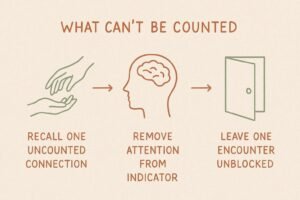
This practice is not about withdrawing from digital life. It is about actively confirming the existence of what the quantification frame has been making harder to see.
STEP 1: Recall one connection from this week that produced no number
Find one moment from the past week that appeared in no feed, generated no reaction count, and left no visible metric — and that was, in some way, genuinely warm.
A few words exchanged with someone. Something that made both people laugh. A conversation that continues even though replies are slow. Time that was simply good to be in.
Confirm that this was real connection — without a number to prove it. The absence of a metric was not evidence of absence.
STEP 2: In one exchange, remove the attention from the indicator
When replying to a message from someone close, set aside attention to reply speed, read receipts, and reaction counts, and ask instead what is actually wanted to be said.
What is the thing I actually want this person to receive right now — not what performs well, not what avoids tension, but what is true and specific to them?
When content receives the attention that indicators were receiving, the quality of the exchange shifts. The shift is small and immediate.
STEP 3: Leave one accidental encounter unblocked
Today, when an unscheduled contact arises — a brief conversation in a corridor, a comment from someone nearby — let it happen without reaching for the phone to fill the space.
Receive the contingency as it is. Don’t optimize it. Don’t document it.
What the algorithm has been trying to remove is here, in this moment. It doesn’t need to be captured to be real.
Session 3: The Metric Was Measuring the Relationship. It Was Never the Relationship Itself
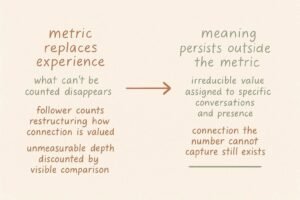
Quantification had been rewriting the cognitive frame for what counts as real
Sociologists Wendy Espeland and Mitchell Stevens’ concept of commensuration describes how placing qualitatively different things on a common numerical scale does not simply record pre-existing differences — it actively restructures how those things are understood and valued. When follower counts, like counts, and match numbers become the persistent visible metrics of social standing, they perform exactly this restructuring: the diverse, incommensurable experiences of connection — the trust built through years of small moments, the ease of silence with a specific person, the warmth that has no origin that can be pointed to — are placed on a scale where they can be compared, optimized, and ranked. Sociologist Jerry Muller’s analysis of what he called the tyranny of metrics describes the structural consequence: when measurement targets become the dominant frame, what cannot be measured tends to be discounted or treated as though it does not exist. The lived experience of connection that resists quantification — everything that makes a relationship specifically this relationship rather than a scored interaction — does not disappear. But it becomes harder to trust without a number confirming it, and easier to overlook in the presence of metrics that are always visible and always comparable.
The algorithm had been removing the condition under which depth forms
Analyses of cold intimacies and the commercialization of intimate life both track the process by which emotion and relationship are progressively subjected to market logic — managed, optimized, and evaluated for efficiency. Dating applications represent the most complete implementation of this logic: they calculate compatibility, surface the algorithmically preferred candidates, and eliminate the encounters that no predictive model would have recommended. What they eliminate in doing so is contingency — the unplanned, unrecommended, inefficient encounter that did not fit any optimization criteria. The research literature on how deep relationships form is consistent on this point: depth tends to emerge from exactly the circumstances that algorithmic optimization would remove. The relationship that formed in the gap where no model would have placed it. When the design removes the irregular and the unpredictable, it is removing — structurally, at scale — the conditions that made the most significant connections in most people’s lives possible.
People had been assigning meaning outside the metric the entire time
Economic sociologist Viviana Zelizer’s research on the social meaning of money documented a finding that runs against the logic of commodification: people persistently and actively assign relational meaning that cannot be reduced to market value, even in contexts of intensive commercialization. The same sum of money given as a gift carries fundamentally different meaning depending on who gives it to whom and under what circumstances — and this meaning cannot be extracted from the transaction’s monetary value. The same resistance operates against the quantification of relationships. In a world where follower counts are visible and comparable, people nonetheless continue to assign irreducible specific value to particular conversations, particular presences, particular moments that produced nothing countable. The connections that the metric cannot capture have not ceased to exist.
Conclusion: The Metric Was Always Measuring Something. It Was Never Measuring the Thing That Mattered Most

The quantification of relationship continues. Matching algorithms continue removing contingency at scale. The daily count of reactions and followers continues producing its fluctuating emotional weather.
But the act of recalling one connection from this week that produced no number — and confirming that it was real — is available in any moment. That confirmation is the beginning of trusting what the frame has been making harder to see.
The number was a measurement of the relationship. It was never the relationship itself.
KEY TERMS
Commensuration and the Quantification of Relationships
Wendy Espeland and Mitchell Stevens’ concept describing how placing qualitatively different things on a common numerical scale actively restructures how they are understood and valued — not merely recording pre-existing differences but reorganizing what is perceived as real and significant. Applied to connection: follower counts and like numbers place incommensurable relationship experiences on a comparable scale, making what cannot be quantified — trust built over time, ease of silence, warmth without origin — harder to perceive as real in the absence of a confirming number.
Tyranny of Metrics
Jerry Muller’s analysis of how measurement targets, when they become the dominant organizational frame, cause what cannot be measured to be systematically discounted or treated as nonexistent. In the context of connection: the lived experience of relationship that resists quantification does not disappear, but becomes structurally harder to trust and easier to overlook in the continuous presence of visible, comparable metrics. The cognitive mechanism through which deep connection becomes harder to recognize even when it is present.
Engineering of Intimacy and Removal of Contingency
The process by which dating algorithms, in optimizing for compatibility and removing inefficient encounters, structurally eliminate the contingent, unpredictable, algorithmically unrecommended encounters that research consistently identifies as the conditions under which deep connection tends to form. Optimization and depth are in structural tension: what gets removed in the service of efficiency is frequently what made the most significant connections possible.
Relational Resistance to Commodification
Viviana Zelizer’s economic sociology finding that people persistently assign irreducible relational meaning that cannot be reduced to market or metric value, even within heavily commercialized contexts. Applied to quantified connection: people continue assigning specific, non-comparable value to particular moments and presences even in metric-saturated environments. The most real connections have been running outside the count the entire time — not captured by it, not destroyed by it.
Cognitive Frame Rewriting by Quantification
The compound effect of commensuration and metric dominance on how connection is recognized and trusted: living inside a system where relationship metrics are continuously visible restructures the cognitive frame through which connection is assessed, making the non-numerical signals of deep relationship harder to trust without confirmation and easier to discount. Not a permanent or complete transformation — the resistance Zelizer documents establishes that meaning-making outside the metric continues — but a structural pressure on perception that produces the experience of being connected and simultaneously unconvinced that the connection is real.