
Introduction: The Anxiety That Comes with the Freedom

Choose your hours, choose your location, choose your work. The freedom the gig economy offers is real. But it comes with a shadow.
The uncertainty of not knowing when the next job will arrive. The constant exposure to evaluation and competition. And the moments when income fluctuation lands not as a financial event, but as a verdict on your worth as a person.
When work dries up, the question that surfaces isn’t just where is the next job — it’s am I not good enough? And even in good stretches, the undercurrent remains: how long can this last?
Session 1: The Fusion of Market Value and Self-Worth

The psychological toll of gig work goes beyond financial worry. It quietly distorts self-perception itself.
At the center of it is a complete merging of market evaluation and personal value. A platform rating, a dry spell between contracts — these stop being external data points and start registering as assessments of who you are. A single piece of negative feedback lands not as information about one job, but as a statement about your character.
From there, the natural variation in workload and income gets converted into a self-narrative: I am an unstable, unreliable person. The realistic concern — what if the next contract doesn’t come? — slides, automatically and below the threshold of awareness, into something more corrosive: I am not enough.
Add to this the physical isolation from the colleagues and social fabric that traditional workplaces provide, and a further layer appears — not just loneliness, but a sense of having drifted from the main current of society, of existing on the margins of something you can’t quite name.
As long as that fusion holds — market price as personal worth — every economic fluctuation will continue to reach directly into the center of how you feel about yourself.
Session 2: Practice — Creating Space Between Value and Price
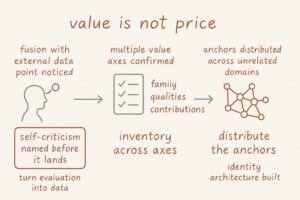
This practice is about building a stable internal vantage point — one from which the weather of market evaluation can be observed rather than absorbed.
STEP 1: Turn evaluation into data
Catch the moment when self-worth begins to shake — a low rating, a gap between projects, a contract that didn’t renew. In that moment, quietly note to yourself:
“Right now, I am fusing with an external data point, and self-criticism is starting.”
That single act of noticing creates the first gap between the event and the reaction. The evaluation is market feedback. It was never a measurement of your worth.
STEP 2: Take inventory across multiple axes
Bring to mind — without forcing — the ways you hold value that have nothing to do with your role as a gig worker. Who you are to your family, your friends, your community. The qualities that don’t convert into income: curiosity, reliability, the capacity to care, creative instinct. The things you have built, the people you have affected, the contributions that exist regardless of any platform’s rating system.
This is not an exercise in positive thinking. It is a quiet act of remembering that the income wave is one surface of something much deeper and wider.
STEP 3: Distribute your anchors
Deliberately cultivate a range of connections — colleagues in other fields, mentors, long-term clients, communities with no relation to work at all. When self-worth rests on multiple axes, the fluctuation of one axis no longer destabilizes the whole.
This is not financial advice. It is a question of architecture — of where you place the foundations of identity.
Session 3: The Structures Underneath the Feeling
The anxiety was structural from the start
Seen from a sociological perspective, the gig economy is, at its core, a business model in which risks that employers once carried — employment security, social insurance, career development — are transferred to individual workers under the name of freedom. Illness, old age, economic downturns: all of it becomes personal responsibility.
What this structure produces is not only financial precarity. The social recognition that comes through stable employment, the solidarity of working alongside colleagues over time, the narrative of a career unfolding — the elements that give work its dignity — are hollowed out by design.
The instability you feel in your sense of self-worth is not a psychological weakness. It is the result of risks that society and employers were meant to absorb flowing, instead, into the interior of one person.
Why it hurts as much as it does
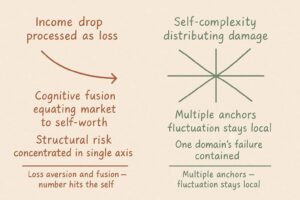
Behavioral economists Daniel Kahneman and Amos Tversky demonstrated what they called loss aversion: people feel the pain of a loss approximately twice as intensely as the pleasure of an equivalent gain. Income fluctuation is processed by the brain as loss. When that loss then passes through the filter of cognitive fusion — the equation market evaluation equals self-worth — a drop in income is no longer just a number. It is processed as a diminishment of the self.
Two mechanisms compounding each other. This, too, is a structural problem, not a personal one.
The case for multiple anchors
Psychologist Patricia Linville’s research on self-complexity shows that people who define themselves across multiple distinct domains — not just by a single role or identity — experience less overall damage to self-worth when one domain fails. A professional setback lands differently when the self also contains a friend, a creative person, someone embedded in a community. The other domains absorb some of what would otherwise be a full hit.
Think of it in terms of where risk is concentrated. When self-worth is held in a single axis — market evaluation — any movement in that axis moves everything. Distributed across multiple axes, the fluctuation of one affects the whole system far less. Building that architecture deliberately — not as consolation, but as structure — is what the practice in Session 2 moves toward.
Conclusion: The Market Sets the Price

The precarity of the gig economy does not resolve. The waves keep arriving. But there is a difference between being pulled under and watching them come.
Distributing self-worth across multiple axes is not resignation. It is the act of reclaiming yourself from a single, unelected judge — returning, one moment at a time, to the wider ground that market evaluation was never able to reach.
The market sets the price. It was never setting your worth.
KEY TERMS
Gig Economy
An economic structure in which short-term, contract-based work replaces traditional employment. The flexibility it offers comes with a structural transfer of risk — employment security, social insurance, career continuity — from institutions to individuals. The psychological instability many gig workers experience is not a personal failing. It is the interior experience of a structural design.
Loss Aversion
A finding from behavioral economics, established by Daniel Kahneman and Amos Tversky, showing that people feel the pain of loss approximately twice as intensely as the pleasure of equivalent gain. Income fluctuation is processed as loss — which is why downturns in gig work tend to hit harder, and linger longer, than the good stretches do.
Cognitive Fusion
The state in which the thought my market value equals my worth as a person becomes indistinguishable from reality. When loss aversion and cognitive fusion operate together, a drop in income is processed not as financial data but as a verdict on the self. The practice in Session 2 works to loosen this fusion — creating the gap in which evaluation can be seen as information rather than identity.
Self-Complexity Theory
Developed by psychologist Patricia Linville. People who define themselves across multiple distinct domains experience less overall damage to self-worth when one domain fails. The practice in Session 2 is a deliberate act of building this complexity — so that the self has more than one place to stand when the ground shifts in one area.
Sati
Pāli for “awareness” or “mindfulness.” The capacity to notice the moment of fusion — when market evaluation begins to feel like personal verdict — before it completes. The orientation underlying all three steps of the practice in Session 2.