
Introduction: A Sensation Is Not a State. It’s a Process.

Itchy. Warm. Tight. We tend to register sensations as fixed conditions — a label applied, a category filled, attention moving on.
But look more closely, and none of them hold still. What gets called itchy turns out to be a pulse, a heat, a surface pressure — shifting in intensity, changing in quality, moving toward something else or fading toward nothing. The label was a simplification. The sensation itself was always in motion.
This guide is a practice in following that motion: observing sensation not as a photograph but as something that has a beginning, a middle, and an end.
Session 1: Why Sensation Looks Like a State

The brain categorizes incoming sensory information rapidly and efficiently. The moment a label is applied — itchy, warm, tight — detailed processing of that sensation tends to stop. The label functions as an answer, and the brain moves on.
This is useful for navigating daily life. It also means that the actual texture of sensation — its subtle variations, its quality shifts, its rhythm of arising and fading — is routinely discarded before it reaches conscious awareness. The label substitutes for the experience.
Directing attention to the temporal unfolding of sensation is a temporary suspension of that labeling process. It is an attempt to meet the sensation before the category arrives — to observe what is actually there rather than what it has been named. What becomes visible, with enough sustained attention, is not a fixed state but a continuously changing process.
Session 2: Three Steps
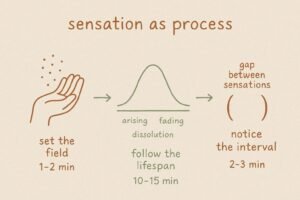
Find a quiet space and sit comfortably. The palm of the hand is a good starting point — sensation there tends to be accessible and varied.
STEP 1: Set the field of observation (1–2 minutes)
Place attention on one hand — the right palm, or whichever feels more present. Without labeling what’s there, simply register: temperature, pressure, movement, or the absence of any clear sensation. Whatever is present becomes the starting point.
STEP 2: Follow the lifespan of a sensation (10–15 minutes)
Identify the most distinct sensation currently present and track its development through time.
Arising: How did this sensation enter awareness? Was there a moment before it was there?
Peak: Where is its point of greatest intensity? What is its quality at that point?
Fading: How does it diminish? Does the quality change as the intensity decreases?
Dissolution or transition: Does it disappear entirely, or shift into something else?
When one sensation completes its arc, move to the next one that presents itself. The aim is to keep the thread of observation continuous — sensation to sensation, without gaps.
STEP 3: Notice the interval (2–3 minutes)
When a sensation has passed and the next has not yet arrived, place attention on that gap. The absence of sensation is also part of the experience. Notice the quality of that interval — and whether it is as empty as it first appears.
Session 3: What Impermanence Actually Feels Like — From Three Directions
The observation that sensation is process rather than state is one that philosophy and neuroscience have arrived at from different directions — and that contemplative practice reached long before either.
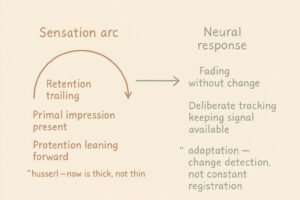
Husserl’s analysis of time-consciousness, developed in his early twentieth-century lectures, describes the structure of what we experience as now. The present moment, Husserl argued, is not a thin, isolated instant — it is a thick, layered structure comprising three simultaneous dimensions: retention (the just-elapsed, still lingering as a trailing edge of present experience), primal impression (what is occurring right now), and protention (an implicit anticipation of what is about to arrive). These three are not sequential — they are co-present in every moment of experience, giving the now its sense of continuity and flow. When this guide asks you to follow a sensation through its arising, peak, and fading, you are moving through exactly this structure. Retention holds the moment just before; primal impression registers the current quality; protention leans toward what comes next. The practice makes this architecture available as direct experience rather than abstract description.
Neuroscience explains from a different angle why sensation appears static in the first place. Sensory adaptation — the reduction in neural response to a stimulus that continues without change — is a fundamental operating principle of the sensory system. The fabric of clothing against the skin, the ambient smell of a room, the pressure of a chair: these sensations are present but no longer detected, because nothing has changed. The brain’s sensory apparatus is tuned to detect change, not to maintain continuous registration of constant states. This means that the sensation appearing to be there as a fixed condition is, neurologically, already in the process of fading from detection. Deliberately tracking the temporal unfolding of sensation is an intentional intervention against this adaptation — by following the changes actively, sensation that would otherwise recede into background remains available to awareness.
The observation that all phenomena arise, change, and pass — that nothing in experience is fixed — is what Theravada practice describes as Anicca, often translated as impermanence. This is not presented as a metaphysical claim requiring acceptance on faith. It is an observation available to anyone who watches the palm of their hand with sustained attention for twenty minutes. What arises will change. What changes will pass. The interval before the next arising is real and observable. Husserl described this structure as the thickness of the present moment. Neuroscience describes it as the change-detection architecture of the sensory system. Theravada practice described it as the fundamental characteristic of all conditioned experience — and developed systematic methods for observing it directly, long before the other two vocabularies existed. The language differs. The phenomenon being pointed at is the same.
Conclusion: The Sensation Was Already Moving

By the time a sensation is labeled, it has already shifted. The label captures a moment that is already passing — a still image imposed on something that was never still. The texture, the rhythm, the quality changes: these were always there, running beneath the category that replaced them.
The sensation was never still. Following it is how you find out what it actually was.
KEY TERMS
Husserl’s Time-Consciousness: Retention, Primal Impression, Protention
Husserl’s phenomenological analysis of the structure of the present moment. What we experience as now is not a thin instant but a layered co-presence of the just-elapsed (retention), the currently occurring (primal impression), and the implicitly anticipated (protention). The practice of following a sensation through its arising, peak, and fading moves through this structure directly.
Sensory Adaptation
The reduction in neural response to a stimulus that continues without change — a fundamental principle of sensory processing. The brain detects change, not persistent states. Clothing, ambient sound, the pressure of a surface: these become undetectable not because the stimuli have disappeared but because they have stopped changing. Deliberately tracking the temporal unfolding of sensation counteracts this adaptation, keeping in awareness what the sensory system would otherwise filter out.
Anicca (Impermanence)
The Theravada observation that all conditioned phenomena arise, change, and pass — presented not as metaphysical doctrine but as something directly observable through sustained attention to experience. The lifespan of a single sensation — arising, peak, fading, dissolution — is one of the most accessible entry points into this observation. What Husserl described as the thickness of the present moment and neuroscience describes as change-detection architecture, Theravada practice described as the fundamental characteristic of experience, and developed methods for observing directly.
Perceptual Labeling and Detail Suppression
The brain’s efficiency mechanism by which incoming sensation is rapidly categorized and detailed processing is suspended once a label is applied. Itchy becomes the answer; the actual texture, intensity variation, and temporal movement of the sensation are discarded. Attention directed to the temporal unfolding of sensation temporarily suspends this process — an attempt to meet experience before the category arrives.
Defusion
A core skill in Acceptance and Commitment Therapy (ACT): the capacity to observe thoughts as passing mental events rather than facts requiring immediate response. When nothing is changing or I can’t feel anything distinct arrives as a verdict during the observation, recognizing it as a thought rather than an accurate assessment — and returning attention to whatever is present in the palm right now — is defusion applied to the evaluative response that fine-grained perceptual practice tends to generate.