
Introduction: Same Map, Different Cities

Security gates at luxury apartment buildings. Surveillance cameras along private residential streets. Signs that say, in various ways, you don’t belong here. The modern city is divided into islands by lines that are invisible on any official map.
We walk the same streets and shop at the same stores — and somehow live in entirely different economic and cultural realities. That neighborhood always makes me uncomfortable. I feel a wall go up when I talk to someone outside my usual circle. This is not a personality trait. It is what happens when the design of urban space gets reproduced inside the mind.
Session 1: “Their World” and “Our World” — When Division Becomes Internal

The physical divisions of the city enter our cognition in three layers that work as a single process.
First, there is the automatic linking of space and people. Hearing the name of a particular district triggers an immediate, unexamined image of the people who live there. The physical gate reinforces the mental one — and the mental one was already there, waiting to be activated.
Layered onto this is the habit of measuring self-worth through group membership. The moment of comparing your community to another — feeling either superior or inadequate — is the moment when a defensive posture toward different groups forms automatically. Where I belong becomes who I am, and anything outside that belonging registers as a mild threat.
Then the reach of empathy quietly contracts. Beyond the commute route, the familiar shops, the friends’ apartments — the world beyond that radius becomes, gradually, someone else’s problem. The city’s divisions don’t just separate spaces. They set a perimeter around the imagination itself.
Once that shortcut fuses with identity, the individual complexity of anyone on the other side of the line becomes invisible.
Session 2: Practice — Rewriting the Internal Map
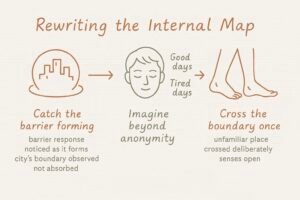
This practice is about noticing the automatic barriers as they arise, and finding small ways to experience the city as a network of connection rather than a map of division.
STEP 1: Catch the barrier as it forms
The moment it arrives — this isn’t my world or I have nothing in common with these people — receive it without judgment. Bring quiet attention to the place, the situation, the person that triggered it, and note internally:
“A barrier response is forming. I’m touching a boundary the city drew.”
This noticing transforms an automatic reaction into something that can be observed. The shift is from being inside the reaction to watching it happen.
STEP 2: Imagine beyond the anonymity
When you encounter a stranger — a delivery worker, a resident of an unfamiliar neighborhood, someone whose life looks nothing like yours — try, for just a moment, to imagine past their anonymity.
“What small success or failure did this person have today?”
“They probably have tired days and good days, just like I do.”
This is not sentimentality. It is a practice of seeing a person rather than a category — briefly restoring the individual complexity that distance and division have flattened.
STEP 3: Cross the boundary deliberately
Once in a while — once a week, once a month — go somewhere you almost never go. Have lunch at a neighborhood restaurant in an area you usually pass through without stopping. Ride an unfamiliar bus line to its terminus. Show up to a local event organized around something outside your usual interests.
The goal is not tourism. It is exposure — placing yourself in an environment that feels slightly unfamiliar and letting your senses stay open. That is what begins to rewrite the internal map.
Session 3: The Design Behind the Discomfort
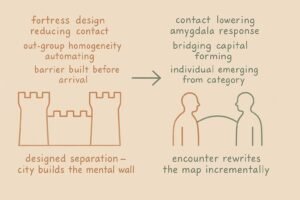
The barrier was built before you arrived
Urban sociologist Mike Davis described what he called the “fortress city” — the gradual transformation of urban space into a collection of secured enclaves, designed not only for safety but to ensure that economically and culturally similar people remain together and everyone else stays out. The gated community is not simply a response to crime. It is a spatial product that systematically eliminates the possibility of accidental contact with people who are different.
The discomfort you feel in an unfamiliar neighborhood is not evidence of your prejudice. It is the designed experience of a space that was built to make you feel like you don’t belong. The barrier in the mind is the barrier in the city, internalized.
Why the mental barrier automates
Social psychologist Henri Tajfel’s research showed that human beings divide the world into “us” and “them” with remarkable speed and automaticity — and that this division intensifies as contact decreases. The less we encounter members of another group, the more that group is perceived not as a collection of individuals but as a uniform category. What Tajfel called out-group homogeneity — the sense that *they’re all the same* — is not a fixed feature of perception. It is a product of reduced contact.
When gated design structurally reduces the opportunities for contact, this automation accelerates. The feeling that everyone on the other side of the gate is interchangeable is something the gate itself produces.
What contact does to the brain
The contact hypothesis — one of the most replicated findings in social psychology — shows that direct contact with people who are different lowers the amygdala’s automatic threat response and activates the empathy circuits of the anterior cingulate cortex. Each contact moves the other person, incrementally, from category back toward individual. Imagining the inner life of a stranger partially activates those empathy circuits without direct contact; crossing a boundary deliberately does the work through actual encounter. Each small exposure slightly recalibrates the baseline.
What urban division actually removes
Sociologist Robert Putnam’s research on social capital distinguishes between two kinds: bonding capital — the trust and solidarity within a group — and bridging capital — the connections that form across different groups. Bonding capital is what gated communities cultivate. Bridging capital is what they eliminate. And it is bridging capital — the loose, incidental contact with people unlike ourselves — that generates new information, creative possibility, and the kind of social trust that holds a city together. The map only changes through contact with what it currently excludes. That change doesn’t happen dramatically. It happens in the accumulation of small encounters, each one quietly expanding where the imagination reaches.
Conclusion: The Gate Is in the City

The gates will remain. The design of urban space will keep producing the conditions for division. But whether the city’s barriers become the mind’s barriers is a different question.
Noticing the moment a barrier forms — and choosing, once, to imagine past it — is the practice. Small and repeatable. Not a transformation, but a direction.
The gate is in the city. It doesn’t have to be in you.
KEY TERMS
Gated Community
A residential form defined by physical security infrastructure that limits contact with the surrounding city. Analyzed by urban sociologist Mike Davis as part of the broader “fortress city” phenomenon — not merely a response to safety concerns, but a spatial design that systematically eliminates accidental contact with economically and culturally different people.
In-group Bias / Out-group Homogeneity
Two related findings from social psychologist Henri Tajfel’s research. In-group bias is the automatic tendency to favor one’s own group; out-group homogeneity is the tendency to perceive members of other groups as uniform and interchangeable rather than individually complex. Both intensify as contact decreases — making them structural consequences of gated urban design, not fixed features of human nature.
Contact Hypothesis
One of the most replicated findings in social psychology and neuroscience. Direct contact with people who are different lowers the amygdala’s automatic threat response and activates empathy-related neural circuits. Each contact incrementally moves a person from category back toward individual. The scientific grounding for both STEP 2 and STEP 3 in Session 2.
Bridging vs. Bonding Social Capital
A distinction developed by sociologist Robert Putnam. Bonding capital is the trust and solidarity within a homogeneous group; bridging capital is the connection across different groups. Gated urban design cultivates the former and eliminates the latter — removing precisely the kind of incidental contact that generates new information, social trust, and civic cohesion.
Defusion
The capacity to notice — and step back from — the fusion between a mental shortcut (that area equals those kinds of people) and one’s sense of reality. STEP 1 in Session 2 trains this capacity: shifting from being inside the barrier response to observing it as a response, which is the first condition for choosing something different.