
Introduction: Why Massage Doesn’t Hold
A session at the massage therapist, a round of stretching, and the tension releases. A few days later, the familiar dull tightness has returned. The shoulders, the neck, the back of the skull. By now it has become the default state — the body’s version of normal. The issue is not insufficient care.
The tension returns because the problem is in the nervous system, not the muscle.
Session 1: The Shoulder Holds What Wasn’t Said

Chronic tension in the shoulders and neck is not adequately explained by muscle overuse or poor posture. It is what happens when cognitive and emotional load accumulates in the neuromuscular system over time — slowly, without announcement, until the tension has become structural.
When the thinking runs — this can’t fail, it has to be done correctly, there isn’t enough time — the body responds in kind. The sympathetic nervous system enters a low-level state of vigilance. The shoulders rise slightly. The breath shallows. The jaw carries a quiet pressure. None of this is dramatic. All of it is continuous. When the pattern repeats across enough days, the muscles begin to learn it. The braced position gradually becomes the resting position.
There is also what happens with emotions that go unprocessed — the anger that wasn’t expressed, the anxiety that was pushed through, the grief that was set aside to keep moving. When emotional experience is consistently managed by not feeling it, the energy finds somewhere to go. It settles in particular locations in the body. The tension in those locations is not random. It is where the body has been holding what wasn’t otherwise allowed to exist.
Session 2: Practice — Treating Tension as a Signal, Not an Enemy
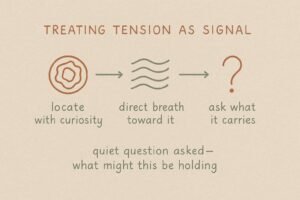
This practice is not about eliminating tension. It is about changing the relationship with it — from something to defeat toward something that can be observed, approached, and gradually understood.
STEP 1: Locate the Tension With Curiosity
When tension is present in the shoulder or neck, instead of moving immediately to relieve it, move toward it first. Close the eyes and find the point where the tension is strongest.
What is actually here — tight, heavy, hot, pressing? What is its texture?
Observe without judgment and without trying to change anything — the way one might observe weather. This shift from being inside the tension to watching it from slightly outside creates a small distance. That distance is the starting point.
STEP 2: Direct Breath Toward the Location
Bring the attention to the point identified in the first step. On the inhale, hold the image of soft air reaching into the center of the tense area. Not an attempt to force relaxation — an attempt to bring a different quality of attention into contact with the location.
On the exhale, feel for any sense of space opening within the area. The tension may not change. The aim is not to make it change but to find the small interval of spaciousness that exists even inside it.
STEP 3: Ask What the Tension Might Be Holding
With attention resting on the tense area, bring a quiet question inward.
If this tension is carrying something, what might it be?
There is no required answer. An emotion may surface — fear, frustration, something that doesn’t have a name yet. A memory or an image might appear. Nothing may come at all. Whatever emerges, receive it without evaluation. The question itself creates the first connection between the body’s symptom and the state that may be generating it.
Session 3: The Work Demanded the Vigilance Posture
What the Desk Asked of the Body
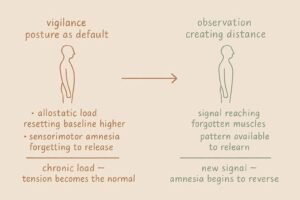
The posture that contemporary white-collar work requires — forward lean, sustained screen focus, continuous cognitive demand — maintains the sympathetic nervous system in a low-level state of alert. Raised shoulders, shallow breath, tension in the jaw and neck: these are the physical expression of that alert state. This is distinct from the industrial instrumentalization of the body — the body optimized for physical output. What desk work asks is different: not exertion but sustained vigilance. The cognitive and emotional pressure of deadlines, performance expectations, and continuous information processing is experienced by the nervous system as a form of low-grade, continuous threat preparation. That preparation has a physical form, and it is held in the body for the duration of the workday. When this pattern repeats across months and years, the body stops treating the vigilance posture as a response to a condition. It begins treating it as the default condition itself.
When Adaptation Became Accumulation
Neuroendocrinologist Bruce McEwen’s concept of allostatic load describes the process by which the body’s stress response systems, when activated chronically, produce cumulative damage rather than recovery. In the short term, stress responses are adaptive: cortisol mobilizes energy, muscle tension prepares for action, inflammatory markers facilitate repair. These responses are designed to activate and then resolve. When the activating conditions are chronic — sustained work pressure, persistent vigilance, ongoing emotional load — the resolution doesn’t arrive. The responses leave residue. Muscle tension accumulates at a higher baseline. Inflammatory markers persist. The nervous system recalibrates around a new normal that carries more tension than the previous one. The reason massage releases tension only temporarily is that the allostatic load has reset the body’s default setting to a higher tension level. Addressing the symptom without addressing the accumulation returns the system to where it was set.
The Muscle Had Learned to Stay Tense
Somatic educator Thomas Hanna’s concept of sensorimotor amnesia provides the most precise account of why chronic tension persists. Hanna observed that when muscles are held in contracted positions repeatedly and over time — in response to stress, habitual posture, or protective bracing — the motor cortex progressively loses its ability to sense and voluntarily control those muscles. The brain stops registering that the contraction is happening. Sensorimotor amnesia: the forgetting, at the level of the nervous system, of how to release what has been learned to hold. When someone consciously tries to relax a chronically tense shoulder, the instruction may simply not reach muscles the brain has stopped monitoring. When massage temporarily releases the physical contraction, the neuromuscular pattern that was generating it has not been rewritten. The nervous system returns to what it knows. The tension comes back not because the body is stubborn or the treatment insufficient, but because the learned pattern was never addressed. Tension is a neuromuscular habit. And the nervous system that learned it is the same system that, given a different signal, can begin to learn something else.
Conclusion: The Pattern Was Learned

Desk culture will keep demanding the vigilance posture tomorrow. Allostatic load will keep accumulating with each unresolved stress cycle. Sensorimotor amnesia will keep maintaining the patterns the nervous system has learned. The structure does not change.
But the question where is the tension right now, and what is its texture can be asked at any desk, at the end of any day. Approaching the tension with observation rather than the intent to eliminate it sends a different signal to the same nervous system that learned to hold it. What was learned through repetition can be relearned the same way — one moment of a different quality of attention at a time.
The tension wasn’t stubbornness. It was the nervous system doing exactly what it had learned to do.
KEY TERMS
Postural Imprinting of Labor
The process by which contemporary desk work — forward lean, sustained screen focus, continuous cognitive demand — maintains the sympathetic nervous system in a low-level alert state, writing the physical expression of that state (raised shoulders, shallow breath, jaw tension) into the body through daily repetition. Distinct from the industrial instrumentalization of the body: what operates here is not physical exertion but sustained vigilance, and its physical form is the chronic tension of the desk posture held across years.
Allostatic Load
Bruce McEwen’s term for the cumulative bodily damage produced when stress response systems are activated chronically rather than episodically. Adaptive responses — cortisol, muscle tension, inflammation — are designed to activate and resolve. When chronic conditions prevent resolution, these responses leave residue that resets the body’s baselines: higher resting muscle tension, persistent inflammation, recalibrated nervous system thresholds. The reason temporary treatment returns to its starting point: the accumulated load that set the default was never addressed.
Sensorimotor Amnesia
Thomas Hanna’s term for the process by which the motor cortex progressively loses the ability to sense and voluntarily control muscles that have been held in chronic contraction. The brain stops registering that the contraction is occurring; conscious attempts to relax cannot reach muscles the nervous system has stopped monitoring. Massage releases the physical contraction without rewriting the neuromuscular pattern that generates it, which is why the tension returns. Chronic tension reframed as a learned neuromuscular habit rather than a structural defect.
Somatization
The process by which emotional and cognitive stress manifests as physical tension, pain, and bodily symptoms through the nervous system. Emotional experience that is consistently managed by not being felt settles in particular locations in the body as held tension. Chronic shoulder and neck tension understood not as muscle fatigue but as the physical residue of emotional and cognitive load that has been carried rather than processed.
Defusion
The capacity to notice that the automatic response to tension — this is an enemy to be eliminated — has fused with the experience of the symptom, and to approach it instead from an observational distance. Directing curiosity toward the tension rather than the impulse to defeat it sends a different signal to the nervous system that learned to hold it — the first available input toward relearning what was learned through repetition.