
Introduction: Stopping in Front of the Shelf

Standing in front of the supermarket shelf, motionless. Organic. Fair trade. Locally sourced. Plastic-free. Every label is making a claim about the right choice. Nothing gets decided, and exhaustion is what comes home. Or something is chosen, and what follows is the quiet sense that a better option was probably missed.
This exhaustion is not a sign of insufficient concern. It is not a failure of willpower. It is the accurate experience of being placed inside a structure that turned consumption from selecting what you need into proving who you are.
Session 1: The Weight of Being a Correct Consumer

When ethical consumption becomes painful, what is operating is not a personal failing. It is a specific structure.
At some point, consumption stopped being a straightforward act of acquisition. What is chosen became a declaration — I am someone who cares about the environment, someone who supports social justice. A grocery run became a values test. Getting it wrong — choosing the less ethical product — began to carry the threat of self-condemnation.
And the information keeps expanding. The options keep multiplying. But as options increase, so does the demand to find the best one among them, and with it the potential regret of having missed something better. I should have researched more. There was probably a better option. As long as consumption is a site of proof, this exhaustion is structurally guaranteed.
The fatigue is not the result of approaching things wrongly. It is the accurate functioning of a person placed inside demands that were pointed in an unfair direction.
Session 2: Practice — From Best Option to Today’s Axis
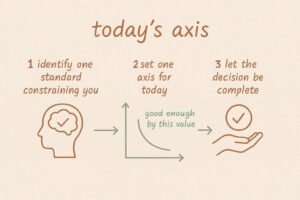
This practice is about shifting consumption from proving rightness toward an honest choice in this moment.
STEP 1: Identify One Standard That Is Constraining You
Before or during shopping, notice the voice that arrives to constrain the decision.
This has to be organic or it doesn’t count. Plastic packaging is completely unacceptable. I need to research more before deciding.
Ask once whether that voice is coming from something you genuinely value — or from the demand to be a correct consumer. When the answer is the second, the voice loses some of its authority. Recognizing it as an externally manufactured demand is the first movement out of its grip.
STEP 2: Set One Axis for Today’s Choices
It is not possible to satisfy all ethical criteria simultaneously. Choose one value to prioritize in today’s decisions.
Today I’ll prioritize fair labor conditions. This week I’ll buy one thing from a local shop.
Choosing a single axis may feel like giving something up — like the other values are being abandoned. They are not. They are being deferred. Stop searching for the option that is best across all dimensions, and decide on the basis of good enough by today’s axis. With a clear axis, it becomes possible to step out of the infinite comparison.
STEP 3: Let the Decision Be Complete
Once a choice is made, stop analyzing it.
Today’s choice was an honest step — the best available to me right now.
If the intention behind the choice was genuine, the choice is complete at that point. The decision made from a real value — however imperfect — is already something different from a decision made in fear of getting it wrong. Direct the energy that would go into regret toward the quality of the next decision instead.
Session 3: Where the Exhaustion Was Made and Where the Exit Is
The Pressure Had a Manufacturer
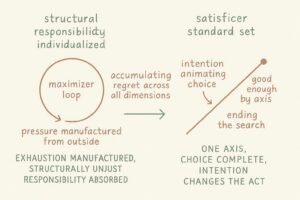
Environmental sociologist Michael Maniates’s concept of the individualization of responsibility identified the mechanism through which the solution to structural problems — climate change, labor exploitation, inequality — has been transferred from the level of corporations and governments to individual consumer choices. Recycle. Choose fair trade. Calculate your carbon footprint. These messages appear to respond to consumer ethical concern, but they perform a substitution: the structural responsibility that corporations and governments carry is reframed as a problem of individual daily choices. The pressure to choose correctly did not arise naturally from inside you. It functions by leveraging your guilt and your ideals — and it was structurally manufactured to do so. The exhaustion of ethical consumption is not a signal that your concern is insufficient. It is the signal of someone who has been absorbing a structurally unjust responsibility for an extended period.
More Options Made the Decision Harder, Not Better
Psychologist Sheena Iyengar’s choice overload research demonstrated that as the number of available options increases, satisfaction with the chosen option decreases and post-decision regret increases. Psychologist Barry Schwartz’s subsequent work on maximizers and satisficers extended this finding: the maximizer — the person who consistently searches for the best available option — accumulates the sense of having missed something better with each decision, and becomes chronically depleted. In the context of ethical consumption, this maximizer loop accelerates. When consumption is a site of identity proof, every choice carries the demand to be optimal across all relevant dimensions. Choosing a jar of jam and choosing clothing fabric both become equally significant judgments. As ethical information expands, the number of things to compare expands, and with it the depth of potential regret for the best option that was not found. For the maximizer, completing a choice is not an endpoint — it is the starting point for the next search.
The Exit Was a Different Standard
The satisficer — Schwartz’s counterpart to the maximizer — sets a personal standard and decides on the basis of the first option that meets it. The satisficer does not make worse decisions than the maximizer. The satisficer simply does not accumulate chronic regret and depletion in the process. The shift from the perfect choice to good enough by today’s axis is the cognitive exit from choice overload that the satisficer stance makes available. The deeper exit is moving the value of the act from what was chosen to what motivated the choosing. The same product selected as proof of being a correct consumer and the same product selected as an honest response to something genuinely valued are different acts — not in outcome but in their nature. The quality of the intention animating the choice is the only personal exit available from exhaustion that was structurally manufactured. It does not change the structure. It changes what the act is for.
Conclusion: The Pressure Came From Outside. The Intention Is Yours

The individualization of responsibility continues. Options keep multiplying. The maximizer loop does not stop on its own. The structure does not change.
But the question good enough by today’s axis — what is that? can be brought to any shelf, before any comparison begins. When the answer to that question comes from what you actually value rather than from fear of failing the test, consumption shifts from proof to an honest step.
The guilt was manufactured alongside the product. The intention behind the choice was always yours alone.
KEY TERMS
Individualization of Responsibility
Michael Maniates’s concept describing the mechanism through which the solution to structural problems — climate change, labor exploitation, inequality — has been transferred from corporations and governments to individual consumer choices. The structural origin of the pressure to choose correctly. Functions by leveraging consumer guilt and ideals to reframe what are properly institutional responsibilities as problems of personal daily decision-making.
Choice Overload
Sheena Iyengar’s finding that as the number of available options increases, satisfaction with the chosen option decreases and post-decision regret increases. In the context of ethical consumption, the expansion of ethical information and options structurally produces the experience of having missed the best choice — accelerating the maximizer loop and making the completion of any decision feel provisional rather than final.
Maximizer
Barry Schwartz’s term for the person who consistently searches for the best available option across all relevant dimensions, accumulating the sense of having missed something better with each decision. In ethical consumption contexts, the identity-proof function of consumption intensifies the maximizer pattern — every choice must be optimal, and the loop has no natural endpoint.
Satisficer
Schwartz’s counterpart to the maximizer. The person who sets a personal standard and decides on the basis of the first option that meets it. Does not make worse decisions than the maximizer — simply does not accumulate chronic regret in the process. The shift from the perfect choice to good enough by today’s axis is the cognitive exit from choice overload that the satisficer stance makes available.
Quality of Intention
The reorientation of the value of an act from its outcome — what was chosen — to its motivation — what animated the choosing. The same product selected as proof of being a correct consumer and the same product selected as an honest response to something genuinely valued are different in kind, not in result. The only personal exit available from structurally manufactured exhaustion — not by changing the structure, but by changing what the act is for.