
Introduction: The Second Weight That Comes With Loneliness

When loneliness arrives, something else arrives with it. It’s my fault I’m alone. I’m not good enough at this. Wanting to be understood is just weakness. Feeling this way means something is wrong with me. The feeling itself is one weight. The voice that follows is often heavier.
This voice is not an accurate description of who you are. It is a script — learned from outside, automated over time, and read aloud by a system that is responding to threat. When a distance opens between the script and the self, the relationship to the voice changes.
Session 1: What the Critical Voice Actually Is

When self-criticism arrives alongside every wave of loneliness, what is operating is not a character trait. It is two structures working at the same time.
The first is a problem of inner speech. The voice that speaks inside the mind — commenting, evaluating, instructing — is not generated from within. It is learned. Try harder. Stop being so needy. You should be handling this better. These phrases were once outside, in the words of others, absorbed through repetition until they moved inside and began running on their own. What sounds like a personal verdict is a linguistic pattern that has been automated.
The second is a problem of threat activation. Loneliness is processed by the brain as a social threat signal. When the threat system activates, the brain begins searching for the source of the danger — and the search tends to arrive at the most available answer: something must be wrong with the self. This attribution is not a conclusion drawn from evidence. It is the threat system doing what threat systems do when they need to locate a cause quickly.
When these two structures overlap — a cultural script that has been automated, and a threat system that is actively searching for a target — the critical voice becomes louder. Every wave of loneliness turns up the volume on a script that was already running. The voice is not telling the truth about who you are. It is a learned text being read aloud by a system in threat mode.
Session 2: Practice — Creating Distance Between the Voice and the Self
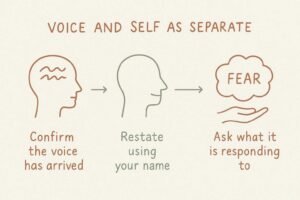
This practice is not about silencing the critical voice. It is about creating a small gap — when the voice arrives — between the script and the person it is speaking to.
STEP 1: Confirm that the voice has arrived
When a self-critical thought appears, before agreeing with it or arguing against it, confirm that it is there.
Right now, the voice saying “I’m not good enough” is here. Right now, the thought “this is weakness” is arriving.
The phrase is here places the voice as something happening rather than something that is true. That placement creates the first gap between the script and the self.
STEP 2: Restate it using your own name
Take the content of the voice and restate it in the third person, using your name.
“I’m a failure” becomes “Name is hearing a voice right now that says failure.”
The shift from I to name is small and immediate. It moves the position from inside the script to slightly outside it — from being spoken to, to observing what is being said. The emotional weight of the voice changes when the position changes.
STEP 3: Ask what the voice is responding to
From that slightly removed position, look for one thing the voice might be reacting to.
What is the “not good enough” responding to right now. Is it the fear of not being accepted. The fear of losing connection.
The critical voice is often a threat system’s response to something specific — not a general truth about character. When the underlying reaction becomes visible, the voice stops being the whole story and becomes one signal among others.
Session 3: The Critical Voice Was Never the Self. It Was a Script — Written Outside and Read Aloud by a System in Threat Mode
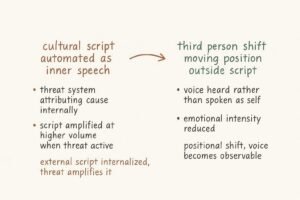
The script had been written by a culture that required self-improvement
Philosopher Michel Foucault’s concept of technologies of the self described how, in modernity, individuals have been formed as subjects who must continuously manage, improve, and monitor their own inner lives. Sociologist Nikolas Rose extended this into the specific domain of psychological language: through the proliferation of self-help discourse, therapeutic frameworks, and productivity culture, the inner life became something to be governed — and the language of that governance became internalized as the voice through which people speak to themselves. Be more productive. Be more social. Don’t be weak. These are not instructions that originated inside. They entered through repeated cultural contact — through what was said, what was rewarded, what was treated as evidence of adequate selfhood — and over time migrated inward, becoming automated as inner speech. The content of the critical voice is not a personal truth. It is a script written outside, running inside.
Loneliness had activated the threat system — and the threat system had amplified the script
Research on social pain has established that responses to social exclusion activate neural circuits that partially overlap with those involved in physical pain. Loneliness is processed as a threat signal. When the threat system activates, the brain begins attributing the danger to a locatable cause. Psychologist Paul Gilbert’s work on threat-based attribution patterns demonstrated that under threat, the cause of a problem is more likely to be located internally — in the self — than externally, in circumstances or structures. This is not reasoning. It is a fast, automatic process designed to identify and address danger quickly. The cultural script that has been automated as inner speech becomes the available content for this attribution. When loneliness arrives and the threat system activates, the script is not just running — it is running louder, because the system that would normally modulate it is occupied with locating a threat. The voice gets louder not because its content is more accurate. It gets louder because the threat system is reading it at higher volume.
The language shift had introduced a distance that changed what the voice could do
Psychologist Ethan Kross’s self-distancing research, applied here to inner speech rather than to narrative self-model updating, demonstrated that restating a thought in the third person — using one’s own name rather than I — reduces the emotional intensity of the experience and interrupts the automatic loop of self-critical inner speech. The mechanism is linguistic: the shift from first person to third person changes the position of the speaker relative to the content. Inside the script, the voice is the self. Outside the script — one step back, observing — the voice is something the self is hearing. This positional shift does not change the content of the script. It does not argue with the attribution the threat system produced.
Conclusion: The Voice Continues. The Distance Changes What It Can Do

The cultural scripts that produced the critical voice are not being rewritten. The threat system will keep amplifying them when loneliness arrives. The inner speech will keep running.
But the moment of confirming this voice is here right now — and restating it with the name, from one step back — is available whenever the voice arrives. That step is the distance. And from the distance, the script becomes observable rather than absolute.
The critical voice was never the self. It was a learned script — and scripts can be read from a distance.
KEY TERMS
Inner Speech and Cultural Learning
Drawing on Vygotsky’s foundational work establishing that inner speech — the voice through which we speak to ourselves — is learned from external language rather than generated from within, combined with Morin’s research on self-reflective inner speech and its automation. The basis for understanding the critical voice not as personal truth but as a linguistic pattern absorbed through repeated cultural contact and running automatically. The origin of the script is outside; the automation is what makes it feel internal.
Technologies of the Self and Governing the Soul
Foucault’s concept of how modern subjects are formed through practices of self-management and self-improvement, extended by Rose’s analysis of how psychological language internalizes the imperative to govern one’s inner life. The cultural mechanism through which the instruction to be more productive, more social, and less emotionally vulnerable becomes automated as inner speech. The script was written by a culture that required continuous self-improvement — and installed through the language that culture used to describe adequate selfhood.
Loneliness and Attribution Error
Research on social pain — social exclusion activates neural circuits overlapping with physical pain — combined with Gilbert’s work on threat-based attribution patterns, in which the cause of a problem is more likely to be located in the self under conditions of threat activation. When loneliness triggers the threat system, the automated critical script becomes the available content for a rapid attribution process. The voice does not get louder because it is more accurate. It gets louder because the threat system is reading it at higher volume.
Threat-Activated Inner Speech Amplification
The compound mechanism in which culturally learned self-critical inner speech and neurological threat activation combine: the script was already running, and the threat system’s search for a locatable cause selects the self as the target and amplifies the script accordingly. The structural explanation for why loneliness and self-criticism arrive together — and why the voice’s volume is not evidence of its truth.
Intentional Redirection of Inner Speech
Kross’s self-distancing research applied specifically to inner speech: restating a self-critical thought in the third person, using one’s own name, shifts the speaker’s position from inside the script to slightly outside it. The shift does not change the content of the voice or argue with the threat system’s attribution. It introduces a linguistic distance at which the script becomes observable rather than inhabited — at which it can be recognized as a script running, rather than mistaken for a description of the self.