
Introduction: The Comfortable but Lonely Place of the “Eternal Guest”

Two national flags beside your name at an international conference. Video-calling family back home while scheduling plans with local friends in your calendar. The blurring sense of “home” when you return, and the persistent feeling of being an outsider in the place you actually live.
This feeling of belonging nowhere — experienced by many who live across borders, whether as expatriates, immigrants, or digital nomads — goes beyond homesickness or adjustment difficulties. It is an existential tension unique to our times: the condition of having to locate yourself in the space between multiple cultures, languages, and social norms.
What follows does not treat that tension as a defect to be fixed. Instead, it introduces a practice for observing it clearly and using it as an entry point toward a broader, more flexible sense of identity. A first step toward stepping back from the urge to fit yourself into a single label, and finding ease with a layered, fluid way of being.
Session 1: The Self Standing Between Worlds

When you live across cultures, the mind moves between two modes — neither of them chosen, both of them costly.
In one, you adjust instantly: behavior, tone, the way you express what you value — all calibrated to the room you’re in. It’s a sophisticated skill. But it also requires constant internal monitoring of which version of yourself to present. Over time, that monitoring quietly drains you.
In the other, the question turns over and over: Where do I actually belong? Which culture should I be more loyal to? The question loops without resolution. Anxiety accumulates. Neither mode delivers what it promises.
Underneath both is a thought that has stopped feeling like a thought: I must be something definite. I must belong fully to this group. When that belief fuses completely with experience, every ambiguous moment becomes confirmation. Every moment of ease gets discounted. The question is no longer where do I belong? — it has quietly become proof that you don’t belong anywhere.
Session 2: Practice — 3 Steps Toward Freedom from the Automatic Thought of “Belonging”
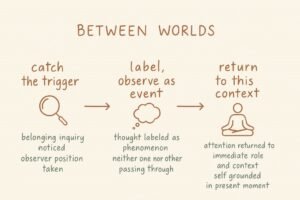
This practice trains the capacity to observe your own experience as it is — loosening the grip of fixed ideas about where you belong.
STEP 1: Catch the Trigger
The moment a thought arises — Do I really fit here? Which culture should I have represented in that moment? — catch it. Quietly declare to yourself:
“The belonging inquiry has started.”
Simply taking the position of observing the process itself, rather than entering the content of the thought, weakens its pull.
STEP 2: Labeling — Observe the Thought as Phenomenon
Label the thought or feeling that has arisen — not judging its content, but treating it as a simple mental event.
“There is a feeling of wanting to belong.”
“The thought ‘I am neither one nor the other’ is passing through.”
If it registers as a physical sensation, describe it as such:
“There is a tightening in the chest — the sensation of being pulled in two directions at once.”
Turn the urge to define yourself into an object of observation.
STEP 3: Return to This Context
Step away from the abstract question of who am I and bring your attention back to the specific role you are in right now.
“Right now, I am contributing to this project.”
“Right now, I am listening to this person.”
“Right now, I am drinking coffee in this café.”
Rather than defining yourself through a fixed story about who you are — nationality, cultural identity — ground your awareness in the immediate experience and role in front of you. Through this moment-by-moment grounding, the space between worlds shifts from a burden into a place you can actually inhabit.
Session 3: Between Cultures, a New Self Forms
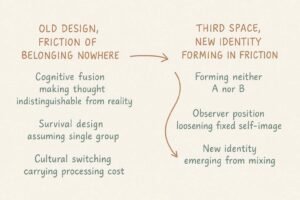
The thought that becomes a verdict
Psychologists describe a phenomenon called cognitive fusion — the state in which a thought becomes indistinguishable from reality itself. The belief I must be a certain kind of person is just one thought among many, but when you fuse with it completely, contradicting evidence stops registering. The experience of returning home and still not feeling at home, the sense of being permanently foreign even where you live — all of it gets processed as confirmation of the belief. When you can observe a thought as a thought rather than as reality, the belief shifts from absolute truth to one possible interpretation.
The design that was never built for this
That fusion is so powerful because the underlying need is not psychological — it’s structural. For most of human history, survival meant belonging to a single group — a village, a tribe, a clan. The need to belong is a survival instinct, and the brain processes the state of belonging nowhere as a primitive danger signal. The problem is that this design assumed a single group as the unit of belonging. People living across multiple cultures simultaneously are operating outside that design. Each time the brain switches between cultural frameworks, it carries a processing cost — and that cost surfaces in consciousness as the instability of feeling like neither one nor the other. The discomfort is not a failure of adaptation. It is the structural friction between an old design and a new way of living.
The space where something new forms
Sociologist Homi Bhabha called this in-between space the “third space” — not A, not B, but a place where something new emerges from the mixing. The identity forming in that space is not a compromise between two cultures. It is a third thing — one that didn’t exist before the mixing began. The sense of misalignment that transnational lives produce is not evidence of something broken. It is the friction of a new identity forming as older frameworks for belonging stop working. In Buddhist terms, the self-image of I am this kind of person is itself a temporary phenomenon, shaped by conditions — not a fixed truth to be defended.
Conclusion

Living across borders means navigating territory where ready-made maps no longer work. The absence of a map is real. So is the discomfort it produces.
The belonging you were searching for was never in one place. It was in the capacity to notice where you actually are.
KEY TERMS
Cognitive Fusion
The state in which a thought becomes indistinguishable from reality itself. The belief “I must be a certain kind of person” feels like absolute truth, and experiences that contradict it stop registering. The practice in Session 2 works to loosen this fusion — developing the capacity to observe thoughts as interpretations rather than facts.
Need to Belong
The instinctive drive to seek membership in a group. Evolutionarily designed around belonging to a single group, this drive generates friction in transnational lives where multiple cultural memberships are held simultaneously. The discomfort this produces is not a personal failing — it is a structural mismatch between an old design and a new reality.
Cultural Hybridity
The state in which two or more cultures blend to produce new meanings and expressions that cannot be reduced to either original. Theorized by Homi Bhabha. The identity of someone living across cultures is understood not as a choice between A and B, but as the process of mixing itself — producing a third thing that didn’t exist before.
Transnationalism
A contemporary way of living in which the basis of life is distributed across multiple locations beyond national borders. Belonging is no longer concentrated in a single nation-state but dispersed across multiple places and networks. The social backdrop to the feeling of belonging nowhere.
Sati
Pāli for “awareness” or “mindfulness.” The inner capacity to observe cultural labels and identity narratives as phenomena — a perspective that belongs to no culture and is constrained by none. The foundational capacity underlying the practice in Session 2.