
Introduction: Why “It’s Just the Internet” Doesn’t Work

A message left on read. A critical comment. A number that went down. A post that landed in silence.
I shouldn’t let this affect me this much. And yet it does. That is not an overreaction. It is not a sensitivity problem.
The platform was designed so that you would care about the evaluation. The nervous system was designed to process digital social rejection through the same circuitry as physical pain. You are at the intersection of two designs — and neither of them is your fault.
Session 1: Two Designs Overlapping

The particular way that social media evaluation becomes impossible to stop caring about is not a willpower failure.
Platforms are designed so that notifications, likes, and comments arrive at unpredictable intervals. This unpredictability — the not-knowing-when — activates the learning pattern that produces the strongest behavioral dependency. The result, over time, is that platform evaluation becomes integrated into the self-concept as a measure of self-worth.
When that integrated self is criticized or ignored, the nervous system processes it as physical pain. What happens on the other side of the screen becomes something that happens inside the body.
Session 2: Directing Mettā Toward the Digital Wound
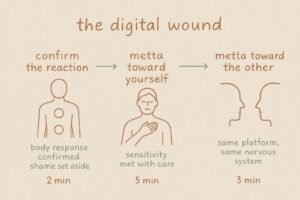
STEP 1: Confirm the reaction (2 minutes)
Bring to mind a recent moment of being hurt by something on a screen — a message, a comment, a number, a silence.
Was there a response somewhere in the body? Around the chest, the stomach, the throat.
Set aside the evaluation of I shouldn’t feel this and confirm the physical response as it is.
STEP 2: Direct Mettā toward yourself (5 minutes)
Toward the self that received the impact, direct quiet intention.
May I be gentle with how much this landed.
May I recognize this pain without adding shame to it.
When the self-criticism arrives — it was just a screen, why does this matter — direct intention toward that layer too:
May I meet my own sensitivity with care.
STEP 3: Direct Mettā toward whoever is on the other side (3 minutes)
The person who criticized, who ignored, who didn’t respond — they are also inside the same platform design. The same nervous system. The same two overlapping structures.
No change in expression or action is required. Direct quietly:
May we all find some ease in this space that was designed to unsettle us.
Session 3: Variable Ratio Reinforcement, the Extended Digital Self, the Social Pain Circuit, and the Structure That Amplifies All Three
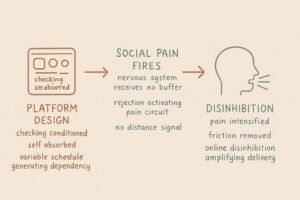
A digital wound feels disproportionate because it is the product of three overlapping systems — each one amplifying the last. Learning psychology, social neuroscience, and cyberpsychology each describe a different stage of that amplification.
Why platform evaluation becomes something that cannot be stopped caring about begins with B.F. Skinner’s variable ratio reinforcement, from his operant conditioning research of the 1950s and 60s. Skinner showed that when rewards arrive at unpredictable intervals — as opposed to fixed, predictable schedules — the resulting behavioral pattern is the most resistant to extinction. The checking behavior continues precisely because the reward might come this time. Nir Eyal, in Hooked (2014), documented how social media platforms deliberately incorporate this principle: notifications, likes, and comments arrive on variable schedules, continuously reinforcing the checking behavior. The inability to stop checking is a response to a design, not a deficit of self-control.
What that design produces over time — in the relationship between the digital self and the actual self — is described by Sherry Turkle’s research on digital identity. In Alone Together (2011), Turkle showed that digital self-presentation — posts, profiles, response counts — comes to be processed not as performance but as an extension of the real self. The online self is gradually integrated into the self-concept, and its evaluations begin to function as measures of self-worth. With Skinner’s variable ratio reinforcement generating dependency on platform evaluation, and Turkle’s integration making that evaluation part of the self-concept, the like count and the comment and the read receipt are no longer external data. They are being processed as information about the value of the self. The phrase it’s just the internet describes the physical substrate accurately and the psychological reality not at all.
What happens neurologically when that integrated digital self is criticized or ignored is described by Naomi Eisenberger’s social pain research. Eisenberger and colleagues, publishing in Science (2003), showed that social exclusion activates the dorsal anterior cingulate cortex and anterior insula — regions substantially overlapping with those involved in processing physical pain. The critical angle for this article is that this circuit fires without physical contact: a critical comment, a message left on read, a follower count that dropped activate the same neural pathway as being physically hurt. The screen creates spatial distance. The nervous system receives no corresponding signal that the distance is there. The self-criticism of I’m overreacting is neurologically inaccurate — the pain is happening exactly as the circuitry is designed to produce it.
Why digital pain tends to be more severe than its offline equivalent is where John Suler’s online disinhibition effect provides the final layer. In CyberPsychology & Behavior (2004), Suler identified the conditions under which behavior that would be suppressed by social norms in face-to-face interaction is released online: anonymity, asynchronous communication, the physical absence of the other person, and the dissociative quality of the screen. Under these conditions, words are written that would not be spoken. The person delivering criticism cannot see the expression of the recipient, receives no immediate relational feedback, and may have no stable identity attached to the words. Eisenberger’s social pain circuit — already activated by rejection regardless of medium — receives input that has been amplified by the disinhibition that Suler described. The platform designed the dependency. The digital self absorbed the evaluation. The nervous system processed the rejection as pain. The disinhibition ensured the pain was delivered without the friction that physical presence would have imposed.
Conclusion: It Was Designed to Land

None of that was a personal failing.
The self that cared was not weak. It was working precisely as the system intended.
The platform was designed to make you care. The nervous system never knew it was a screen.
KEY TERMS
Variable Ratio Reinforcement
B.F. Skinner’s finding, from operant conditioning research in the 1950s–60s, that rewards delivered at unpredictable intervals produce the most persistent and extinction-resistant behavioral patterns. Documented as the design principle underlying social media notification systems by Nir Eyal in Hooked (2014). The checking behavior that platforms generate is a learned response to a reinforcement schedule, not a failure of self-regulation.
Digital Self Extension
Sherry Turkle’s observation, from Alone Together (2011), that digital self-presentation comes to be processed as an extension of the real self rather than as performance — integrating online evaluation into the self-concept as a measure of self-worth. Combined with Skinner’s reinforcement schedule, platform evaluation shifts from external data to self-relevant information.
Social Pain Circuit
Naomi Eisenberger and colleagues’ finding, from Science (2003), that social exclusion activates neural regions overlapping with physical pain processing — the dorsal anterior cingulate cortex and anterior insula. Digital criticism and rejection activate this circuit without physical contact; the screen creates spatial distance that the nervous system does not register. Developed into Social Pain Overlap Theory, with ongoing research into applications in digital and organizational contexts.
Online Disinhibition Effect
John Suler’s concept, from CyberPsychology & Behavior (2004), describing how anonymity, asynchronous communication, and physical absence release behavior that social norms would suppress in face-to-face contexts. Suler’s framework explains why digital criticism tends to be delivered without the friction that physical presence imposes — amplifying the social pain that Eisenberger’s circuit would generate in any medium.