
Introduction: Why “Just Five Minutes” Becomes Two Hours

Late at night, you open your phone for a moment. One video. One post. The feed keeps offering the next thing, and there is no particular reason to stop. When you next look up, the window is lighter than it was. You close the screen with the familiar residue of having wasted time.
This is not a failure of self-control. The time disappearing was designed in.
Session 1: Why the Scroll Doesn’t Stop

The loss of time that accompanies social media scrolling is not a concentration problem or a weakness of will. It is a predictable outcome that occurs at the intersection of platform design and the brain’s cognitive architecture.
The scroll continues not only because the content is interesting but because there is no end. Books and films have endings; as the finish approaches, the sense of almost done naturally surfaces.
Infinite scroll eliminates that signal. A continuous feed with no visible terminus removes the decision point — the moment at which stopping becomes a natural option rather than an act of resistance.
Meanwhile, the brain processing the scroll is handling a rapid sequence of emotionally charged stimuli — anger, laughter, surprise, recognition — at high speed. This sustained processing consumes cognitive resources, and tracking subjective time gets deprioritized in favor of handling what’s immediately in front of it. Time doesn’t disappear because the content is enjoyable. It disappears because the brain allocated its resources elsewhere.
The regret that follows — I wasted time again — is not evidence of personal failing. It is the experience of a system that functioned exactly as it was designed to, producing exactly the result it was optimized to produce.
Session 2: Practice — Reclaiming the Exit

This practice is not about stopping the scroll entirely. It is about creating moments of awareness before and during scrolling — points at which the choice to continue or to stop becomes genuinely available, rather than structurally foreclosed.
STEP 1: Name the Purpose Before Opening
When the hand reaches for the phone, pause for a single beat before the app opens.
Why am I opening this right now?
Is there specific information to find? Someone’s update to check? Or is there no particular reason? When no reason surfaces, the option of not opening becomes real for the first time. When there is a reason, carrying that purpose into the session makes the moment of completion — when the purpose is fulfilled — recognizable. That single beat of intention is the first interruption in the automatic chain.
STEP 2: Use Completion as the Marker, Not the Clock
When the sense of just a little more arrives mid-scroll, the question is not how many minutes have passed but whether there is still something being looked for.
Am I still searching for something? Or have I already found what I came for?
When the answer is that the looking has finished — that there is nothing specific remaining to find — that is the natural exit point. Practicing the recognition of that moment builds, over time, the capacity to find an ending inside a design that removed one.
STEP 3: Return to the Body After Closing
Immediately after putting the phone down, when awareness is still partly drifting in digital space, bring attention once to the physical. Place a hand on a surface and feel the texture. Take three breaths, attending only to the sensation of air moving through the nose.
This is not a way of managing guilt about the time spent. It is the practice of letting awareness travel back from the screen to the body — a short return to the place that was always here while the scroll was running.
Session 3: The Ending Was Removed
The Inventor Who Regretted the Design
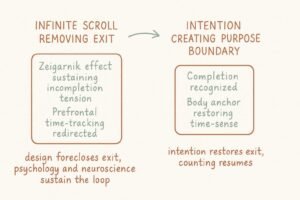
Aza Raskin invented infinite scroll in 2006 — and later regretted it publicly. The intention had been practical: eliminating the friction of clicking to the next page would make browsing smoother. The feature was adopted across platforms and became one of the defining structural elements of contemporary social media. By Raskin’s own estimate, infinite scroll consumes hundreds of millions of hours of human attention every day. What pagination — the practice of dividing content into discrete pages — provided was not just organization. The act of clicking to continue was simultaneously the option to stop. It was a recurring decision point, built into the architecture of the experience. Removing it shifted the default from I choose to continue to I continue unless I actively stop — a small structural change with an outsized behavioral consequence. The difficulty of stopping is not a property of the person using the scroll. It is a property of a design from which the natural exit was deliberately removed.
The Incompletion That Kept the Hand Moving
Psychologist Bluma Zeigarnik’s research demonstrated that incomplete tasks are retained in memory more persistently than completed ones, generating a form of cognitive tension that persists until resolution is reached. This finding — known as the Zeigarnik effect — takes on a specific character in an infinite scroll environment. A continuous feed of content maintains a perpetual state of incompletion: there is always one more post, one more video, one more update that hasn’t been seen. Each piece of content functions as an unresolved task, and the accumulated tension of multiple unresolved items keeps the seeking behavior active. The brain is looking for the completion that will release the tension. But infinite scroll has no completion. The tension does not resolve — it compounds. The sense of just a little more is not appetite. It is the cognitive system seeking a closure that the design will never provide.
Time Didn’t Disappear — It Stopped Being Counted
Neuroscience research on temporal processing identifies the prefrontal cortex as central to the tracking of subjective time. When the brain is engaged in sustained processing of emotionally intense stimuli — the rapid sequence of content designed to produce strong affective responses — the prefrontal cortex allocates its resources toward handling the incoming material and deprioritizes the ongoing task of monitoring elapsed time. The result is not that time passes more quickly because the experience is pleasurable. It is that the mechanism responsible for registering its passage has been redirected. Raskin’s design removed the ending. The Zeigarnik effect made incompletion accumulate. The prefrontal cortex stopped tracking the clock. These three operate as a sequence: the structure forecloses the exit, the psychology sustains the tension, and the neuroscience extinguishes the sense of time passing. The hours that went missing were not stolen. The counting simply stopped.
Conclusion: The Exit Was Always There

The platforms will keep delivering endless content tomorrow. The Zeigarnik effect will keep generating incompletion. The prefrontal cortex will keep deprioritizing time-tracking in favor of stimulus-processing. The design does not change.
But the question why am I opening this right now can be asked before any session, on any night, with any device in hand. That single question reintroduces a decision point into a structure that removed one. The exit was always available. It just needed to be looked for.
The scroll had no ending by design. The exit was always yours to make.
KEY TERMS
Infinite Scroll Design
The UI feature invented by Aza Raskin in 2006 and later regretted by its creator. By eliminating pagination — the division of content into discrete pages — infinite scroll removed the recurring decision point at which continuing required an active choice. The default shifted from deliberate continuation to continuous flow interrupted only by active stopping. The structural origin of scroll-stopping difficulty as a design property rather than a personal one.
Zeigarnik Effect
Psychologist Bluma Zeigarnik’s finding that incomplete tasks persist in memory more tenaciously than completed ones, generating cognitive tension that continues until resolution. In an infinite scroll environment, the unending content stream maintains a permanent state of incompletion — each unseen post functions as an unresolved task. The tension accumulates without ever resolving, sustaining the seeking behavior indefinitely. The psychological mechanism behind the sense of just a little more that never reaches satisfaction.
Prefrontal Time-Tracking Suspension
The neuroscientific finding that sustained processing of emotionally intense stimuli redirects prefrontal cortex resources away from the monitoring of elapsed time. The mechanism is not that enjoyment causes time to pass quickly — it is that the brain’s time-tracking function is deprioritized in favor of handling incoming content. The neural component of the three-part sequence — design removes the exit, psychology sustains the tension, neuroscience suspends the clock — that produces the experience of hours disappearing.
Cognitive Exit Difficulty
The structural state produced by the convergence of infinite scroll design, the Zeigarnik effect, and prefrontal time-tracking suspension, in which disengaging from the scroll requires overcoming compounding friction rather than simply deciding to stop. The difficulty of stopping is not a character trait or a failure of discipline. It is the predictable outcome of three interlocking mechanisms, each of which independently makes continuation more likely than cessation.
Defusion
The capacity to notice that the impulse — just a little more — has fused with the experience of scrolling and is operating as an automatic instruction rather than a conscious choice. The pause before opening an app — why am I opening this right now — reintroduces the observational gap between impulse and action, making a genuine decision available where the design had removed one.