
Introduction: Why Time With Someone Close Can Leave You Depleted

After a long evening with a close friend, something is unexpectedly tired. After a family dinner, a faint hollowness settles. In the middle of a conversation with a partner, a real thought reaches the throat and gets swallowed — because it might hurt, because it might break something, because the expectation of harmony feels more urgent than the truth. The more careful the tending of the relationship, the further the self can feel from the surface of it.
This depletion is not evidence that the love is insufficient. It is what happens when the definition of closeness makes maintaining a self feel like proof that the love is failing.
Session 1: What the Exhaustion in Close Relationships Actually Is

When close relationships consistently produce depletion, what is operating is not a problem with the love or the person. It is two structures working at once.
The first is a cultural definition problem. Contemporary intimacy has come to be defined by its ideal form: complete mutual understanding, the sharing of everything, connection at the level of the soul. Within this definition, the desire for space, the impulse to hold something back, the reality of not being able to fully merge — all of these register as signs that something is missing. The guilt of wanting distance inside a close relationship is not a personal moral failure. It is the internalized weight of a cultural framework that has equated fusion with love.
The second is an attachment pattern problem. Through early relationships with caregivers, each person develops a template for how proximity and distance are managed in close relationships. The template arrives in adult relationships intact — the direction it leans toward depends on what early experience taught about whether closeness is safe. When the cultural demand for fusion lands on top of this pattern, the depletion compounds: the person who learned that closeness risks loss finds the fusion standard confirms their worst fear; the person who learned that distance keeps them safe finds it being named as insufficient love.
The tiredness after time with people who matter is not a sign of inadequate feeling. It is the output of two systems — a cultural definition and an early-formed pattern — operating simultaneously on the same relationship.
Session 2: Practice — Staying Near Without Disappearing
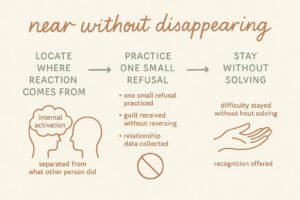
This practice is not about creating emotional distance. It is about discovering, incrementally, that keeping the self does not break the relationship — and that this discovery changes what staying close costs.
STEP 1: Locate where the reaction is coming from
When a close person’s behavior produces a strong response, pause once before directing the feeling outward.
Is this about what they did — or is something inside being activated that was already there?
The move from you made me feel to something in me is responding to this is not a technique for avoiding accountability. It is the first separation between the relationship problem and the internal pattern — the space in which both can be looked at rather than collapsed into blame.
STEP 2: Practice one small refusal
When a pattern of always saying yes to a close person is noticed, identify one thing to decline.
Today I need time for myself — let’s find another time. That’s a bit much for me right now — is there a different way I can help?
The guilt that follows a small refusal is real and normal. Receiving it without reversing the decision is the practice. The data the relationship needs is that the self can be maintained and the relationship continues — and that data only becomes available through the experience of it happening.
STEP 3: Stay without solving
When someone close is in difficulty and sharing it, stop the movement toward solution and stay with what is being said.
That sounds genuinely hard. That makes sense that you’d feel that way.
Not fixing is not withholding. Naming what is present without redirecting it toward resolution is the most available form of recognition — and recognition, without the cognitive effort of problem-solving, is what the presence-based practice is offering.
Session 3: The Fusion Instruction Came From Outside. The Distance Was Never the Problem
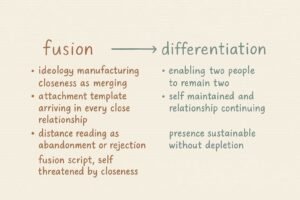
Romantic ideology had manufactured fusion as the definition of closeness
Sociologist Eva Illouz’s analysis of how emotional life has been shaped by capitalism and culture traces the construction of romantic love as an ideology: the ideal of complete mutual understanding, the soul-mate narrative, the promise that the right relationship will produce total transparency between two people. This ideal did not arise from the nature of love. It was assembled, circulated, and normalized through literature, cinema, therapeutic culture, and consumer marketing across the nineteenth and twentieth centuries. Sociologists Ulrich Beck and Elisabeth Beck-Gernsheim, in their analysis of what they called the normal chaos of love, described the structural collision between this romantic ideal and the simultaneous cultural emphasis on individual autonomy — a collision that produces chronic low-level tension in intimate relationships, because the complete fusion the ideal demands and the individual self-determination that modernity requires cannot both be fully achieved at once. The distance that appears inside close relationships — the desire to hold something back, the inability to fully merge, the relief of time alone — is not the failure of love to reach its ideal form. It is the accurate experience of two people who remain, in fact, two people.
The attachment pattern had arrived in every close relationship from childhood forward
Developmental psychologist John Bowlby’s attachment theory and Mary Ainsworth’s strange situation research demonstrated that the quality of early caregiving — specifically, whether the caregiver’s responses were consistent, predictable, and available — shapes a template for how proximity and distance are managed in subsequent close relationships. When early caregiving was consistently responsive, a secure base forms: the person can move toward closeness and away from it without either feeling dangerous. When caregiving was inconsistently responsive, the template that forms is organized around the anxiety that distance means abandonment — and closeness is sought with intensity disproportionate to what the present relationship warrants. When caregiving was dismissively unresponsive, the template organizes around the assumption that closeness brings rejection — and distance becomes a default protection. These templates do not simply describe personality. They arrive, largely intact, in every significant adult relationship.
Differentiation had been the structure that made staying possible without depletion
Family therapist Murray Bowen’s concept of differentiation of self proposed a counterintuitive claim: the capacity to remain in a close relationship while retaining a distinct self — one’s own thoughts, feelings, and values, separate from the emotional field of the relationship — is not the enemy of intimacy. It is the precondition of intimacy that doesn’t consume. Fusion — the state in which the other’s anxiety becomes one’s own anxiety, the other’s emotional weather determines one’s internal state — is not a deeper form of closeness. It is the dissolution of the boundary that makes two people available to each other. A differentiated person can recognize a partner’s distress without being destabilized by it. Can receive a family member’s disappointment without it rewriting the self-assessment. Can stay close without the self becoming the cost of staying. This is not coldness. It is the structural condition under which long-term presence in a close relationship remains sustainable.
Conclusion: The Definition Was What Was Heavy. The Distance Was Never the Evidence

The romantic ideology that equates fusion with love continues to circulate. The attachment patterns formed in early relationships continue to arrive in current ones. The guilt of maintaining a self inside closeness does not disappear quickly.
But the moment of asking is this coming from the relationship or from something already inside me is available in any moment the response arrives. That question is the first gap between the cultural weight and the actual relationship — and in that gap, something closer to the truth of what the relationship actually needs becomes visible.
The exhaustion was never evidence that the love was insufficient. It was evidence that the definition of love had asked for too much.
KEY TERMS
Romantic Ideology and the Demand for Fusion
Eva Illouz’s analysis of how romantic love was constructed as an ideology across the nineteenth and twentieth centuries — assembling the soul-mate narrative, complete mutual understanding, and total transparency as the definition of genuine intimacy. The cultural framework that interprets the desire for individual space inside closeness as evidence of insufficient love. The external origin of the guilt that close relationships produce when the self needs maintaining.
Normal Chaos of Love
Ulrich Beck and Elisabeth Beck-Gernsheim’s sociological concept describing the structural collision between the romantic ideal of complete fusion and modernity’s simultaneous emphasis on individual autonomy. The chronic low-level tension this collision produces in intimate relationships — the inability to fully merge and the inability to fully separate — is structural rather than personal. The basis for understanding the difficulty of close relationships as a social condition rather than a relational failure.
Attachment Theory and Adult Distance Regulation
John Bowlby’s developmental framework and Mary Ainsworth’s strange situation research demonstrating that the consistency and responsiveness of early caregiving forms a template for how proximity and distance are managed in adult close relationships. Anxious and avoidant templates arrive in every significant relationship and interact with the cultural fusion norm to amplify depletion: the anxious pattern finds the fusion standard confirming its fear, the avoidant pattern finds it adding shame to its protection.
Emotional Fusion and Loss of Boundary
Murray Bowen’s family therapy concept describing the state in which another person’s emotional weather determines one’s own internal state — their anxiety becomes one’s anxiety, their mood sets the register of the interaction. Distinguished from closeness: fusion is the dissolution of the boundary that makes two people available to each other, not a deeper form of it. The basis for understanding the depletion that chronic accommodation and self-suppression in close relationships produces.
Differentiation of Self
Bowen’s counterintuitive proposition that the capacity to maintain a distinct self — one’s own thoughts, values, and emotional responses — inside a close relationship is not the enemy of intimacy but its precondition. A differentiated person can remain present with another’s distress without being destabilized by it, and sustain long-term closeness without the self becoming the cost of staying. The practical counter to the romantic ideology’s equation of self-maintenance with insufficient love.