
Introduction: “Terrible” Arrived Before You Decided Anything

A moment of ordinary irritation — the weather, a slow driver, a message that landed wrong. This is terrible. The judgment is there before the thought is finished. It wasn’t deliberated — it simply appeared, automatic and certain, the moment the rain registered.
Judgments arrive faster than thinking. Between sensation and evaluation, there is almost no gap. The evaluation feels like the perception itself.
But whether the judgment is accurate is a separate question. The rain is rain. Terrible is something the brain added.
This practice is about noticing the addition.
Session 1: Why Judgment Is So Fast

Evaluation is central to the brain’s survival architecture.L
The amygdala generates a rough assessment — safe or threatening — within milliseconds of receiving sensory input, before the prefrontal cortex has begun detailed analysis. The emotional response is already underway before conscious interpretation starts. This speed was adaptive: slow threat detection carried a high survival cost. The fast evaluation system was selected for.
The modern brain runs this same ancient system on psychological stimuli. A comment from a manager, a post on social media, a memory of a past failure — the amygdala applies the same rapid evaluation it evolved for physical danger. The machinery hasn’t changed. The environment it operates in has changed completely.
A second feature compounds this: negativity bias — the consistent finding that negative information is processed more strongly, more quickly, and more durably than positive information of equivalent intensity. The same event, framed negatively, produces a stronger neural response than when framed positively. This asymmetry is architectural, not temperamental. It was built in because the cost of missing a threat exceeded the cost of missing an opportunity. It also means that terrible lands harder than wonderful, and stays longer.
Session 2: Three Steps
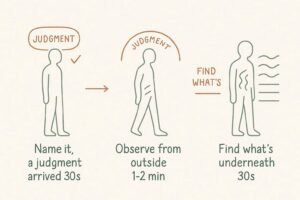
A moment of strong emotion, or irritation at someone or something, is ideal for this practice — when judgment is vivid rather than subtle.
STEP 1: Notice the judgment and name it (30 seconds)
When a good/bad evaluation appears, register it quietly.
A judgment just arrived
Criticism-type evaluation is running
This is a comparison judgment
No agreement, no argument. Just the recognition that something has occurred.
STEP 2: Observe the judgment from outside it (1–2 minutes)
This is the step that resists itself — the judgment wants to be agreed with, not observed. Take a slight step back and look at it rather than through it.
Where in the body is it felt — chest, throat, stomach?
What is it trying to produce — approach, avoidance, defense?
How old is this particular judgment pattern? Is it familiar?
The shift is from I think this is terrible to there is a judgment here that things are terrible. Small grammatically. Significant experientially.
STEP 3: Find what’s underneath the judgment (30 seconds)
Set the evaluation aside briefly and check what’s actually present. The physical sensations — heat, tension, weight. The immediate environment — sounds, light, air. What remains when the judgment is not the foreground?
Session 3: Why the Judgment Arrived Before You Did
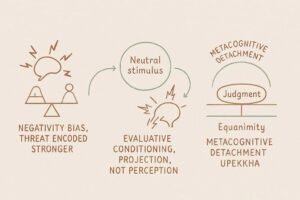
The finding that bad feels stronger than good has been documented across multiple levels of analysis.
Research synthesizing evidence across emotion, cognition, memory, and social interaction has consistently found that negative events produce larger and longer-lasting effects than positive events of comparable magnitude. At the neural level, the amygdala devotes more neurons to negative stimuli, fires for longer in response to them, and the hippocampus encodes negative memories with greater fidelity. This is negativity bias: not a pessimistic tendency but a measurable, structural feature of how the brain allocates processing resources. Its origin is evolutionary — the asymmetric cost of threat versus opportunity — and its presence in modern life produces the consistent result that ordinary inconveniences are experienced as more significant than their objective magnitude warrants.
Negativity bias explains the intensity of negative judgment. Evaluative conditioning explains its specificity. When a neutral stimulus is repeatedly paired with an emotionally significant experience, it acquires evaluative valence — it begins to trigger positive or negative responses automatically, without the original emotional experience being present. The person whose tone you find immediately grating may have become associated, through past experience, with situations that produced frustration or threat. The response is not to them as they currently are, but to a learned pattern that their presence activates. I don’t like that person’s attitude may be less a reading of the current moment than an automatic replay of prior associations. Judgment often presents as a perception of reality. It frequently functions as a projection of pattern.
Naming a judgment as a mental event — a judgment arrived — interrupts the automatic sequence: metacognitive monitoring engages prefrontal processing, which modulates the amygdala’s initial response. What observation adds is a more specific operation. When a judgment is held as a mental event rather than identified with — when the position shifts from I think this is terrible to there is a judgment running that things are terrible — the medial prefrontal cortex begins processing the judgment as an object of self-referential observation rather than as a transparent window onto reality. This creates metacognitive detachment: a functional separation between the judging and the observing that reduces the automatic behavioral pull of the judgment. The judgment doesn’t disappear. The relationship to it changes.
There is a parallel recognition in contemplative traditions that have studied the judging mind directly. The concept that maps most cleanly here is Upekkhā — equanimity — as developed in Theravada practice. Not detachment in the sense of indifference, but a stable, even awareness that can receive both pleasant and unpleasant experience without being pulled disproportionately toward or away from either. What neuroscience describes as negativity bias — the asymmetric pull toward threat and aversion — is precisely what this quality of awareness has been trained to meet and not follow. The science describes the mechanism. The practice develops the capacity to remain present within it.
Conclusion: The Judgment Came. You Noticed.

The judgment will arrive. It always does — quickly, automatically, with a response recommendation already attached. The amygdala doesn’t wait for permission. Negativity bias doesn’t take days off. The system is working exactly as it was built to work.
The judgment was automatic. The noticing was not.
KEY TERMS
Negativity Bias
The structural asymmetry in how the brain processes negative versus positive information — stronger neural response, longer duration, more detailed memory encoding for negative stimuli. Documented across amygdala activation, hippocampal encoding, and prefrontal resource allocation. Evolutionary in origin: the cost of missing a threat exceeded the cost of missing an opportunity. The architectural explanation for why *terrible* lands harder than *wonderful* and stays longer.
Evaluative Conditioning
The process by which neutral stimuli acquire automatic positive or negative valence through repeated pairing with emotionally significant experiences. Produces judgments that function as projections of learned patterns rather than readings of current reality. The cognitive science explanation for why judgment often feels like perception while operating as association.
Metacognitive Detachment
The functional separation between the judging and the observing that occurs when a judgment is held as a mental event rather than identified with. Involves medial prefrontal cortex processing the judgment as an object of self-referential observation. Reduces the automatic behavioral pull of the judgment without requiring its elimination. The neurological basis for the observing step.
Upekkhā (Equanimity)
The stable, even awareness developed in Theravada practice that can receive pleasant and unpleasant experience without being disproportionately pulled toward or away from either. Not indifference, but a grounded presence within the full range of experience. Negativity bias describes the pull that equanimity is trained to meet. The science and the practice address the same feature of mind from different directions.
Defusion
A core skill in Acceptance and Commitment Therapy (ACT): the capacity to observe thoughts as passing mental events rather than facts requiring immediate response. When this is terrible arrives with the force of fact, recognizing it as a judgment rather than a verdict — and returning attention to what’s actually present in the body and environment — is defusion applied to evaluative thinking.