
Introduction: You Don’t Need to Cross Your Legs
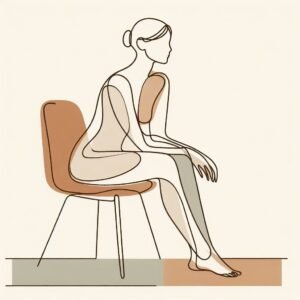
Most people have tried to sit down and meditate at some point. The word tends to conjure images of crossed legs and formal cushions — and with those images, an assumption: that the posture is the prerequisite, that without the right physical setup, the practice can’t begin.
It can. What matters is that the body is stable, the mind is alert, and the state is sustainable. A chair provides all three conditions. This practice is about using one to build the foundation that everything else rests on.
Session 1: Why Posture Comes First
The body and mind influence each other in both directions.
Anxiety tightens the shoulders. Tension shortens the breath. These are familiar. Less often noticed is the reverse: the body’s state shapes the mind’s. A slight lengthening of the spine, an opening of the chest — these physical changes alter breathing, which alters the autonomic state, which alters what the mind can do.
The neurological basis involves the reticular activating system — the brainstem structure responsible for regulating arousal, wakefulness, and attention. Proprioceptive signals from the muscles and joints of the spinal column feed continuously into this system. An aligned posture changes the pattern of these inputs, shifting the system toward a state of alert, balanced arousal — awake without being agitated, relaxed without being drowsy. The experience of mental clarity that follows straightening the spine is a reflection of this pathway.
The goal here is not to achieve a “correct” posture through effort. It’s to find the configuration in which the body can be at ease and alert simultaneously — and to discover that these two qualities are not in opposition.
Session 2: Four Points
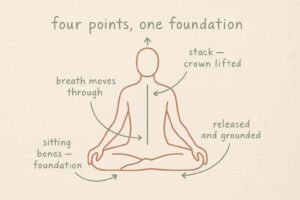
Work through these slowly. Each adjustment is itself an act of directed attention.
POINT 1: Sit on the sitting bones
Move toward the front half of the chair. Find the two bony points at the base of the pelvis — the sitting bones — and feel them making contact with the seat. Rock slightly forward and back to locate them clearly. When the weight is carried by bone rather than by muscular effort, the foundation becomes stable without being held.
POINT 2: Stack the spine
Imagine the vertebrae as blocks stacked lightly on top of each other, with a gentle upward pull from the crown of the head. No forced straightening, no exaggerated lumbar curve. The chin draws slightly in. The back of the neck lengthens. The posture finds itself rather than being constructed.
POINT 3: Release the hands and feet
Place the feet flat on the floor, hip-width apart, directly below the knees or slightly forward. Rest the hands on the thighs without gripping or arranging them. Let the fingers relax into a natural curve. Nothing held, nothing performed.
POINT 4: Feel the breath move through the posture
Once the adjustments are complete, take one full breath. On the inhale, notice the spine lengthen slightly. On the exhale, notice the shoulders and abdomen soften. The body becomes, briefly, simply a vessel that breath moves through.
Session 3: Why Straightening the Spine Is Already an Act of Attention
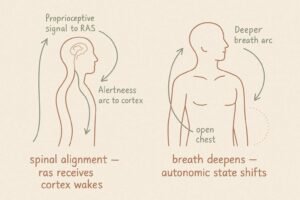
The observation that posture affects mental state has been present in contemplative traditions for a very long time. The neuroscience now provides several overlapping explanations for why.
The reticular activating system receives proprioceptive input from the spinal column continuously. This input influences its output: the arousal signal sent to the cortex, which determines the overall alertness of the system. An aligned spinal posture produces a different proprioceptive input pattern than a collapsed or strained one, and the system responds accordingly. This is not a large effect, but it is a real one — the small but consistent shift in alertness that follows postural adjustment has this pathway as one of its mechanisms.
The relationship between posture and cognitive and emotional state has also been studied directly in psychology, with results that require care in interpretation. Within the broader framework of embodied cognition — the finding that body configuration influences cognitive and emotional processing — the “power pose” hypothesis proposed that expansive postures directly raise testosterone and confidence. This claim has faced significant replication challenges and should not be taken at face value. What is better supported is that posture influences mental state through more indirect pathways: an open chest allows deeper breathing, and deeper breathing activates the parasympathetic nervous system through vagal stimulation. The posture-to-mind connection is real; the mechanism runs through breath and autonomic state rather than directly through hormones.
Attending to the sitting bones and feet on the floor engages somatic grounding: the use of specific contact points as objects of interoceptive attention. The executive attention network functions more effectively when it has a concrete sensory object. Attending to the physical contact of sitting bones with seat and feet with floor provides exactly this — a present-tense, body-based anchor that creates a counterweight to the mind’s automatic drift toward past and future. This is why postural practice and attentional practice are not separate preparations. They operate through the same mechanism.
The transition from postural adjustment to breath awareness is the bridge between the two. As the chest opens and the spine aligns, breathing deepens — not through instruction but through the mechanical removal of constraint. Noticing that the breath has changed, without having directed it to change, is the first instance of the kind of observation this practice is designed to cultivate: something was already happening; attention simply arrived to receive it.
Conclusion: The Sitting Was Already the Beginning
The body was here the whole time — weight on the chair, breath moving, spine available to lengthen. None of that required preparation. What was missing was not the condition but the attention directed toward it.
The posture and the practice were never two things. Sitting down and paying attention are the same act.
KEY TERMS
Reticular Activating System (RAS)
The brainstem structure regulating arousal, wakefulness, and attentional tone. Receives continuous proprioceptive input from the spinal column, making postural alignment a direct physiological input to the arousal regulation system. The neurological basis for the mental clarity that follows straightening the spine — not metaphorical, but a real pathway from body to brain state.
Embodied Cognition and Posture
The research framework proposing that body configuration influences cognitive and emotional processing — not through direct hormonal effects, but through more indirect pathways: posture shapes breathing, breathing shapes autonomic balance, autonomic balance shapes what the mind can do. The “power pose” hypothesis overreached this framework; the underlying principle of posture influencing state through breath and the nervous system is well-supported.
Somatic Grounding
The use of specific physical contact points — sitting bones, feet on floor — as objects of interoceptive attention. Provides the executive attention network with a concrete present-tense anchor, creating a counterweight to the mind’s automatic drift toward past and future. Not a relaxation technique but an attentional one: the ground under the body becomes the ground for the practice.
Kayanupassana
The Theravada practice of body awareness — sustained, non-evaluative attention to physical sensation as a primary object of meditation. Earlier in this series, this was approached as passive reception: noticing what was already present in stillness. This guide approaches its more active dimension: the deliberate adjustment of posture as an act of body awareness in itself. The preparation and the practice are not separate here. Moving into the posture is already the observation.
Defusion
A core skill in Acceptance and Commitment Therapy (ACT): the capacity to observe thoughts as passing mental events rather than facts requiring immediate response. When *am I doing this correctly* arrives as an evaluative thought during postural adjustment, recognizing it as a thought — and returning attention to the physical sensation of the sitting bones or the breath — is defusion applied to the self-monitoring that practice tends to generate.