
Introduction: Why Adding More Connection Didn’t Solve It

More scheduled plans. More followers. More communities joined. And still the same hollowness, or something that feels worse — a tiredness that accumulates precisely from the effort of connecting more.
The premise that loneliness is solved by more connection may be the wrong question entirely. The opposite of loneliness is not a larger quantity of contact. It is the quality of what happens when contact occurs — the specific experience of something actually landing between two people. And that quality has been structurally eroded by the conditions of accelerated contemporary life.
Session 1: What Resonance Is

When more connection fails to reduce loneliness, the problem is not quantity. It is something about the quality of what is happening in the contact itself.
When a person experiences genuine connection, something beyond simple contact is taking place. There is a sense that the other person is actually responding — not performing a response but being genuinely altered by what was said or done. There is the experience of one’s own presence making a difference to the other’s state. And there is the experience of being changed, however slightly, by the encounter. Sociologist Hartmut Rosa calls this bidirectional responsiveness resonance.
Resonance cannot be produced by increasing the number of interactions. It can be present in a glance between strangers and absent across hundreds of social media exchanges. It has conditions: responsiveness, mutuality, and the room for something unpredicted to occur. What contemporary accelerated life has been systematically removing is exactly this room — through optimized scheduling that eliminates the unpredictable encounter, through the demand for instant response that removes the time for genuine reception, through the rationalization of communication that closes in advance the space for what the other person might actually bring.
The sensation of being connected and simultaneously lonely is the accurate signal of this condition: contact without resonance.
Session 2: Practice — Leaving One Condition for Resonance Intact
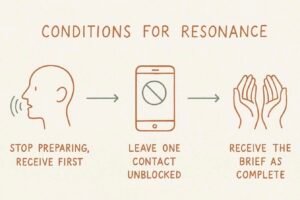
This practice is not about connecting more. It is about deliberately preserving — in at least one moment of the day — the conditions under which resonance can occur: responsiveness, mutuality, and the unpredictability that optimization keeps removing.
STEP 1: In one conversation today, stop preparing the response
When someone is speaking, set aside the construction of a reply and wait for their words to arrive before anything forms in response.
Whatever comes, let it come first. The response will follow from having actually received it.
A prepared response is efficient. It is also a way of closing the space before the other person has finished filling it. Receiving before responding is the minimum condition for resonance.
STEP 2: Leave one unplanned contact unblocked
When an unscheduled encounter arises — a colleague’s voice in a corridor, someone sitting unexpectedly nearby, an unanticipated call — resist the move toward the phone or the calendar and let the contact happen.
This was not optimized. That is precisely why something could happen here.
Accidental contact is the most natural site for resonance. The systematic removal of the unplanned from daily life has been, simultaneously, the removal of resonance’s most available condition.
STEP 3: Receive one temporary shared experience as complete in itself
When something is briefly shared with another person — a view, a reaction to something, a moment of laughter — resist the evaluation of it as a diminished version of deeper connection and receive it as what it actually is.
This was brief. Brief does not mean shallow. It was complete while it lasted.
The habit of treating temporary connection as insufficient has been making one of the most available forms of resonance invisible.
Session 3: The Opposite of Loneliness Was Never More Connection. It Was the Condition Under Which Contact Could Land
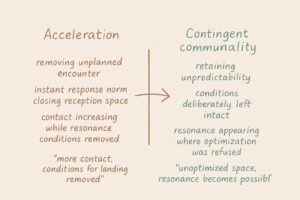
Acceleration had been removing the conditions under which resonance occurs
Hartmut Rosa’s resonance theory reframes contemporary loneliness not as a deficit of contact but as the loss of a specific kind of relationship: the experience of genuine bidirectional responsiveness between a person and the world, including other people. Resonance, in Rosa’s account, is the experience of one’s voice reaching something and something reaching back — of being touched by the world and touching it in return. What Rosa documents is the systematic erosion of this experience under conditions of social acceleration: the optimization of schedules eliminates the unplanned encounter; the norm of instant response removes the time required for genuine reception; the rationalization of communication closes in advance the space for what the other person might actually bring. The quantity of contact increases while the conditions for resonance are progressively removed. The result is the specific form of loneliness that feels most contemporary — not the loneliness of isolation but the loneliness of contact that doesn’t land, of being surrounded by connection that produces no resonance.
Contingent communality had been functioning as resonance’s contemporary form
Sociologist Michel Maffesoli’s concept of neo-tribalism described the fluid, temporary forms of collective belonging that emerge in contemporary societies after stable community becomes difficult to sustain: the concert, the demonstration, the crowd gathered around a shared event. Sociologist Randall Collins’s interaction ritual chains theory provides the mechanism: when people share a common focus of attention and synchronize their emotional energy around it, a genuine experience of social solidarity and energetic replenishment occurs — regardless of how briefly the gathering lasts. The temporary alignment is not a degraded version of deep community. It is a form of resonance in its own right, and in certain respects it is the form most available to contemporary life: it has not been optimized, it was not scheduled, and it retains the unpredictability that optimization removes. In Rosa’s terms, contingent communality preserves the conditions for resonance that accelerated daily life systematically destroys. The one-time crowd, the accidental gathering, the brief shared recognition — these are not insufficient substitutes for something more real. They are among the most reliably resonant experiences available.
Resonance cannot be controlled. But the conditions for it can be deliberately left intact.
Rosa’s concept of Unverfügbarkeit — which might be translated as the quality of being beyond control or availability — identifies the central paradox of resonance: it cannot be produced intentionally. The moment of trying to make resonance happen is typically the moment it fails to occur, because the attempt closes the open space that resonance requires. And yet conditions can be arranged. Developmental psychologist Daniel Stern’s research on what he called moments of meeting demonstrated that deep mutual recognition in early development — and by extension in adult life — arises not from prepared interaction but from the unpredicted instant of mutual recognition: the moment when both parties find themselves responding to something neither anticipated. The conditions for resonance are not complicated. What is required is primarily the refusal to optimize them away.
Conclusion: The Conditions Were There. The Optimization Had Been Removing Them
The structural acceleration that removes unpredictability from daily life continues. Contingent communality cannot be scheduled or guaranteed. Resonance will keep arriving unannounced and refusing to appear on demand.
But the choice to receive before responding — in one conversation, today — is always available. That choice is the preservation of one condition. And one condition is enough for something to begin.
The opposite of loneliness was never more connection. It was the quality of attention that made contact feel like it actually landed.
KEY TERMS
Resonance Theory
Hartmut Rosa’s sociological framework reframing contemporary loneliness as the loss of bidirectional responsiveness rather than a deficit of contact. Resonance is the experience of one’s presence affecting the world and the world affecting one in return. Social acceleration erodes its conditions — through optimized scheduling, instant-response norms, and rationalized communication — while increasing the quantity of contact. The basis for understanding the experience of being connected and simultaneously lonely as structurally produced rather than personally caused.
Unverfügbarkeit
Rosa’s concept of the quality of being beyond deliberate control — the central paradox of resonance: it cannot be produced intentionally, and the attempt to produce it typically destroys its conditions. What can be done is preserve the space resonance requires: the gap before the prepared response, the unscheduled encounter, the moment received as complete rather than evaluated. The practical basis for understanding the Session 2 practices not as techniques for generating resonance but as acts of not removing its conditions.
Contingent Communality and Neo-Tribalism
Michel Maffesoli’s concept of the fluid, temporary forms of collective belonging that emerge in contemporary societies: concerts, demonstrations, crowds gathered around shared events. Not a degraded substitute for deep community but a contemporary form of resonance in its own right — one that retains unpredictability and shared focus, the conditions that acceleration removes from daily life. The basis for receiving temporary shared experience as complete rather than insufficient.
Interaction Ritual Chains
Randall Collins’s sociological framework establishing that shared focus of attention and synchronized emotional energy produce genuine social solidarity and energetic replenishment regardless of the duration of the gathering. The mechanism through which contingent communality generates real resonance: the temporary alignment is neurologically and socially real, not a simulation of something more permanent. The basis for understanding the brief shared moment as complete in itself.
Moments of Meeting
Daniel Stern’s developmental psychology research establishing that deep mutual recognition arises from unpredicted instants of mutual response rather than from prepared interaction. The developmental basis for Rosa’s resonance paradox: what produces the deepest connection is precisely what cannot be planned. Applied to adult life: receiving before responding, leaving unplanned contact open, and allowing temporary experience to be what it is — rather than optimizing it — are the conditions under which moments of meeting remain possible.