
Introduction: The “Oh” Moment Is the Practice

You were meditating, and somewhere along the way you were just thinking. You got frustrated, and by the time you noticed, your tone had already changed. You sat down to eat, and somehow the phone was in your hand.
And then — a beat later — oh. I was on autopilot again.
Most people follow that moment with self-criticism. I failed again. I’m not getting any better. But that moment of noticing isn’t evidence of failure. It’s evidence that the brain is doing exactly what it’s supposed to do. The shift from not-noticing to noticing — that’s the practice. Even when it arrives late.
Session 1: The Brain Learns by Detecting Its Own Errors

The feeling that noticing came too late seems intuitively right. From the brain’s perspective, it’s backwards.
The brain operates by generating predictions and detecting gaps between what it expected and what actually happened. That gap — the prediction error — is the basic unit of learning. The moment of oh, I was doing it again is the brain’s error detection system working accurately. The latency isn’t the problem. The detection is what matters.
There’s something else worth knowing. The capacity to observe your own thoughts and behavior from a slight distance — metacognition — develops the same way a physical skill does: through use. If today you noticed ten seconds after the fact, the practice is creating the conditions for five seconds next month. That narrowing only happens because the not-noticing happened first. The gap is the material the brain learns from.
Session 2: Three Steps for Receiving the Moment
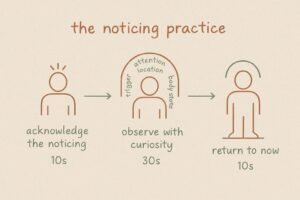
This starts the moment oh, I was doing it again arrives.
STEP 1: Acknowledge the noticing (10 seconds)
Set aside both self-criticism and self-congratulation. Simply register the fact: noticing happened. Internally, that’s enough. Nothing more is needed at this step.
STEP 2: Observe with curiosity (30 seconds)
Curiosity is harder than it sounds here — the impulse to judge the episode is strong. The researcher’s stance means staying with the what, not the why.
What triggered the noticing? A body sensation? Someone else’s reaction? A change in tone?
Where was attention just before the moment of noticing?
What is the body’s state right now, in this moment of having noticed?
An answer isn’t required. Holding the question is the observation.
STEP 3: Return to now (10 seconds)
Once the observation is complete, let the episode be past. One full breath. Return attention to something immediate and physical — the contact of feet on the floor, the movement of the breath. The incident is finished. This moment is new.
Session 3: Why the Brain Always Detects Errors After the Fact
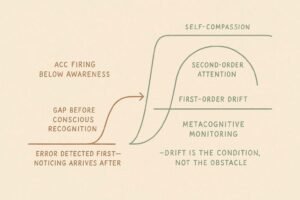
A specific electrical response generated in the anterior cingulate cortex — the Error-Related Negativity — fires in the milliseconds immediately following a mistake, before conscious awareness registers what happened. The brain detects the error before you know you’ve made one. What feels like slow noticing is structurally built into the system: there is always a gap between neural detection and conscious recognition. Damasio’s research on the relationship between body, error processing, and decision-making illuminates how this detection system operates largely below the level of conscious awareness — and why the felt sense of having gone wrong often arrives as a physical signal before it becomes a thought.
The behavioral science case against self-criticism is equally clear. I failed again is not reflection — it’s rumination. And rumination consumes the attentional resources that learning requires. Neff’s research on self-compassion has consistently found that self-criticism does not improve performance over time; it degrades it. The intuition that being hard on yourself drives better outcomes turns out to be wrong in the direction that matters: harsh self-evaluation correlates with reduced motivation, lower practice continuity, and slower skill acquisition. Treating the noticing gently is not an emotional concession. It is the configuration that keeps the learning system running.
Cognitive psychology adds another layer. Noticing that you weren’t noticing requires a second-order attention — not attention directed at an object, but attention directed at attention itself. This is metacognitive monitoring: the capacity to observe the current state of your own mind from a slight remove. Siegel’s work on this second-order awareness describes it as a trainable capacity with measurable neural correlates. The critical structural point is this: second-order attention only activates when first-order attention has drifted. The moment of oh, I was somewhere else is the only moment in which metacognitive monitoring can occur. Without the drift, the observer has nothing to observe. The not-noticing is not the obstacle to the practice. It is the practice’s raw material.
Conclusion: Late Noticing Is Noticing

The gap between the error and the noticing is not a design flaw. It is the design. Neural detection precedes conscious recognition by construction — the system was never built to catch things in real time, only to detect and correct after the fact. Self-criticism aimed at that gap is aimed at the wrong target.
The drift was not the failure. It was the only thing that made the noticing possible.
KEY TERMS
Error-Related Negativity (ERN)
A distinct electrical response generated in the anterior cingulate cortex in the milliseconds following an error — before conscious awareness registers what happened. Identified by Gehring and colleagues in the early 1990s, ERN research has become central to the neuroscience of attention, learning, and self-regulation. The consistent finding: the brain detects errors faster than the mind knows about them. “Noticing late” is structurally built into the system.
Metacognitive Monitoring
The capacity to observe the current state of one’s own attention, thinking, or emotional tone from a slight remove — a second-order awareness directed at first-order experience. Develops through repeated practice. Structurally, metacognitive monitoring can only activate when first-order attention has drifted — meaning the not-noticing is not a failure of the system but its necessary precondition.
Self-Compassion
Neff’s framework for relating to one’s own failures and limitations with the same warmth one might extend to another person. Supported by longitudinal research showing positive correlations with learning efficiency, practice continuity, and resilience. The counterintuitive finding — that self-criticism impairs rather than improves performance — is among the more replicated results in the field.
Prediction Error Signal
The brain’s mechanism for detecting gaps between expected and actual outcomes — the basic unit by which learning occurs. The oh, I was doing it again moment is this system functioning accurately. Damasio’s research on the relationship between body, error processing, and decision-making remains a foundational reference for understanding how this detection system operates below the level of conscious awareness.
Defusion
A core skill in Acceptance and Commitment Therapy (ACT): the capacity to observe thoughts as passing mental events rather than facts requiring immediate response. When I failed again or I’ll never get this arrives as a verdict after the noticing, recognizing it as a thought rather than an accurate assessment — and returning attention to the physical fact of having noticed — is defusion applied to the self-evaluative response that practice reliably generates.