
Introduction: The Walls Are Not Personal. They Are Structural

Maybe this isn’t for me. Maybe I’m doing it wrong. Maybe none of this is actually working.
Most people who begin a meditation practice encounter some version of these thoughts at some point.
But the majority of these walls are not evidence of personal failure or insufficient willpower. They are predictable difficulties — anticipated by what neuroscience and learning psychology know about how the brain acquires new skills. Understanding why a wall appears changes the relationship to it: from I’m failing to this is what this stage looks like.
This is the final guide in the foundations series.
Session 1: The Walls Have Structural Explanations

When a new skill is being acquired, the brain attempts to use existing neural circuits. What mindfulness practice asks for is, in many cases, the reverse of how existing circuits operate — noticing before reacting rather than reacting automatically. Reversing that direction requires forming new circuitry. That formation takes time, involves resistance, and does not proceed smoothly.
The learning curve — the finding from learning psychology that skill acquisition does not progress linearly — describes what this looks like from the outside. Periods of rapid apparent progress alternate with periods in which no change seems to be occurring. These plateau periods are not periods when learning has stopped. Neurologically, the plateau often coincides with the phase in which individual synaptic changes are being integrated into coordinated circuit-level function. The subjective experience of nothing is happening and the neural reality of significant integration is in progress can occur at the same time.
Seen through this frame, the five walls look different.
Session 2: The Five Walls
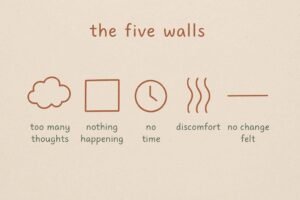
WALL 1: Too many thoughts
I can’t concentrate. This isn’t working. I’m not built for this.
Thoughts arising during meditation are not a concentration failure. They are the brain’s default operation. The default mode network — the circuit that generates self-referential thought automatically during low-stimulation states — becomes more active during meditation, not less, as external inputs are reduced.
What matters is the moment of noticing. When oh, I was thinking arrives, a shift has already happened: from being entirely inside the thought to observing it from a slight remove. That shift — however many times it occurs in a single session — is the practice. The number of thoughts is irrelevant. The number of noticings is what accumulates.
WALL 2: No special experience arrives
I thought something would happen. It’s just sitting.
This is an expectation problem. Cultural images of meditation — profound peace, dramatic insight, altered states — set expectations that the actual experience of practice rarely matches, especially early on.
What is being developed is not a spectacular experience but a quiet skill: attentional control. Noticing the temperature of the breath, the tension in the shoulders, the thought arriving and passing — none of this feels like something happening. But it is the practice itself. Until the criteria for what counts as a meaningful experience shifts, this wall will recur. The shift is part of what practice develops.
WALL 3: Not enough time
I’m too busy to keep this up. Five minutes can’t be enough.
Habit formation research is consistent on this point: continuity matters more than duration. A five-minute daily practice builds a stronger habit loop than a twenty-minute weekly one, because the reward signal is received more frequently and the cue-routine-reward association is reinforced more often.
The time problem is usually a design problem in disguise.
WALL 4: Physical discomfort
The pain and the drowsiness always win.
Pain has two layers: the nociceptive signal and the suffering added by resistance to it. What becomes intolerable in most cases is not the sensation itself but the resistance. Adjusting posture is not failure — it is a conscious choice made on the basis of clear observation.
Drowsiness during practice is a predictable neurophysiological response to the reduction of arousal-maintaining external stimulation. It is not evidence that the practice isn’t working. The drowsiness is the design working. What to do with it is a separate question.
WALL 5: No change is felt
I’ve been doing this for weeks. Nothing is different.
This is the plateau. And as noted above, the plateau is not necessarily evidence that nothing is changing.
There is a second mechanism worth knowing here. Hedonic adaptation — the brain’s rapid reclassification of repeated positive experiences as baseline rather than gain — applies to practice effects as much as to anything else. The sense that nothing has changed may reflect not the absence of change but its successful integration: what was once a noticeable shift has become the new normal.
A deliberate before-and-after comparison directly counters this adaptation — restoring visibility to changes that have become invisible through familiarity.
Session 3: The Learning Curve, the Plateau Paradox, and the Order in Which Motivation Develops
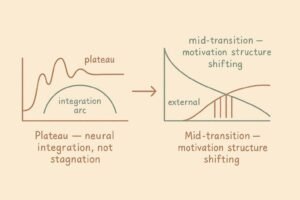
The learning curve is among the most replicated findings in skill acquisition research. Progress is not linear; periods of rapid improvement alternate with plateaus, and this pattern has been observed across domains from musical performance to surgical technique to language acquisition. Research on expert skill acquisition shows consistently that genuine mastery requires passing through multiple plateaus — that the non-linearity is not incidental to the learning process but intrinsic to it. Neurologically, plateau periods appear to coincide with phases of circuit-level integration: the consolidation of individually strengthened synaptic connections into coordinated, efficient networks. The subjective experience of stagnation and the neural reality of deep integration are not mutually exclusive. They can be simultaneous.
The beginner’s effect — a phenomenon in which the early phase of a new practice produces disproportionately vivid responses, partly as a function of the nervous system’s novelty reaction — helps explain Wall 2. The initial clarity, the striking sensations, the sense that something is happening: these are partly the brain responding to genuine novelty. As the practice becomes familiar, the novelty response diminishes. What remains is the actual skill being built — quieter, less dramatic, but more durable. When the vivid early experiences are taken as the standard against which later practice is measured, everything that follows will feel like decline. Recognizing the beginner’s effect reframes the early experience as a starting condition rather than a benchmark.
Edward Deci and Richard Ryan’s self-determination theory describes the transition from external to internal motivation not as a single event but as a gradual process driven by repeated personal discovery. The phase in which external motivation — obligation, commitment, scheduled reminders — is doing most of the work is the phase in which the walls are most likely to appear and feel most formidable. Internal motivation — I want to practice because I have noticed what it does — has not yet developed enough to sustain the practice through difficulty. The walls cluster in this transition zone. Knowing this doesn’t eliminate the difficulty, but it locates it accurately: not a sign that the practice is wrong, but a sign that the motivation structure is mid-transition.
Conclusion: The Series Ends. The Practice Continues.

The foundations series ends here.
The walls will continue to appear — they will. But each time one appears, it can be recognized for what it is: a predictable feature of a non-linear process, not a verdict on the practitioner.
Being able to name the wall, locate its structural basis, and return to the practice — that capacity is itself what this series has been building.
The wall was never the problem. Not knowing it was structural — that was the only thing worth fixing.
The wall and the awareness of the wall are not the same thing.
KEY TERMS
Learning Curve and Plateau
The finding from skill acquisition research that learning does not progress linearly — periods of rapid improvement alternate with plateaus in which no change is apparent. Research on expert skill acquisition shows that genuine mastery requires passing through multiple plateaus, and that this non-linearity is intrinsic rather than incidental to the learning process. Neurologically, plateau periods may coincide with phases of circuit-level integration. The subjective experience of stagnation and the neural reality of deep integration can be simultaneous.
Beginner’s Effect
The disproportionately vivid responses that often characterize the early phase of a new practice, partly as a function of the nervous system’s novelty reaction. When these initial experiences are taken as the benchmark against which all subsequent practice is measured, everything that follows will seem like decline. Recognizing the beginner’s effect reframes early experience as a starting condition rather than a standard — and Wall 2 as a predictable consequence of the novelty response fading as the actual skill begins to form.
Self-Determination Theory and Motivational Transition
Edward Deci and Richard Ryan’s framework describing the gradual transition from external motivation (obligation, commitment) to internal motivation (genuine interest in what the practice produces). This transition is not linear and is driven by repeated personal discovery. The walls cluster in the period before internal motivation has developed enough to sustain practice through difficulty. The walls mark the transition zone, not a terminal condition.
Default Mode Network and Wandering Thoughts
The neural circuit that generates self-referential thought automatically during low-stimulation states — active by default, not by failure. Thoughts during meditation are DMN activity, not evidence of inadequate concentration. The noticing of thoughts — however many times it occurs — is the practice. What accumulates is not fewer thoughts but more noticings.
Defusion
When I’m not built for this, nothing is changing, or this is pointless arrives as a conclusion, recognizing it as a thought rather than an accurate assessment — and returning attention to whatever is actually present in this moment — is defusion applied to the evaluative response that difficulty in practice consistently generates. The wall and the thought about the wall are not the same thing.