
Introduction: Suspended Between Two Answers

Work stalls. A career doesn’t move the way it was supposed to. A relationship breaks down. When this happens, the explanation gets pulled in two directions. This is the structure of a competitive society — or — I didn’t work hard enough, I didn’t have what it takes.
Both explanations contain something real. But taking either one all the way produces something that feels dishonest. All the system’s fault makes personal choice disappear. All my own fault makes the conditions you were placed in disappear. Between these two, the actual situation becomes harder to see.
Session 1: Why the Binary Has Such Strong Pull

When thinking collapses into one of these two positions, what is operating is not a failure of reasoning. It is a structural feature of how the mind handles complexity.
Analyzing causes that are genuinely multiple and entangled is cognitively demanding. When several factors are interacting and the contribution of each is unclear, the mind tends toward simpler explanations. Collapsing the cause to a single source reduces the discomfort of uncertainty quickly. The binary is a form of cognitive efficiency.
Each pole also has an emotional function. All the system’s fault protects self-esteem from the pain of failure and disappointment. All my own fault maintains, paradoxically, the sense that the world is controllable — that outcomes are determined by effort, and effort is something that can be applied. Both positions function as protection against the discomfort of a reality that is genuinely difficult to manage.
The cost is that the protection obscures what could actually be done. System’s fault removes the motivation to act on what is within reach. My fault directs energy toward what cannot be changed, producing exhaustion. The binary protects while simultaneously making the situation harder to navigate.
Session 2: Practice — Shift From “Whose Fault” to “What Can Move”

This practice is about replacing the attribution question — who caused this? — with the tractability question: what here can actually be changed?
STEP 1: Decompose Instead of Consolidate
When the pull toward a single explanation arrives, try decomposing instead.
What are three or more factors contributing to this situation? My choices, other people’s actions, structural conditions, chance — what proportion does each represent?
Precision is not required. The shift from one cause to several factors in interaction is what matters. Once the situation is seen as multiply determined, the range of possible responses widens.
STEP 2: Sort by Controllability
Divide the factors identified into what can be changed through your actions and what cannot.
Does this change if I act differently? Or does it stay the same regardless?
Directing energy toward what cannot be changed is the primary source of the exhaustion that the binary produces. Finding the smallest, most reliable action available within what can actually be moved is where realistic agency begins — not confident, not complete, but grounded.
STEP 3: Replace “Responsibility” With “Responsiveness”
Substitute the question whose responsibility is this? with what can I respond to in this situation?
Whatever the origin of this situation, what response is available to me now?
Locating the source of a problem and responding to it are separate operations. The response can begin before the attribution analysis is finished. This substitution is the movement from analytical paralysis toward action.
Session 3: Where the Binary Was Made and What Can Replace It
The “It’s All My Fault” Feeling Had a Manufacturer
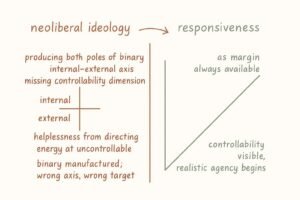
Geographer and political economist David Harvey’s analysis of neoliberalism traced the political and economic transformation of the decades following the 1970s — a shift in which market logic extended progressively into all domains of social life, and in which the causes of social outcomes were increasingly attributed to individual effort and choice. Within this framework, structural inequalities — the family one was born into, the neighborhood, access to education, the behavior of economic cycles — are reframed as personal obstacles to be overcome by individual effort. The sense of excessive personal responsibility — I should have been able to make this work, I didn’t try hard enough — is not a natural psychological response to difficulty. It is a standard of self-evaluation that a specific ideological formation manufactured and distributed. The all the system’s fault position that emerged in partial reaction to this is not its opposite. It is the other pole of the same binary that the ideology produced.
The Missing Dimension Was Never Internal Versus External
Psychologist Bernard Weiner’s attribution theory proposed that when people explain the causes of events, they organize their attributions along three dimensions — not just the familiar internal versus external axis, but also stable versus unstable, and controllable versus uncontrollable. This three-dimensional framework makes visible what the binary cannot see. Within internal factors, effort — controllable and unstable — is a different kind of cause than innate capacity — less controllable and more stable. Within external factors, this particular organization’s practices — potentially changeable — is a different kind of cause than the structure of the broader economy — resistant to individual action. Helplessness arises when energy is directed toward uncontrollable factors as if they were controllable. Excessive responsibility arises when uncontrollable factors are treated as if they fell within personal reach. When the controllability dimension becomes visible, the realistic range of action becomes visible with it.
The Structure Was Being Remade by the People It Constrained
Sociologist Anthony Giddens’s structuration theory proposed that the relationship between social structure and individual action is not one of opposition but of mutual constitution. Structures constrain individual action — they define what is possible and what is not, what is rewarded and what is penalized. But structures are also reproduced, and sometimes gradually transformed, by the accumulation of individual actions over time. Every day, people in organizations reproduce the practices of those organizations — and sometimes, through the way they act and speak and choose, alter those practices incrementally. Consumer choices send signals to markets. The quality of conversation in a team shapes the culture of that team over time. The individual is neither fully determined by the system nor free to redesign it. The individual is something more specific: a participant in the ongoing reproduction of a structure that can be, slowly and partially, remade through that participation. This understanding is the basis of responsiveness — not full freedom, but always a margin for response.
Conclusion: Both Answers Were Partial

The neoliberal ideology keeps producing the sense of excessive personal responsibility. The reaction to it keeps producing the pull toward structural explanation. The binary keeps reasserting itself. The structure does not change.
But the question what here can actually be changed by what I do? can be brought into any situation where the pull toward one pole or the other has arrived. That question moves the analysis from attribution to action — from whose fault to what responds.
The structure was never fixed. It was being remade, continuously, by the very people it constrained.
KEY TERMS
Neoliberalism and Personal Responsibility Ideology
Based on David Harvey’s analysis. The political-economic transformation following the 1970s produced an ideological framework in which social outcomes are attributed almost entirely to individual effort and choice — reframing structural inequalities as personal obstacles. The social origin of excessive personal responsibility as a felt sense, and the same binary’s opposite pole: the attribution of all difficulty to systemic forces.
Attribution Theory
Bernard Weiner’s framework organizing causal attribution along three dimensions: internal versus external, stable versus unstable, and controllable versus uncontrollable. The binary collapses this into a single axis. The controllability dimension — what can actually be changed through action — is the cognitive key to moving between helplessness and excessive responsibility toward realistic agency.
Structuration Theory
Anthony Giddens’s framework in which social structure and individual action mutually constitute each other. Structures constrain individual action while being continuously reproduced and incrementally transformed by that action. The third position between all the system’s fault and all my own fault — the individual as a participant in the ongoing reproduction and gradual remaking of structure.
Responsiveness
The reorientation from whose responsibility is this? to what can I respond to in this situation? Locating the source of a problem and responding to it are separate operations. Response can begin before attribution analysis is complete. The practical concept that makes action possible within conditions of partial constraint and partial agency.
Controllability Dimension of Attribution
One of three axes in Weiner’s attribution theory. Distinguishes factors that change with different action from factors that remain regardless of what is done. Directs energy away from what cannot be moved and toward what can — the cognitive reorientation that makes realistic agency visible within situations that are multiply determined.