
Introduction: The Exhaustion That Follows

An unfair treatment. A clear injustice witnessed. A betrayal by someone who mattered. The body heats up, words come out. What remains afterward is not the sense that something changed — it is depletion, and often regret.
Anger carries energy. But the energy goes somewhere that damages rather than changes — self, relationship, the room. The question is not how to use anger better. It is a question about what anger actually is, and what it has been sent to cover — because the answer to that question is where the energy can go differently.
Session 1: There Is Another Emotion Underneath

When anger finds no useful exit, what is operating is not a failure of willpower. It is the structure of emotion itself.
Just before anger arrives, something else was already there. The pain of dignity being disregarded. The fear of a threat that felt real. The helplessness of a situation that could not be changed. These feelings carry vulnerability — and the vulnerability is difficult to stay with. Anger arrives quickly, as protection. It is stronger-feeling, more external-facing, and it temporarily replaces the sensation of being hurt or afraid with the sensation of having power.
Anger is a defense, not a strength. It functions as cover for the more tender experience underneath.
This is why working with anger at the level of the anger itself — suppressing it, expressing it, reasoning with it — often changes nothing. The underlying feeling has not been touched. The defense keeps regenerating because what it is protecting is still there, unacknowledged.
When the source becomes visible, the energy that was going into the defense becomes available for something else.
Session 2: Practice — Making Contact With What Is Underneath
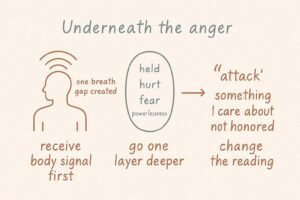
This practice is not about eliminating anger. It is about touching the feeling the anger is covering, and finding a different direction for the energy.
STEP 1: Receive the Body Signal First
Anger arrives in the body before it arrives in language. Chest heating. Shoulders rising. Jaw tightening. When any of these is noticed, pause once.
Something in the body just changed.
This may be the hardest step — not because it is complicated, but because the pull to respond is already moving. The pause doesn’t need to be long. It only needs to exist. One breath, one moment of noticing, is enough to create the gap the next question requires.
STEP 2: Go One Layer Deeper
Once the anger is noticed, before naming it or acting on it, turn inward once:
What was present just before this anger? Was it pain? Fear? A sense of having no options?
The goal is not to find the complete answer. It is to hold the question. When even a partial answer arrives — I am hurt, I am afraid, I feel powerless — the anger shifts from a reaction into a signal. A signal can be read and used. A reaction just continues.
STEP 3: Change the Reading of the Situation
When the immediate intensity has begun to settle, try shifting not the situation but the way it is being read.
If I read this not as “I am being attacked” but as “something I care about is not being honored” — what becomes visible?
This reframing does not eliminate the emotion. It redirects the energy. “Something I care about is not being honored” connects to the question of what matters and what to protect. Action that begins from that question is different in kind from anger being discharged — it is directed toward something rather than against someone.
Session 3: What Anger Is Made Of and Where It Can Go
The Anger Was Covering Something That Came First
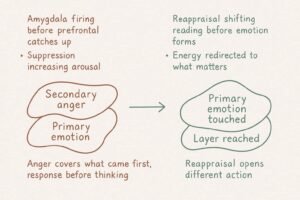
Psychologist Leslie Greenberg’s development of emotion-focused therapy identified a distinction that reframes how anger is understood. Primary emotions are direct responses to experience — hurt, fear, grief — and these are adaptive: they carry information, they point toward what matters, and they are the starting point for genuine change. Secondary emotions are responses to primary emotions rather than to the situation directly. Anger frequently operates here. When hurt arrives, anger activates to cover it. When fear is present, anger replaces it with something that feels more powerful. Greenberg’s central finding is that working with anger at the level of the anger itself tends not to produce change — because the primary emotion it is protecting has not been reached. Touching the primary emotion — staying with the hurt, acknowledging the fear — is what allows the energy that was going into the defense to become available for something else. The anger is not the problem to be solved. It is the signal that something underneath needs to be met.
The Body Was Already Responding Before the Thinking Started
Research on the amygdala’s processing pathways — developed most influentially by neuroscientist Joseph LeDoux — identified a direct neural route through which threat signals reach the amygdala before they have been processed by the prefrontal cortex. This pathway exists for survival: when danger is present, the body needs to be able to respond faster than conscious reasoning allows. The same circuit activates in response to social threats — a challenge to dignity, an experience of injustice, a rupture in a relationship that matters. By the time thinking catches up, the emotional response has already landed in the body. The experience of I had already reacted before I knew what I was doing is not a character deficiency. It is what this early-response processing produces — a system designed for survival that has been activated by the texture of contemporary social life. This understanding is the first ground for setting down the self-criticism that follows reactive anger.
Reappraising the Meaning Worked Better Than Suppressing the Feeling
Psychologist James Gross’s process model of emotion regulation organized the available strategies for managing emotion according to where in the emotional sequence they intervene. Response-focused strategies — suppression being the primary example — intervene after the emotion has already formed, stopping or reducing its external expression. Research shows that suppression tends to increase physiological arousal, imposes cognitive load, and over time is associated with reduced well-being. Antecedent-focused strategies intervene earlier in the sequence, before the emotion has fully formed. The most effective of these is cognitive reappraisal — changing the way a situation is being read, rather than managing the feeling the situation produces. When a situation is read as something I care about is not being honored rather than I am under attack, the amygdala’s threat response is lower, the prefrontal cortex remains more engaged, and the energy that would have gone into anger becomes available for a different kind of action. The gap created by this shift in meaning — the moment of noticing before reacting — is where the choice between defense and response becomes possible.
Conclusion: The Defense Was Also a Signal

The primary emotion underneath keeps accumulating. The amygdala’s early-response pathway keeps activating faster than thinking can begin. The structure does not change on its own.
But the question what was present just before this anger? can be brought into any moment when the body signals that something has arrived. That question is the gap between the defense and what the defense was protecting.
The amygdala fired before you had a choice. What you do with what it was protecting — that part was always yours.
KEY TERMS
Primary and Secondary Emotions
Leslie Greenberg’s emotion-focused therapy distinction. Primary emotions are direct responses to experience — hurt, fear, grief — and are adaptive: they carry information and are the starting point for change. Secondary emotions are responses to primary emotions rather than to situations directly. Anger frequently functions as a secondary emotion, covering a more vulnerable primary response. Working with the anger itself without reaching the primary emotion is why the pattern tends to repeat.
Amygdala Hijack
Based on research into the amygdala’s early-response processing pathway — developed most influentially by Joseph LeDoux — the direct neural route through which threat signals reach the amygdala before prefrontal cortex processing. The mechanism by which emotional response precedes conscious thought. Reactive anger that arrives before any deliberate response was possible is the output of this pathway — a survival circuit activating in response to social threat. Not a character problem; a design feature of a system built for a different kind of danger.
Cognitive Reappraisal
James Gross’s antecedent-focused emotion regulation strategy. Changing the way a situation is being read — its meaning — before the emotion has fully formed. More effective than suppression in terms of physiological arousal, cognitive function, and long-term well-being. The shift from reading a situation as threat to reading it as something I care about is not being honored is a cognitive reappraisal — it changes what the emotion responds to, not just how the emotion is expressed.
Process Model of Emotion Regulation
James Gross’s framework classifying emotion regulation strategies by where in the emotional sequence they intervene. Antecedent-focused strategies — including cognitive reappraisal — intervene before the emotion forms. Response-focused strategies — primarily suppression — intervene after. Cognitive reappraisal consistently shows stronger evidence for long-term effectiveness and carries lower physiological and cognitive cost than suppression.
Anger as Defense
The core structure identified in Greenberg’s emotion-focused therapy. Anger functions as protection against the vulnerability of primary emotions — hurt, fear, helplessness. Because the anger is performing a protective function, it regenerates whenever the primary emotion remains unacknowledged. Making contact with the primary emotion — staying with it rather than covering it — is what allows the energy to move elsewhere. The anger was never the problem to be solved; it was the signal that something underneath had not yet been met.